Thanks to the relaxation of local foreign investment regulations, KT&G is restructuring its business in Indonesia. It has issued loans to its subsidiaries for the construction of new factories.
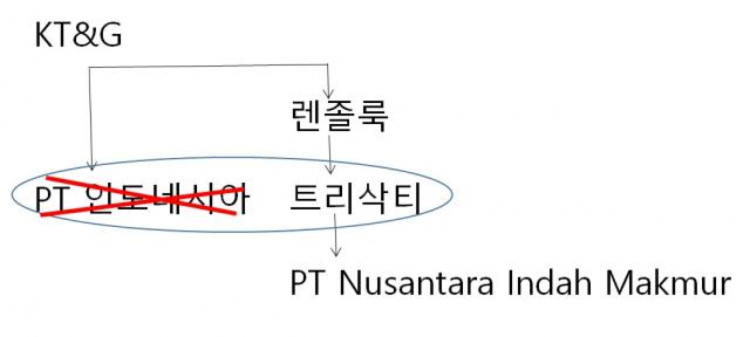
On March 8th, industry insiders reported that KT&G's subsidiary, PT Trisakti Purwosari Makmur (Trisakti), had merged with PT KT&G Indonesia on January 1st. KT&G stated that the purpose of the merger was to establish a foundation for sustainable growth in the medium and long term by effectively reinvesting in local profits in Indonesia.
KT&G's business in Indonesia is operated by three companies: Trisakti, PT KT&G Indonesia, and PT Nusantara Indah Makmur. KT&G controls Trisakti and PT Nusantara Indah Makmur through its intermediate holding company, Renzolluk. PT KT&G Indonesia is a subsidiary of KT&G and is directly controlled by it. Through this restructuring, Indonesia's tobacco business will be unified under Renzolook's management.
Trisakti is a subsidiary of Renzolook. KT&G entered the local market in November 2011, acquiring 100% of Renzoluk's shares for 89.7 billion won, with Renzoluk owning a 51% stake in Indonesian cigarette manufacturer Trisakti. Sales company PT KT&G Indonesia was established in February 2013. The deal represents the integration of manufacturing and sales.
Due to Indonesia's local foreign investment regulations, KT&G separated its sales and manufacturing companies. With local regulations easing, the company has restructured its management system.
An official from KT&G stated that the relaxation of investment restrictions on foreign companies in Indonesia's "Omnibus Law" issued in 2021 has driven this merger. It is expected that management efficiency will be enhanced, such as reducing shared costs and tax savings.
Trisakti's sales and net profit for the previous year were KRW 208.8 billion and KRW 31.6 billion, respectively. PT KT&G Indonesia's sales and net profit, on the other hand, were KRW 291.4 billion and a loss of KRW 2.3 billion.
On January 18th, in accordance with a decision made by the board of directors, KT&G loaned $44.5 million to Trisakti last month to construct a new factory in Indonesia as part of their streamlined governance structure. The establishment of their second factory in Indonesia is expected to accelerate market penetration.
Indonesia is the largest country where KT&G operates its business. It is also one of the largest tobacco-consuming nations, with an estimated 70% of males over the age of 15 being smokers.
References:
KT&G to restructure its domination of Indonesian tobacco industry.
Disclaimer
This article is provided solely for professional research, industry discussion, and informational purposes. Any references to brands, companies, products, technologies, or policies are made for factual reporting and analytical purposes only, and do not constitute endorsement, recommendation, promotion, or advertising by 2Firsts.
Nicotine-containing products, including but not limited to cigarettes, e-cigarettes, heated tobacco products, and nicotine pouches, carry significant health risks. Readers are responsible for complying with all applicable laws and regulations in their respective jurisdictions, including age restrictions and access limitations.
The information contained in this article should not be regarded as investment, legal, medical, regulatory, or commercial advice. While 2Firsts strives to ensure the accuracy and reliability of its content, it does not assume liability for any direct or indirect loss arising from errors, omissions, inaccuracies, or reliance on the information contained herein.
This article is not intended for individuals below the legal age for accessing tobacco or nicotine-related information in their jurisdiction.
Copyright Notice
This article is either original content produced by 2Firsts or content reproduced, translated, summarized, or adapted from third-party sources with attribution where applicable. The intellectual property rights of the original content remain with 2Firsts or the respective original rights holders.
No individual or organization may copy, reproduce, distribute, republish, modify, translate, or otherwise use this content without prior authorization. Any unauthorized use may result in legal action.
For copyright-related inquiries, corrections, or removal requests, please contact: info@2firsts.com.
AI-Assisted Translation and Editing Notice
Portions of this article may have been translated, edited, or reviewed with the assistance of artificial intelligence tools to improve efficiency and readability. Due to the limitations of AI-assisted translation and editing, discrepancies, omissions, or inaccuracies may exist when compared with the original source.
Where applicable, readers are advised to refer to the original source for the most complete and accurate information. If you identify any errors or believe that any content infringes upon your rights, please contact us at info@2firsts.com, and we will review and address the matter promptly.