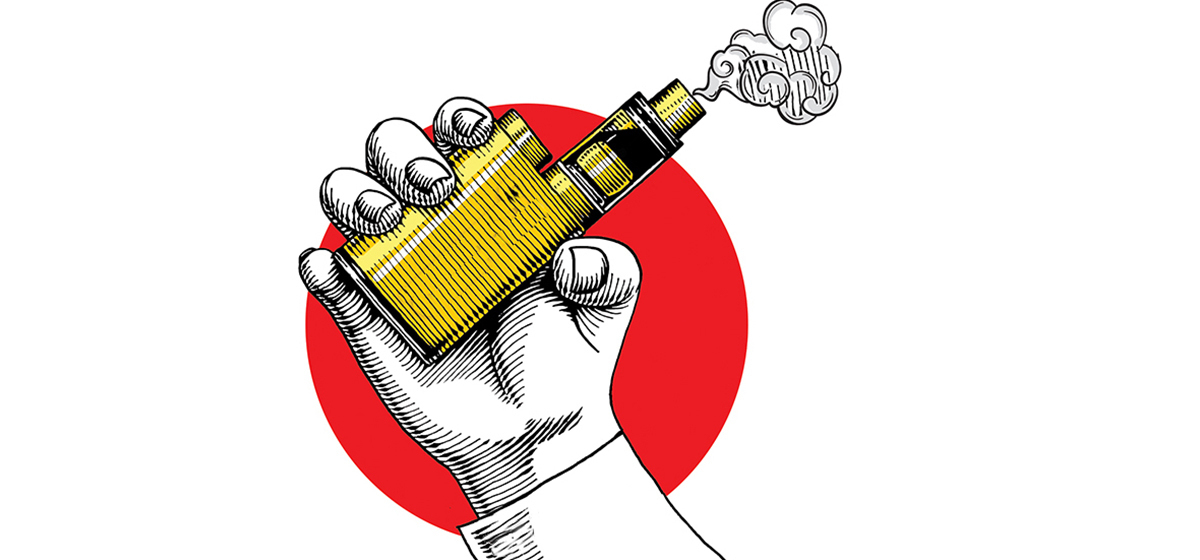
According to a report from Kathmandu media on May 7th, the Nepalese government has initiated the process to ban e-cigarettes. The National Health Education, Information and Communication Center (NHEICC) under the Ministry of Health in Nepal has sought cooperation from multiple departments to enforce this ban.
Director of the National Center for Health Education, Information, and Communication, Keshav Raj Pandit, has called on the Ministry of Communication and Information Technology, Ministry of Finance, Ministry of Industry, Commerce, and Supplies, as well as the Department of Customs and the Department of Commerce, Supply, and Consumer Protection to collectively enforce the ban on the use of e-cigarettes.
Pan Weidi cited Article 28, Paragraph 4 of the Tobacco Products Control Regulations of 2071 BS, which states that individuals or entities are not allowed to produce, import, sell, distribute, consume in public places and public transportation, or promote and advertise e-cigarette products through media channels.
Bhakta Bahadur KC, Senior Health Education Administrator at NHEICC, stated that once the directives issued by the Ministry of Finance and Ministry of Communication are implemented, e-cigarettes will be banned in Nepal. Addressing concerns about individuals potentially using e-cigarettes as a tool to quit smoking, he emphasized that the health risks associated with e-cigarettes are similar to those of traditional cigarettes and could serve as a gateway to tobacco consumption.
He said, "Using e-cigarettes can lead to nicotine addiction and mimic smoking habits. Therefore, e-cigarettes have actually become a gateway to tobacco use." The use of e-cigarettes not only affects individual cardiovascular and nervous system health, but also causes oral health problems. Additionally, it poses risks to people nearby.
In Nepal, there are various flavors of e-cigarettes available to choose from. According to customs data, Nepal imported 3,223,687 e-cigarette devices in the last fiscal year, with the majority coming from China (3,175,815 devices), followed by the United States (265,640 devices) and the United Arab Emirates (12,967 devices). Other countries from which e-cigarettes were imported include India, the United Kingdom, and others.
Dr. Bakta Bahadur KC pointed out that Nepal's annual electrical trade volume is estimated at 32 billion Nepalese Rupees (approximately 240 million USD). He mentioned that in the past five years, Nepal's import volume has increased by 200 times. The prices of e-cigarettes range from 10,000 to 13,000 Nepalese Rupees.
We welcome news tips, article submissions, interview requests, or comments on this piece.
Please contact us at info@2firsts.com, or reach out to Alan Zhao, CEO of 2Firsts, on LinkedIn
Notice
1. This article is intended solely for professional research purposes related to industry, technology, and policy. Any references to brands or products are made purely for objective description and do not constitute any form of endorsement, recommendation, or promotion by 2Firsts.
2. The use of nicotine-containing products — including, but not limited to, cigarettes, e-cigarettes, nicotine pouchand heated tobacco products — carries significant health risks. Users are responsible for complying with all applicable laws and regulations in their respective jurisdictions.
3. This article is not intended to serve as the basis for any investment decisions or financial advice. 2Firsts assumes no direct or indirect liability for any inaccuracies or errors in the content.
4. Access to this article is strictly prohibited for individuals below the legal age in their jurisdiction.
Copyright
This article is either an original work created by 2Firsts or a reproduction from third-party sources with proper attribution. All copyrights and usage rights belong to 2Firsts or the original content provider. Unauthorized reproduction, distribution, or any other form of unauthorized use by any individual or organization is strictly prohibited. Violators will be held legally accountable.
For copyright-related inquiries, please contact: info@2firsts.com
AI Assistance Disclaimer
This article may have been enhanced using AI tools to improve translation and editorial efficiency. However, due to technical limitations, inaccuracies may occur. Readers are encouraged to refer to the cited sources for the most accurate information.
We welcome any corrections or feedback. Please contact us at: info@2firsts.com