Number of Vapers in Britain Surpasses Smokers for the First Time, Government Tightens Nicotine Regulations

Nov.05.2025
 Number of Vapers in Britain Surpasses Smokers for the First Time, Government Tightens Nicotine Regulations
For the first time, more people in Britain now vape than smoke. According to the Office for National Statistics (ONS), 10% of adults (5.4 million) regularly use e-cigarettes compared with 9.1% (4.9 million) who smoke cigarettes. The government credits vaping for the decline in smoking but plans tougher rules through the Tobacco and Vapes Bill, including a generational smoking ban and restrictions on nicotine pouch flavours, packaging, and sales.

Key Points


  • Historic shift: 2024 marks the first year vapers outnumber smokers in the UK.
  • Age trends: Vaping most common among 16–24s (13%), while smoking peaks in 25–34s (12.6%).
  • Long-term decline: Smoking among 18–24s dropped from 25% in 2011 to under 10%.
  • Expert reactions: Health groups hail vaping’s role in cutting smoking, but urge tighter controls.
  • New legislation: Tobacco and Vapes Bill introduces age-based sales bans and nicotine pouch rules.


2Firsts, November 5, 2025 — The number of vapers in Britain has overtaken the number of smokers for the first time, marking a milestone in the country’s tobacco control history, the Office for National Statistics (ONS) confirmed.
 

 Number of Vapers in Britain Surpasses Smokers for the First Time, Government Tightens Nicotine Regulations
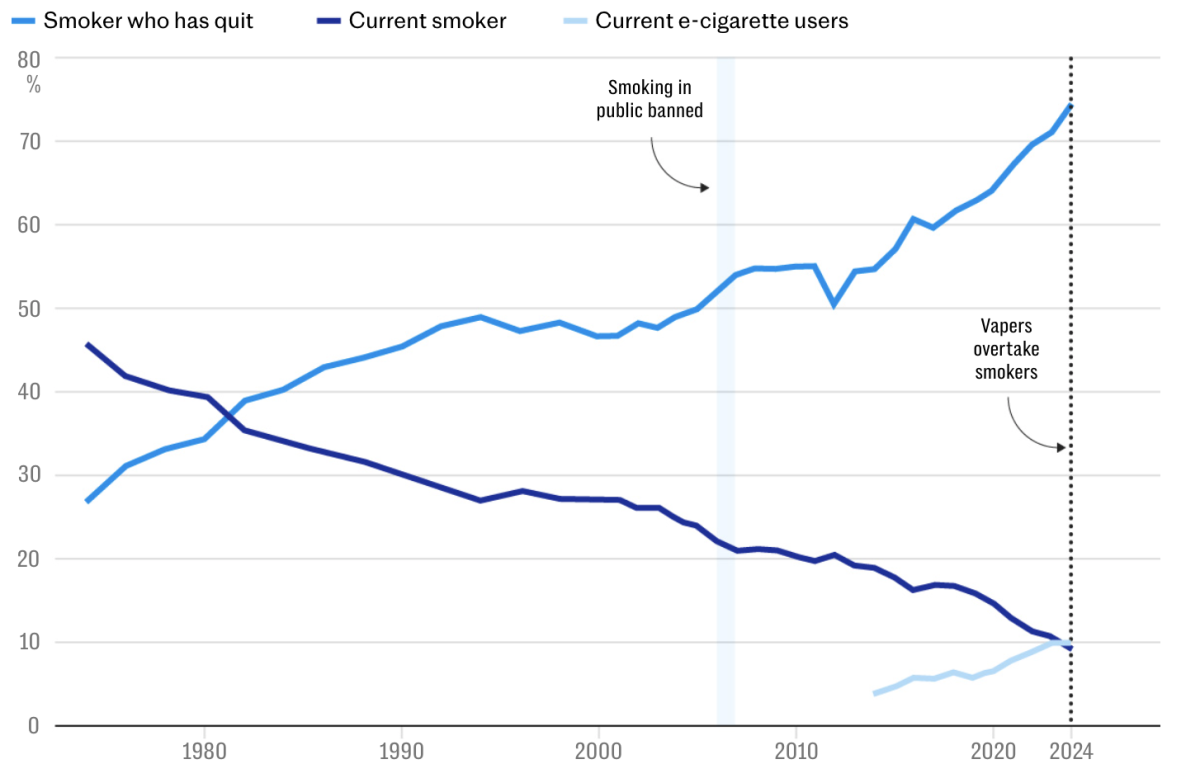
Proportion of current smokers, ex-smokers, and current e-cigarette users among the population aged 16 and over in the UK from 1974 to 2024 | Source: Office for National Statistics, Opinions and Lifestyle Survey.


In 2024, 10% of adults (around 5.4 million) reported regular e-cigarette use compared with 9.1% (4.9 million) who smoke cigarettes. “For the first time, e-cigarette users have surpassed smokers,” said David Mais of ONS, calling it consistent with “the long-term decline in smoking over the past decade.”


Vaping rates fell slightly among men but rose among women, while 16–24-year-olds remain the heaviest users at 13%. Smoking remains most prevalent among 25–34-year-olds (12.6%), and lowest among those 65+ (7.1%).


Public health experts welcomed the crossover as evidence that vaping is displacing smoking, though concerns remain over youth uptake. Hazel Cheeseman of Action on Smoking and Health (ASH) said: “This is a significant moment… but non-smokers and young people taking up vaping remain a worry.”


At University College London, Dr. Deborah Arnott added that vaping “is not risk-free and should only be used to quit smoking.”


The government’s Tobacco and Vapes Bill, now before the House of Lords, will:


  • Ban cigarette sales to anyone born on or after 1 January 2009;
  • Restrict vape flavours, packaging, and advertising;
  • Ban nicotine pouch sales to under-18s;
  • Set nicotine content limits and prohibit fruity flavours;
  • Impose £200 fines on retailers selling to minors.


Health officials said the rules will “set clear standards on strength, flavour, and packaging to keep young people safe.”


Critics, however, warned that the government is “targeting products that help smokers quit.”


Source: The Telegraph


We welcome news tips, article submissions, interview requests, or comments on this piece.

Please contact us at info@2firsts.com, or reach out to Alan Zhao, CEO of 2Firsts, on LinkedIn


Notice

1.  This article is intended solely for professional research purposes related to industry, technology, and policy. Any references to brands or products are made purely for objective description and do not constitute any form of endorsement, recommendation, or promotion by 2Firsts.

2.  The use of nicotine-containing products — including, but not limited to, cigarettes, e-cigarettes, nicotine pouchand heated tobacco products — carries significant health risks. Users are responsible for complying with all applicable laws and regulations in their respective jurisdictions.

3.  This article is not intended to serve as the basis for any investment decisions or financial advice. 2Firsts assumes no direct or indirect liability for any inaccuracies or errors in the content.

4.  Access to this article is strictly prohibited for individuals below the legal age in their jurisdiction.


Copyright


This article is either an original work created by 2Firsts or a reproduction from third-party sources with proper attribution. All copyrights and usage rights belong to 2Firsts or the original content provider. Unauthorized reproduction, distribution, or any other form of unauthorized use by any individual or organization is strictly prohibited. Violators will be held legally accountable.

For copyright-related inquiries, please contact: info@2firsts.com


AI Assistance Disclaimer


This article may have been enhanced using AI tools to improve translation and editorial efficiency. However, due to technical limitations, inaccuracies may occur. Readers are encouraged to refer to the cited sources for the most accurate information.

We welcome any corrections or feedback. Please contact us at: info@2firsts.com

Product | Philip Morris Korea Launches Two TEREA ONYX Capsule Tobacco Sticks, Expanding Portfolio to Five Lines
Philip Morris Korea launched TEREA ONYX, a new tobacco stick line for IQOS ILUMA devices, on October 15, 2026. The initial products, AMANG PEARL and CALI PEARL, feature tropical-inspired flavors, Fresh Filters and capsules designed to deliver different flavor experiences before and after activation. Both are priced at KRW 4,800 per pack and are available at convenience stores nationwide and IQOS-operated stores in South Korea. The launch expands the Korean TEREA portfolio from four product lines to five, following earlier capsule tobacco stick additions in 2026.
product
Oct.23
Australian Coalition Taskforce Calls for 80% Tobacco Tax Cut to Combat Illicit Market
According to SGST on August 26, 2026, Australia’s Coalition Illegal Tobacco Taskforce released a report recommending an up to 80% cut in tobacco excise to reduce the appeal of the illicit tobacco market. The report claimed organised crime groups now control about 80% of Australia’s tobacco market and argued that high excise rates have widened the price gap between legal and illegal products. The recommendation remains a policy proposal and has not been adopted by the Australian government, which said its focus remains on enforcement, compliance and additional resources.
Aug.27
Special Report | How Capital Is Reassessing the Global Tobacco and Modern Nicotine Industry: Lessons from a New York Forum
Capital is reassessing the global tobacco and modern nicotine industry as heated tobacco, vaping and nicotine pouches reshape demand, profitability and regulation. At the 2026 New Approaches Summit in New York, investors and analysts examined whether smoke-free growth can sustain earnings, how regulation shapes startup value, and whether shareholder engagement can be more effective than divestment. The debate points to a broader shift: tobacco transition is increasingly becoming a capital-allocation, governance and valuation question.
Capital Markets
Oct.05
Kelly White Bets on Female Consumers as Nicotine Pouch Competition Intensifies | 2Firsts Interview
Swedish nicotine pouch brand Kelly White is building its strategy around adult female consumers. Founder and CEO Sophia Wilsby told 2Firsts that women accounted for around 70% of the brand’s repeat customers on HAYPP in Sweden in 2025. The interview explores female consumer segmentation, product and design differentiation, gender stereotypes, packaging regulation, and how independent brands can compete with global players such as ZYN and VELO while considering funding, partnerships and future ownership options.
Business
Sep.24
Canada Considers Easing Pharmacy-Only Nicotine Pouch Sales Rules, Potentially Reopening Convenience Store Channel
Canada's federal government is considering changes to current restrictions on where nicotine pouches can be sold, potentially allowing authorized products to return to convenience stores and other general retail channels, although no decision has been made. Since 2024, emerging nicotine replacement therapy products such as nicotine pouches have been largely restricted to behind-the-counter pharmacy sales. Health Canada, meanwhile, continues to recall unauthorized and higher-strength nicotine pouches, indicating that the current discussion concerns retail access for authorized products rather than a broad relaxation of nicotine pouch regulation.
Sep.14
Product | PMI Launches ZYN Melts in UK, Extending ZYN Beyond Nicotine Pouches Into Dissolvable Tablets
Philip Morris International (PMI) has launched ZYN Melts in the UK, introducing a fully dissolvable oral nicotine tablet format alongside the brand's existing nicotine pouches. The range includes Cool Mint and Peppermint, each offered at 1mg and 2mg of nicotine per tablet, creating four SKUs. Each can contains 20 tablets and is priced at £6.50 in the UK. Unlike ZYN nicotine pouches, Melts are placed between the upper lip and gum and dissolve completely during use.
News
Sep.29 by 2Firsts Perspectives