Pakistan Tobacco Growers Association Rejects Set Prices

Dec.09.2022
Pakistan Tobacco Growers Association Rejects Set Prices
Members of Pakistan's TGAP reject government-set tobacco prices, demand increase due to rising costs. Partnership between universities promotes joint research.

At a meeting convened by the Tobacco Growers Association of Pakistan (TGAP), tobacco growers rejected the tobacco prices set by the federal government for the upcoming year. Instead, they demanded price increases based on rising inflation and escalating crop production costs.


Attendees reported that the National Food Security and Research Department has submitted a summary to the Economic Coordination Committee (ECC) of the cabinet to determine the minimum price for tobacco crops in 2023.


They stated that ECC has fixed the price of Virginia Flue-Cured (FCV) tobacco at 310 rupees per kilogram in the plain areas and 351 rupees per kilogram in the mountainous areas.


Similarly, they stated that the price of Dark Air Cured (DAC) tobacco is fixed at 190 rupees per kilogram, while White Patta (WP) and Naswar/Hookah tobacco are fixed at 146 rupees per kilogram. Virginia Sun Cured (SCV) tobacco is fixed at 200 rupees per kilogram, and White Rib tobacco is fixed at 233 rupees per kilogram.


Liaqat Yousafzai, the central chairman of TGAP, stated at the meeting that the new fixed prices are significantly lower than the expenses incurred by farmers in the production of tobacco.


Arif Ali Khan, president of Ittehad Kashtkaran in Khyber Pakhtunkhwa province, stated that the farmers are hoping for the Prime Minister to reconsider this decision.


The attendees decided to meet with the federal Minister of Food Safety and Research, Tariq Cheema, to update him on their concerns.


They demanded to fix the price of tobacco at 400 rupees per kilogram.


Joint research: The Ghulam Ishaq Khan Institute of Engineering Sciences and Technology and the Punjab Information Technology University (ITU) signed a memorandum of understanding here a few days ago to promote joint academic and research activities.


Professor Fazal Ahmad Khalid, President of the GIK Institute, and Professor Sarfraz Khurshid, Vice Chairman of the International Telecommunication Union, have signed a memorandum of understanding.


According to the agreement, they will exchange scientific, academic, and technological information, as well as relevant academic materials and any information of mutual interest that both parties have intellectual property rights to. In addition to collaborating on joint research and development in areas of mutual interest, they will also strive to identify opportunities for communication and cooperation.


Meanwhile, the GIK Institute and Pak-Austria Fachhochschule Institute of Applied Sciences and Technology (PAF-IAST) have signed a memorandum of understanding, agreeing to use each other's facilities and promoting cooperation between them.


Dr. Khalid and Professor Mohammad Mujahid, Principal of PAF-IAST, have signed an agreement.


2FIRSTS will continue to follow this topic and provide updates on the "2FIRSTSAPP". Scan the QR code below to download the app.


Disclaimer

This article is provided solely for professional research, industry discussion, and informational purposes. Any references to brands, companies, products, technologies, or policies are made for factual reporting and analytical purposes only, and do not constitute endorsement, recommendation, promotion, or advertising by 2Firsts.

Nicotine-containing products, including but not limited to cigarettes, e-cigarettes, heated tobacco products, and nicotine pouches, carry significant health risks. Readers are responsible for complying with all applicable laws and regulations in their respective jurisdictions, including age restrictions and access limitations.

The information contained in this article should not be regarded as investment, legal, medical, regulatory, or commercial advice. While 2Firsts strives to ensure the accuracy and reliability of its content, it does not assume liability for any direct or indirect loss arising from errors, omissions, inaccuracies, or reliance on the information contained herein.

This article is not intended for individuals below the legal age for accessing tobacco or nicotine-related information in their jurisdiction.


Copyright Notice

This article is either original content produced by 2Firsts or content reproduced, translated, summarized, or adapted from third-party sources with attribution where applicable. The intellectual property rights of the original content remain with 2Firsts or the respective original rights holders.

No individual or organization may copy, reproduce, distribute, republish, modify, translate, or otherwise use this content without prior authorization. Any unauthorized use may result in legal action.

For copyright-related inquiries, corrections, or removal requests, please contact: info@2firsts.com.


AI-Assisted Translation and Editing Notice

Portions of this article may have been translated, edited, or reviewed with the assistance of artificial intelligence tools to improve efficiency and readability. Due to the limitations of AI-assisted translation and editing, discrepancies, omissions, or inaccuracies may exist when compared with the original source.

Where applicable, readers are advised to refer to the original source for the most complete and accurate information. If you identify any errors or believe that any content infringes upon your rights, please contact us at info@2firsts.com, and we will review and address the matter promptly.

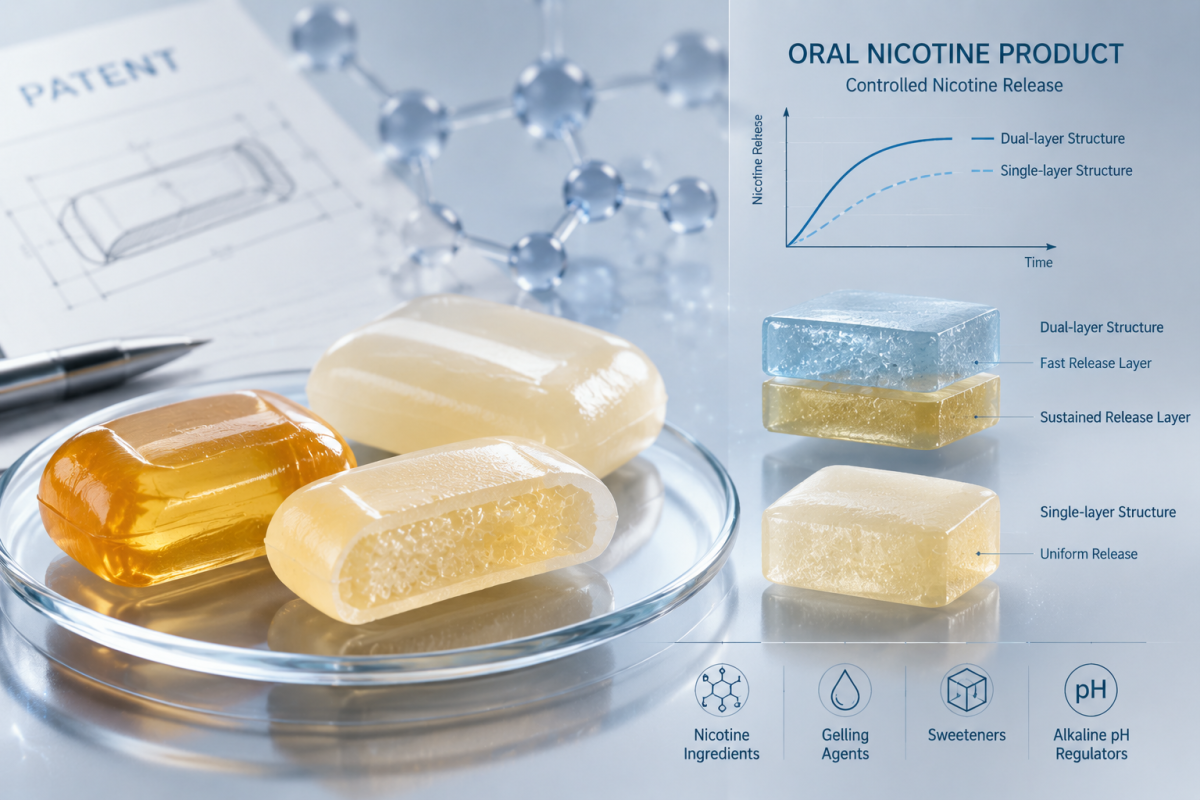
From Nicotine Pouches to Soft Candy Forms: China Tobacco Hubei explores adjustable-release oral nicotine products
China-based China Tobacco Hubei Industrial Co., Ltd. has filed a patent application covering an oral nicotine product and its preparation method. The patent proposes a soft candy-shaped oral nicotine product containing nicotine ingredients, gelling agents, sweeteners and alkaline pH regulators. Through formulation adjustments and homogeneous or dual-layer structures, the technology aims to achieve different nicotine release profiles. The filing reflects exploration of new oral nicotine product formats and controlled nicotine delivery approaches.
Aug.06
IKE Tech Launches IKE 2.0 Compliance Platform for Nicotine Products
IKE Tech launched IKE 2.0 on September 28, initially targeting nicotine products with a platform that combines user identity verification, product authentication, configurable policy controls and data analytics. Products can be authenticated through direct device integration or NFC smart tags. IKE Tech was formed with participation from Ispire's Aspire North America, Berify and Chemular, with Ispire currently holding a 40% interest. Its age-verification component PMTA was accepted by the FDA in 2025 and remains under review. The company did not disclose customer names, commercial deployment volumes, pricing or revenue tied to IKE 2.0.
News
Sep.29 by 2Firsts Perspectives
Senate Democrat Wyden Probes Trump Administration Vape Policy Shift, Seeks Records From HHS and Reynolds American
U.S. Senator Ron Wyden, the Democratic ranking member of the Senate Finance Committee, has launched an investigation into flavored vape policy changes and requested records from the Department of Health and Human Services (HHS), Reynolds American and Botanic Tonics. The investigation focuses on a timeline involving Reynolds American’s $5 million donation to MAGA Inc. in April 2026 and subsequent vape policy developments. Wyden said the review aims to examine potential links between political donations, corporate communications and government decisions. The investigation does not represent a finding of wrongdoing.
Innovation
Aug.07 by 2Firsts Perspectives
China’s Zhengzhou Tobacco Research Institute develops end-to-end heated tobacco analysis to trace aerosol compound origins
The Zhengzhou Tobacco Research Institute of China National Tobacco Corporation has filed a patent application for an end-to-end method to analyze the migration and transformation of chemical compounds in heated tobacco products. Using GC-Orbitrap/MS non-targeted analysis, the method compares tobacco substrate and aerosol samples to distinguish compounds transferred directly from the substrate from those newly formed during heating, while also calculating transfer rates. In an example involving nine heated tobacco products, the patent identified 17 newly formed thermal decomposition compounds and 38 transferred compounds.
Aug.13
Smoore Seeks to Toss CCELL Price-Fixing Claim as Court Weighs Vertical Distribution Versus Horizontal Conspiracy
Smoore and four authorized U.S. CCELL distributors are asking a California federal court to permanently dismiss a core antitrust claim brought by direct purchasers. Plaintiffs allege that Smoore coordinated minimum wholesale prices, customer allocation and limits on price competition among distributors, amounting to a per se unlawful horizontal conspiracy. The defendants say the alleged conduct reflects ordinary vertical relationships between a manufacturer and its distributors. The court previously dismissed a similar claim, and the latest dispute centers on whether the second amended complaint adds sufficient facts to establish a horizontal agreement.
Sep.14
Malaysia Withdraws Appeal Against Liquid Nicotine Ruling as Vape Regulation Framework Enters New Phase
Malaysia’s government has withdrawn its appeal against a High Court ruling concerning the regulatory status of liquid nicotine used in vape and e-cigarette products, according to reports by New Straits Times, Free Malaysia Today and CodeBlue on August 18, 2026. The Kuala Lumpur High Court ruled on May 15 that the government’s decision to remove liquid nicotine from the scheduled poisons list under the Poisons Act 1952 was irrational and made without proper consultation with the Poisons Board. The withdrawal ends the government’s appeal process, while the future regulatory framework for nicotine vape products remains under discussion.
Aug.21