PMI reports full-year 2025 results with net revenues of $40.6 billion and smoke-free net revenues were about $16.9 billion

Feb.06
PMI reports full-year 2025 results with net revenues of $40.6 billion and smoke-free net revenues were about $16.9 billion
Philip Morris International (PMI) released its Q4 and full-year 2025 results on February 6, 2026. PMI reported full-year net revenues of $40,648 million ($40.6 billion), reported diluted EPS of $7.26 and adjusted diluted EPS of $7.54. PMI said smoke-free net revenues were $16.9 billion and represented 41.5% of total net revenues, with smoke-free products available in 106 markets and over 43 million estimated adult consumers.


Key Takeaways 


  • Release date/coverage: February 6, 2026; Q4 2025 and full-year 2025 results 
  • Full-year headline figures: net revenues $40,648 million; reported diluted EPS $7.26; adjusted diluted EPS $7.54  
  • Smoke-free: shipment volumes +12.8% YoY; smoke-free net revenues $16.9 bn; 41.5% of total net revenues; available in 106 markets with over 43 million estimated adult consumers 
  • Category updates: IQOS ~76% global category volume share; ZYN 196 million cans (Q4) and 794 million cans (FY); VEEV available in 47 markets with FY volumes “more than doubled”  
  • Outlook/targets: 2026 adjusted diluted EPS $8.38–$8.53; 2026–2028 targets include organic net revenues CAGR 6%–8%, organic operating income CAGR 8%–10%, and adjusted diluted EPS excluding currency CAGR 9%–11%


2Firsts, February 6, 2026


According to Philip Morris International’s earnings release, PMI reported its fourth-quarter and full-year 2025 results and issued its 2026 outlook and 2026–2028 growth targets.  


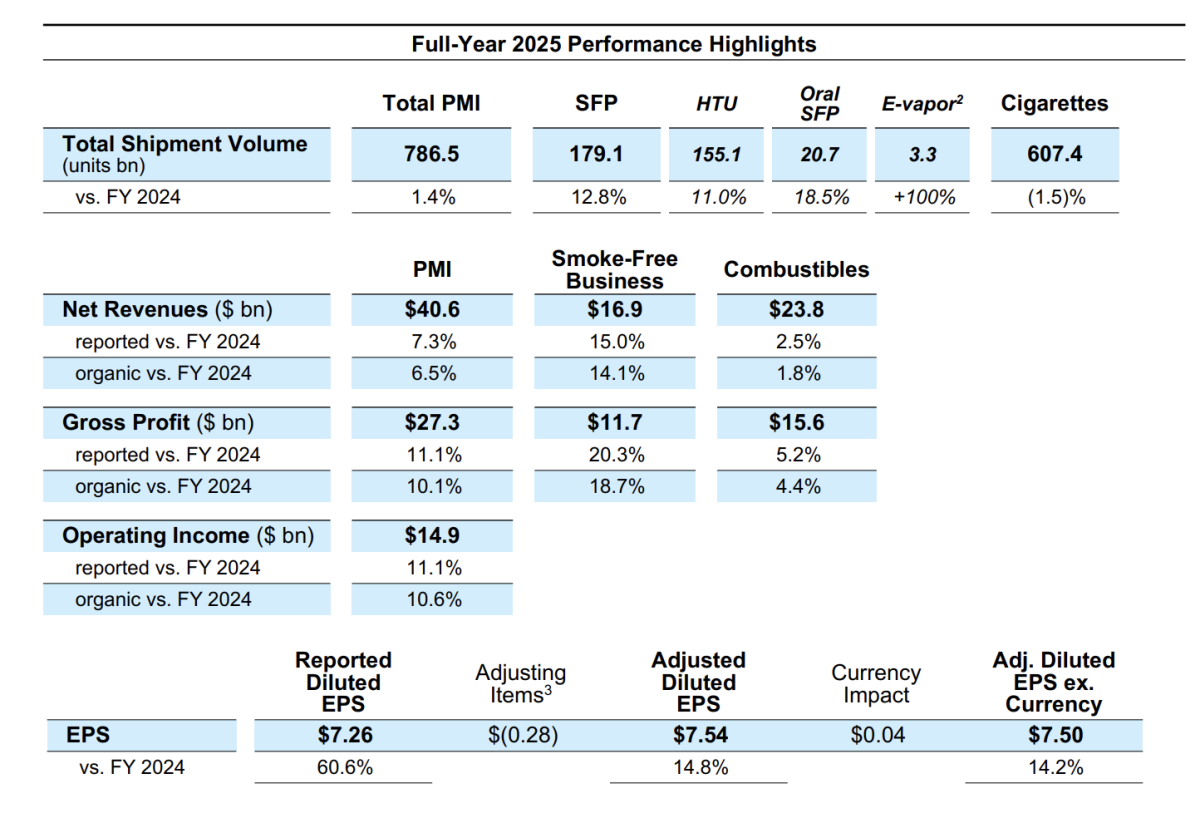
PMI reported full-year 2025 net revenues of $40,648 million (vs. $37,878 million in 2024) and disclosed reported diluted EPS of $7.26 and adjusted diluted EPS of $7.54 for 2025.
PMI reports full-year 2025 results with net revenues of $40.6 billion and smoke-free net revenues were about $16.9 billion
PMI 2025 Q4 financial report screenshot | Image source: PMI official website.


On smoke-free, PMI said full-year smoke-free shipment volumes increased 12.8%, with smoke-free net revenues of $16.9 billion and the smoke-free business accounting for 41.5% of total net revenues. PMI also said its smoke-free products are available in 106 markets with over 43 million estimated adult consumers. 


On heat-not-burn, PMI said IQOS continued to drive the growth of the global category where PMI holds approximately 76% volume share, describing IQOS as the second largest nicotine “brand” in markets where present and holding the #1 volume share position in 13 markets


On oral smoke-free, PMI said ZYN held around two-thirds value share in 2025 and reported ZYN shipments of 196 million cans in Q4 and 794 million cans for the full year


On e-vapor, PMI said VEEV is available in 47 markets, with shipment volumes “more than doubled” on a full-year basis, and stated VEEV holds the #1 closed-pod volume share position in 8 markets


For 2026, PMI forecast reported diluted EPS of $7.87–$8.02 and adjusted diluted EPS of $8.38–$8.53, and provided an adjusted diluted EPS excluding currency range of $8.11–$8.26


PMI also provided 2026–2028 compound annual growth targets of 6%–8% for organic net revenues, 8%–10% for organic operating income, and 9%–11% for adjusted diluted EPS excluding currency, assuming current corporate income tax rates and no share repurchases. 


Image source: PMI


2FIRSTS | 2Firsts Flash|PMI Reports 2025 Results as Smoke-Free Products Account for 41.5% of Net Revenues
Philip Morris International reported full-year 2025 results on February 6, with smoke-free products accounting for 41.5% of adjusted net revenues, up from 38.7% a year earlier. Total net revenues rose 7.3% to $40.65 billion, while shipment volumes increased 1.4%, widening the gap between revenue and volume growth. Cigarette shipments declined as smoke-free volumes rose 12.8%, driven by heated tobacco, oral nicotine and e-vapor products. Results were released alongside a 9:00 a.m. EST webcast.
www.2firsts.com

We welcome news tips, article submissions, interview requests, or comments on this piece.

Please contact us at info@2firsts.com, or reach out to Alan Zhao, CEO of 2Firsts, on LinkedIn


Notice

1.  This article is intended solely for professional research purposes related to industry, technology, and policy. Any references to brands or products are made purely for objective description and do not constitute any form of endorsement, recommendation, or promotion by 2Firsts.

2.  The use of nicotine-containing products — including, but not limited to, cigarettes, e-cigarettes, nicotine pouchand heated tobacco products — carries significant health risks. Users are responsible for complying with all applicable laws and regulations in their respective jurisdictions.

3.  This article is not intended to serve as the basis for any investment decisions or financial advice. 2Firsts assumes no direct or indirect liability for any inaccuracies or errors in the content.

4.  Access to this article is strictly prohibited for individuals below the legal age in their jurisdiction.


Copyright


This article is either an original work created by 2Firsts or a reproduction from third-party sources with proper attribution. All copyrights and usage rights belong to 2Firsts or the original content provider. Unauthorized reproduction, distribution, or any other form of unauthorized use by any individual or organization is strictly prohibited. Violators will be held legally accountable.

For copyright-related inquiries, please contact: info@2firsts.com


AI Assistance Disclaimer


This article may have been enhanced using AI tools to improve translation and editorial efficiency. However, due to technical limitations, inaccuracies may occur. Readers are encouraged to refer to the cited sources for the most accurate information.

We welcome any corrections or feedback. Please contact us at: info@2firsts.com

Netherlands plans to raise nicotine purchase age to 21, including vapes
The Netherlands is planning to raise the legal age for buying nicotine-containing products from 18 to 21, a change that would also cover vapes. The move, embedded in the governing coalition’s latest agreement, aligns with a wider European trend toward tighter youth nicotine controls, though industry groups have criticised the proposal and warned it could fuel illicit trade.
Feb.09 by 2FIRSTS.ai
Russia’s Volgograd Police Seize Illicit Nicotine Products Worth Over US$42.9K+
Police in Russia’s Volgograd region say they seized nicotine products lacking mandatory markings valued at more than RUB 3.3 million (about US$42,900+, using RUB 1 = US$0.013). A 43-year-old suspect allegedly stored and sold the products through two retail outlets in Volgograd’s Central and Dzerzhinsky districts. A criminal case has been opened under Article 171.1(6) of the Russian Criminal Code.
Jan.30 by 2FIRSTS.ai
PMI Launches Mass Production of ZYN at $600M Aurora Manufacturing Hub
Philip Morris International (PMI), through its subsidiary Swedish Match, has started large-scale production at a 600,000-square-foot ZYN nicotine pouch facility in Aurora, Colorado. The $600 million investment makes the site one of three ZYN manufacturing plants in the United States and the company’s second U.S. facility after Owensboro, Kentucky.
PMI
Feb.21
Special Report | China’s New Five-Year Plan Highlights “Health-First” Strategy, Providing Policy Context for Tobacco Sector
China’s 2026 “Two Sessions” reviewed the draft Outline of the 15th Five-Year Plan, which proposes implementing a health-first development strategy and strengthening the effectiveness of the Patriotic Health Campaign. Although the document does not address specific industries, this public-health governance framework provides a new policy context for observing the future regulation, product strategies, and market development of China’s tobacco and next-generation nicotine sectors.
Industry Insight
Mar.08
Russia considers digital tagging for e-cigarette products to strengthen industry regulation
Russia is considering digitizing e-cigarette products for better industry regulation, aiming to protect consumers and prevent counterfeit products.
Feb.05 by 2FIRSTS.ai
BAT CEO Says 2026 Return to Growth Hinges on U.S. Enforcement, Highlights Oral Leadership
British American Tobacco said 2026 will mark a return to its mid-term growth algorithm, but CEO Tadeu Marroco stressed that deliverywill depend heavily on enforcement against illicit vapour products in the United States. Speaking at the FY2025 results call, he positioned Modern Oral as the company’s primary structural growth engine, reframed accelerating cigarette declines through “poly-usage,” and reinforced capital discipline with an expanded share buyback plan.
Feb.12