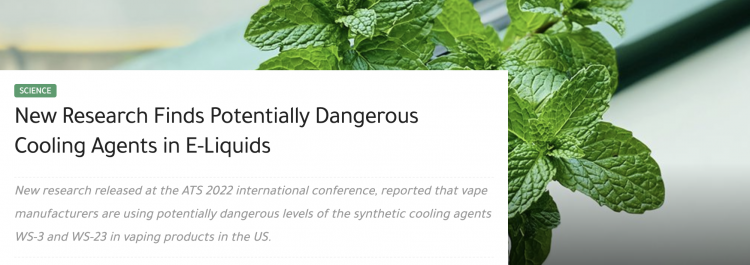
A new research report released at the American Thoracic Society's ATS 2022 International Conference states that electronic cigarette manufacturers in the United States are using synthetic cooling agents WS-3 and WS-23 in their electronic cigarette products, which have the potential to be dangerous.
Due to the popularity of tobacco products with peppermint and menthol flavors, due to their cooling effect, e-cigarette manufacturers have begun to use synthetic versions of these flavors and add them to e-liquids. However, researchers note that to date, there is limited knowledge regarding the ingredients of such cooling agents and their potential health risks.
Dr. Sven Jordt, associate professor of anesthesiology, pharmacology, and cancer biology at Duke University and a researcher on the topic, stated that their findings revealed the addition of a synthetic cooling agent called WS-3 in Juul e-cigarettes sold in Europe, which was the most popular e-cigarette brand at the time. This prompted their investigation of whether e-cigarettes sold in the United States also contained this synthetic cooling agent.
Meanwhile, a recent article in the open-access journal eNeuro published by the Society for Neuroscience discusses a previous American study that found the common green apple-flavored e-liquid chemical, farnesene, stimulates excitatory behavior in the ventral tegmental area of the brain by activating highly-sensitive nAChRs.
In simple terms, the taste of this compound can be addictive. "Whether or not they contain nicotine, flavored electronic cigarettes pose potential risks to the brain and addiction," said lead author Skylar Cooper.
Cooper and her research team have divided their research subjects (mice) into three groups. One group is given nicotine, another is given the green apple flavored compound farnesene, or a combination of both, while the third group is given a saline solution.
Researchers have found that farnesene is a stimulant in and of itself, as mice preferred the farnesene chamber over the saltwater chamber. However, when mixed with nicotine, farnesene was found to further increase stimulation levels.
2FIRSTS will continue to provide coverage on this topic, with updates available on the '2FIRSTS APP.' Scan the QR code below to download the app.
Disclaimer
This article is provided solely for professional research, industry discussion, and informational purposes. Any references to brands, companies, products, technologies, or policies are made for factual reporting and analytical purposes only, and do not constitute endorsement, recommendation, promotion, or advertising by 2Firsts.
Nicotine-containing products, including but not limited to cigarettes, e-cigarettes, heated tobacco products, and nicotine pouches, carry significant health risks. Readers are responsible for complying with all applicable laws and regulations in their respective jurisdictions, including age restrictions and access limitations.
The information contained in this article should not be regarded as investment, legal, medical, regulatory, or commercial advice. While 2Firsts strives to ensure the accuracy and reliability of its content, it does not assume liability for any direct or indirect loss arising from errors, omissions, inaccuracies, or reliance on the information contained herein.
This article is not intended for individuals below the legal age for accessing tobacco or nicotine-related information in their jurisdiction.
Copyright Notice
This article is either original content produced by 2Firsts or content reproduced, translated, summarized, or adapted from third-party sources with attribution where applicable. The intellectual property rights of the original content remain with 2Firsts or the respective original rights holders.
No individual or organization may copy, reproduce, distribute, republish, modify, translate, or otherwise use this content without prior authorization. Any unauthorized use may result in legal action.
For copyright-related inquiries, corrections, or removal requests, please contact: info@2firsts.com.
AI-Assisted Translation and Editing Notice
Portions of this article may have been translated, edited, or reviewed with the assistance of artificial intelligence tools to improve efficiency and readability. Due to the limitations of AI-assisted translation and editing, discrepancies, omissions, or inaccuracies may exist when compared with the original source.
Where applicable, readers are advised to refer to the original source for the most complete and accurate information. If you identify any errors or believe that any content infringes upon your rights, please contact us at info@2firsts.com, and we will review and address the matter promptly.