Key Points
- Putin has signed the trade licensing law.
- Licensing covers tobacco and nicotine products.
- Unlicensed operations will be banned from March 2027.
- Regions may temporarily ban vape and e-liquid retail.
2Firsts
2Firsts, June 30, 2026 — According to AK&M and RIA Novosti, Russian President Vladimir Putin has signed a law introducing mandatory licensing for trade in tobacco and nicotine-containing products. The law covers procurement, storage, supply, wholesale and retail operations, marking a further tightening of Russia’s distribution controls for tobacco and novel nicotine products.
Trade Licensing System Becomes Law
Under the new law, trade in tobacco and nicotine-containing products will be subject to licensing. The scope includes not only traditional tobacco products but also nicotine-containing products, meaning that vapes, e-liquids, heated tobacco-related products and other novel nicotine products may be affected.
Licenses will be issued and revoked by Russia’s Federal Service for Alcohol and Tobacco Market Regulation, Rosalokoltabakcontrol, and by executive authorities of Russian regions. Wholesale licenses will mainly be handled by the federal regulator, while retail licenses will be issued at the regional level.
Public reports say the licensing system will take effect on October 1, 2026, and unlicensed operations will be prohibited from March 1, 2027. For existing operators, that creates a preparation window of about five months between the system’s launch and the ban on unlicensed activity.
The new law will connect with Russia’s existing controls over production, import, export and digital labelling of tobacco and nicotine-containing products. Licensing will bring wholesale and retail channels under market-entry control and give regulators a clearer basis to identify unlicensed sales and abnormal distribution channels.
Retailers Enter Licensed Operation Phase
Under previously published proposals, applicants must meet several conditions, including absence of tax arrears above a specified threshold, payment of state duties, ownership or lease of compliant retail premises and compliance with existing public-health and sales restrictions.
Earlier proposals indicated that retail and delivery-trade licenses would be issued on the principle of one license for each retail facility or vehicle. Retail license fees were proposed at 20,000 rubles per outlet or vehicle for each year of validity, while wholesale licenses could cost up to 800,000 rubles for a term of up to five years.
Licensing requirements may also involve retail floor space. Russian media reported that from March 2028, retailers may need to meet at least a five-square-metre premises requirement, with local authorities able to raise the standard.
For vape shops, convenience stores and small retail outlets, the licensing system will raise operating thresholds. Sales models based on small counters, temporary outlets or flexible delivery may face pressure to reapply for approvals, adjust premises and provide additional compliance documents.
Regions May Temporarily Ban Vape Retail
In addition to licensing, the new law gives Russian regions the power to impose temporary full bans on retail sales of vapes and related e-liquids. Russian media reported that the authority will apply from March 1, 2027, to March 1, 2032.
That means Russia’s vape market will face both a federal licensing system and regional regulatory divergence. Even if an operator obtains a trade license, vape and e-liquid retail may still be prohibited in certain regions.
The measure is consistent with Russia’s broader direction of tightening vape regulation. Russian lawmakers and regional authorities have previously pushed for stricter vape controls, citing youth protection, illegal product circulation and public-health risks.
For the industry, regional sales-ban powers create a higher level of uncertainty than licensing alone. Licensing mainly raises entry barriers and compliance costs, while regional bans can directly change whether products can be sold in particular territories and affect store networks and channel value.
Retail Thresholds Rise for the Industry
The law may affect Russia’s tobacco and novel nicotine market in three main ways.
First, retail thresholds will rise. Small, unstable or under-documented outlets may leave the market, while compliant chain retailers, specialist stores and larger distributors may gain an advantage.
Second, regional market uncertainty will increase. If some regions use temporary sales-ban powers, vape and e-liquid sales could face territorial interruptions. Brands and distributors will need to adjust inventories, channels and market investment according to regional policies.
Third, compliant channels may benefit, but costs will also rise. Licensing may help reduce unlicensed activity and grey channels, but compliant operators will face higher costs for license management, store qualification maintenance, tax compliance and regional policy monitoring.
Overall, Putin’s signing of the law marks a new regulatory phase for Russia’s tobacco and novel nicotine market. Sales of vapes and other nicotine products will no longer be only a product-compliance issue; they will also depend on licensing access, regional policy and retail-channel qualifications.
Key issues to watch include final licensing application rules, fees and premises requirements, and whether regions begin imposing temporary vape and e-liquid retail bans after March 2027.
Follow 2Firsts for the latest updates on global tobacco harm reduction, nicotine products and regulatory developments.
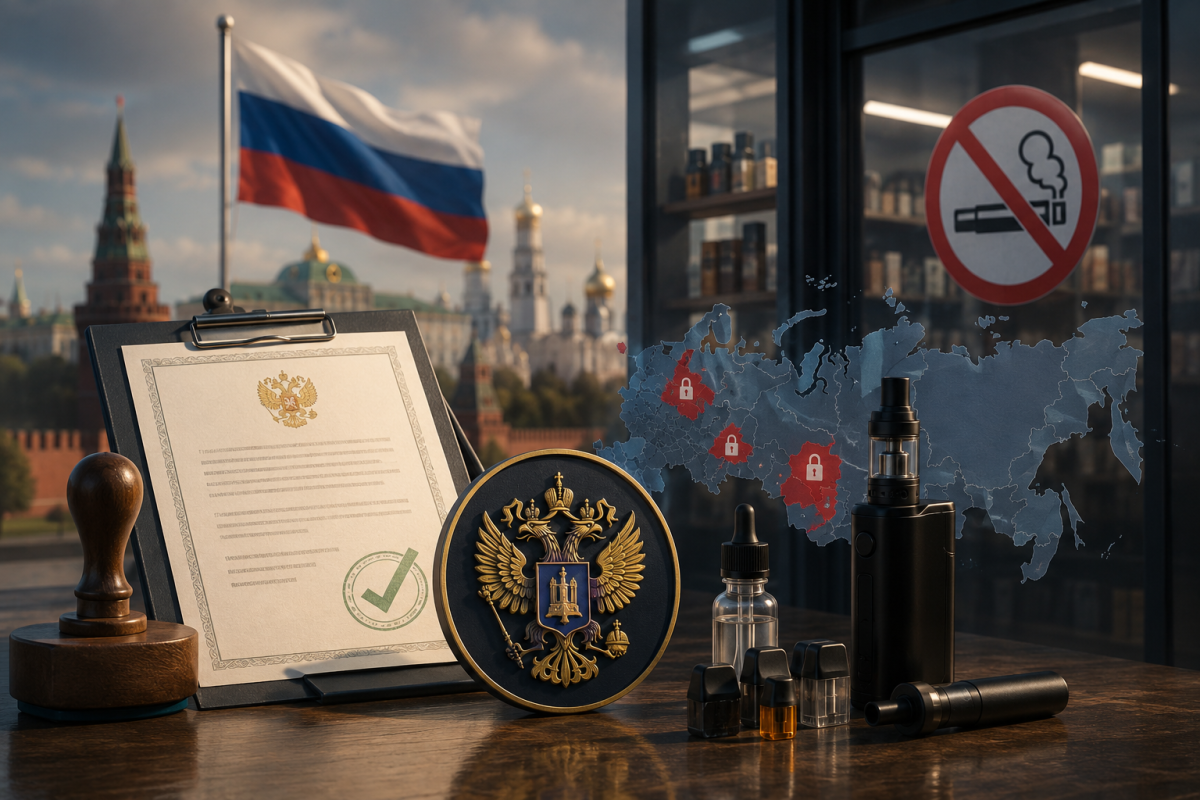
Cover image:generated by AI
Disclaimer
This article is provided solely for professional research, industry discussion, and informational purposes. Any references to brands, companies, products, technologies, or policies are made for factual reporting and analytical purposes only, and do not constitute endorsement, recommendation, promotion, or advertising by 2Firsts.
Nicotine-containing products, including but not limited to cigarettes, e-cigarettes, heated tobacco products, and nicotine pouches, carry significant health risks. Readers are responsible for complying with all applicable laws and regulations in their respective jurisdictions, including age restrictions and access limitations.
The information contained in this article should not be regarded as investment, legal, medical, regulatory, or commercial advice. While 2Firsts strives to ensure the accuracy and reliability of its content, it does not assume liability for any direct or indirect loss arising from errors, omissions, inaccuracies, or reliance on the information contained herein.
This article is not intended for individuals below the legal age for accessing tobacco or nicotine-related information in their jurisdiction.
Copyright Notice
This article is either original content produced by 2Firsts or content reproduced, translated, summarized, or adapted from third-party sources with attribution where applicable. The intellectual property rights of the original content remain with 2Firsts or the respective original rights holders.
No individual or organization may copy, reproduce, distribute, republish, modify, translate, or otherwise use this content without prior authorization. Any unauthorized use may result in legal action.
For copyright-related inquiries, corrections, or removal requests, please contact: info@2firsts.com.
AI-Assisted Translation and Editing Notice
Portions of this article may have been translated, edited, or reviewed with the assistance of artificial intelligence tools to improve efficiency and readability. Due to the limitations of AI-assisted translation and editing, discrepancies, omissions, or inaccuracies may exist when compared with the original source.
Where applicable, readers are advised to refer to the original source for the most complete and accurate information. If you identify any errors or believe that any content infringes upon your rights, please contact us at info@2firsts.com, and we will review and address the matter promptly.