South Dakota Receives $6.18 Million Settlement from Juul

Sep.08.2022
South Dakota Receives $6.18 Million Settlement from Juul
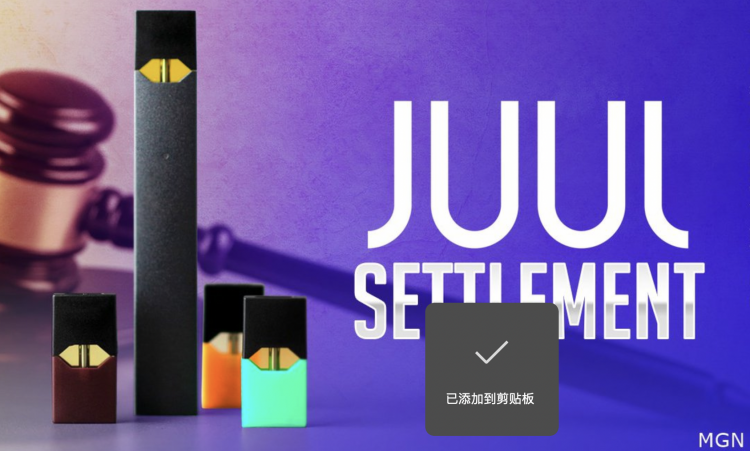
South Dakota receives $6.18 million in settlement from Juul's intentional targeting of youth with e-cigarettes.

South Dakota Attorney General Mark Vargo has announced that the state will receive a grant of $6,181,829.70 as part of a settlement with Jull.


For young people in South Dakota, this is an important "holiday" and a wonderful day," said South Dakota Attorney General Mark Vargo. "It is well known that e-cigarettes are dangerous for young people, and this action helps to ensure they stay away from such products.


A survey has revealed that Juul has become the dominant player in the e-cigarette market by intentionally promoting its products to young people, despite them being illegal and unhealthy for this demographic. The investigation found that Juul marketed to underage users through events, ads featuring young and trendy models, social media posts, and free samples.


Juul marketed a tech-centric fashion design that easily concealed and sold its products with flavors appealing to underage users. Furthermore, Juul adjusted the chemical composition of its products to decrease the throat irritation caused by vapor for young and inexperienced consumers.


A new investigation has found that JUUL relies on ineffective age-verification technology in order to protect its young customer base. The study also revealed that JUUL's original packaging is misleading, as it does not explicitly disclose the presence of nicotine and suggests a lower nicotine concentration than is actually present. Consumers are also being misled to believe that consuming a single Juulpod is equivalent to smoking one combustible cigarette.


The company also falsely claimed that its product was a smoking cessation device, without obtaining FDA approval for such a statement.


States and territories are finalizing and implementing settlement agreements, with the process expected to take approximately 3-4 weeks. A total of $438.5 million will be paid over the course of 6 to 10 years, with the amount increasing as the company continues to make payments over a longer period. If JUUL chooses to extend the payment period to ten years, the final settlement amount will reach $476.6 million.


Disclaimer: 1. The content of this article is compiled from third-party information and is intended for communication and learning purposes within the industry. 2. This article does not represent the views of 2FIRSTS, and 2FIRSTS cannot confirm the authenticity and accuracy of the article content. The compilation of this article is only intended for communication and research within the industry. 3. Due to limitations in compiling skills, the compilation may not fully convey the original meaning of the source. Please refer to the original article for accuracy. 4. 2FIRSTS fully aligns with the Chinese government on any domestic, Hong Kong, Macau, Taiwan, or foreign-related statements and positions. 5. The copyright of the compiled information belongs to the original media and authors. If there is any infringement, please contact us for removal.


Disclaimer

This article is provided solely for professional research, industry discussion, and informational purposes. Any references to brands, companies, products, technologies, or policies are made for factual reporting and analytical purposes only, and do not constitute endorsement, recommendation, promotion, or advertising by 2Firsts.

Nicotine-containing products, including but not limited to cigarettes, e-cigarettes, heated tobacco products, and nicotine pouches, carry significant health risks. Readers are responsible for complying with all applicable laws and regulations in their respective jurisdictions, including age restrictions and access limitations.

The information contained in this article should not be regarded as investment, legal, medical, regulatory, or commercial advice. While 2Firsts strives to ensure the accuracy and reliability of its content, it does not assume liability for any direct or indirect loss arising from errors, omissions, inaccuracies, or reliance on the information contained herein.

This article is not intended for individuals below the legal age for accessing tobacco or nicotine-related information in their jurisdiction.


Copyright Notice

This article is either original content produced by 2Firsts or content reproduced, translated, summarized, or adapted from third-party sources with attribution where applicable. The intellectual property rights of the original content remain with 2Firsts or the respective original rights holders.

No individual or organization may copy, reproduce, distribute, republish, modify, translate, or otherwise use this content without prior authorization. Any unauthorized use may result in legal action.

For copyright-related inquiries, corrections, or removal requests, please contact: info@2firsts.com.


AI-Assisted Translation and Editing Notice

Portions of this article may have been translated, edited, or reviewed with the assistance of artificial intelligence tools to improve efficiency and readability. Due to the limitations of AI-assisted translation and editing, discrepancies, omissions, or inaccuracies may exist when compared with the original source.

Where applicable, readers are advised to refer to the original source for the most complete and accurate information. If you identify any errors or believe that any content infringes upon your rights, please contact us at info@2firsts.com, and we will review and address the matter promptly.

WHO’s First Global Report on Nicotine Pouches: Harm Reduction Questions Remain Amid Global Regulatory Warning
Ahead of World No Tobacco Day 2026, WHO released its first global report on nicotine pouches, warning that rapid market growth, youth-oriented marketing and weak regulation are converging. 2Firsts views the report as an important warning, but not a complete risk assessment, with harm-reduction questions still unresolved.
Special Report
May.17
One Year After UK Disposable Vape Ban: Youth Use Falls to 13%, Adult Use to 8%
among both youth and adults. However, industry groups and regulators warn that the illicit vape market remains a growing concern.
Jun.09
PMI U.S. Launches America250 Initiative, Introduces Limited-Edition ZYN Patriotic Storage Can
PMI U.S. launched its America250 initiative on June 1 to commemorate the 250th anniversary of the United States. As part of the program, the company introduced a limited-edition ZYN Patriotic Storage Can and released an IQOS U.S. Edition device. Beyond product-related activities, the initiative also includes innovation funding, nationwide events and community engagement programs.
PMI
Jun.05
Philippine Health Department Pushes Total Vape Ban, With Tobacco-Only Flavor Limit as Alternative
The Philippine Department of Health said it is pushing for a total ban on vape products. If a full ban is not feasible, DOH officer-in-charge Director Dr. Dominic Maddumba said vape products should at least be limited to plain tobacco flavors to reduce their appeal to minors.
May.06 by 2FIRSTS.ai
Australian State Targets Illegal Tobacco Retailers With Tougher Closure Powers
According to Reuters, Australia’s state of Victoria introduced legislation to give police and the state tobacco licensing regulator stronger powers to shut businesses selling illegal tobacco, with non-compliant operators facing fines of more than A$2.4 million and up to 20 years in prison.
Jun.05
Bringing Tax and Insurance Into Nicotine Regulation: Insights From a Tobacco Harm-Reduction Report
A smoke-free nicotine policy report argues that tobacco harm reduction should move beyond product bans and health warnings into tax policy, insurance pricing and risk-based regulation. While some projections remain open to debate, the report highlights a wider challenge: nicotine products, technologies and consumer behavior have changed sharply over the past decade, and regulatory systems may need new tools to better align tobacco control with harm-reduction goals.
Jun.08