According to a report by South Korean daily newspaper "Maeil Business Newspaper," the South Korean government may increase cigarette taxes after the nationwide elections, as the situation of tax revenue shortfall worsened last year. Despite Prime Minister and Minister of Finance Choi Sang-mok stating that there are no plans to increase taxes, these rumors are gaining strength over time.
Last year, due to a shortage in tax revenue, a discussion about increasing cigarette prices began to circulate. In order to reduce smoking rates, the government has indicated that it may revise cigarette prices, citing long-term perspectives and the need to improve public health. Especially considering that cigarette prices have remained unchanged for nearly a decade, this situation is difficult to dismiss as mere rumor.
As part of the long-term policy direction set by the South Korean government to prevent diseases and improve the health level, the Ministry of Health and Welfare established the Fifth Comprehensive Plan for Citizens' Health Promotion in 2021. The plan highlights that although the smoking rate among men has been continuously reduced through tobacco control policies, it still remains relatively high, while the smoking rate among women is on the rise.
According to the Citizen Health Promotion Comprehensive Plan, the government aims to reduce the smoking rate from 36.7% in 2018 to 25.0% by 2030. Additionally, the plan aims to decrease the smoking rate among women from 7.5% to 4.0%. The plan highlights the need to enhance both price and non-price tobacco regulations, as well as increase the burden of health promotion funding to match the average level set by the World Health Organization (WHO).
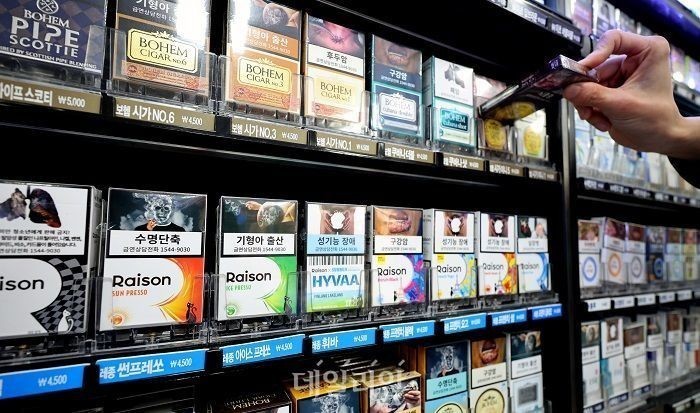
Currently, a pack of cigarettes priced at 4500 South Korean won incurs various taxes and fees totaling 3323 South Korean won, which constitutes 74% of the price. The relevant taxes include cigarette consumption tax, local education tax, health promotion burden, individual consumption tax, waste burden, and financial contributions to tobacco cultivation support projects.
It is projected that cigarette-related tax revenue will reach 11.8 trillion Korean won by 2022. If cigarette prices are raised to 8,000 Korean won, annual tax revenue could increase by 10 trillion Korean won. Alternatively, if prices are raised to 10,000 Korean won, annual tax revenue could increase by 14 trillion Korean won.
However, the South Korean Ministry of Finance has denied plans to increase tobacco taxes. While increasing tobacco tax revenue could have a significant immediate impact on offsetting tax shortfalls, the fact that cigarettes are a consumption item for low-income groups means that this would become a considerable burden during economic downturns and could potentially trigger a chain reaction of price increases for other consumer goods among low-income populations.
Industry insiders say, "With prices constantly on the rise, if cigarette prices increase as well, consumers will undoubtedly bear a heavier burden. Currently, the specific timing of the price hike remains unclear.
We welcome news tips, article submissions, interview requests, or comments on this piece.
Please contact us at info@2firsts.com, or reach out to Alan Zhao, CEO of 2Firsts, on LinkedIn
Notice
1. This article is intended solely for professional research purposes related to industry, technology, and policy. Any references to brands or products are made purely for objective description and do not constitute any form of endorsement, recommendation, or promotion by 2Firsts.
2. The use of nicotine-containing products — including, but not limited to, cigarettes, e-cigarettes, nicotine pouchand heated tobacco products — carries significant health risks. Users are responsible for complying with all applicable laws and regulations in their respective jurisdictions.
3. This article is not intended to serve as the basis for any investment decisions or financial advice. 2Firsts assumes no direct or indirect liability for any inaccuracies or errors in the content.
4. Access to this article is strictly prohibited for individuals below the legal age in their jurisdiction.
Copyright
This article is either an original work created by 2Firsts or a reproduction from third-party sources with proper attribution. All copyrights and usage rights belong to 2Firsts or the original content provider. Unauthorized reproduction, distribution, or any other form of unauthorized use by any individual or organization is strictly prohibited. Violators will be held legally accountable.
For copyright-related inquiries, please contact: info@2firsts.com
AI Assistance Disclaimer
This article may have been enhanced using AI tools to improve translation and editorial efficiency. However, due to technical limitations, inaccuracies may occur. Readers are encouraged to refer to the cited sources for the most accurate information.
We welcome any corrections or feedback. Please contact us at: info@2firsts.com