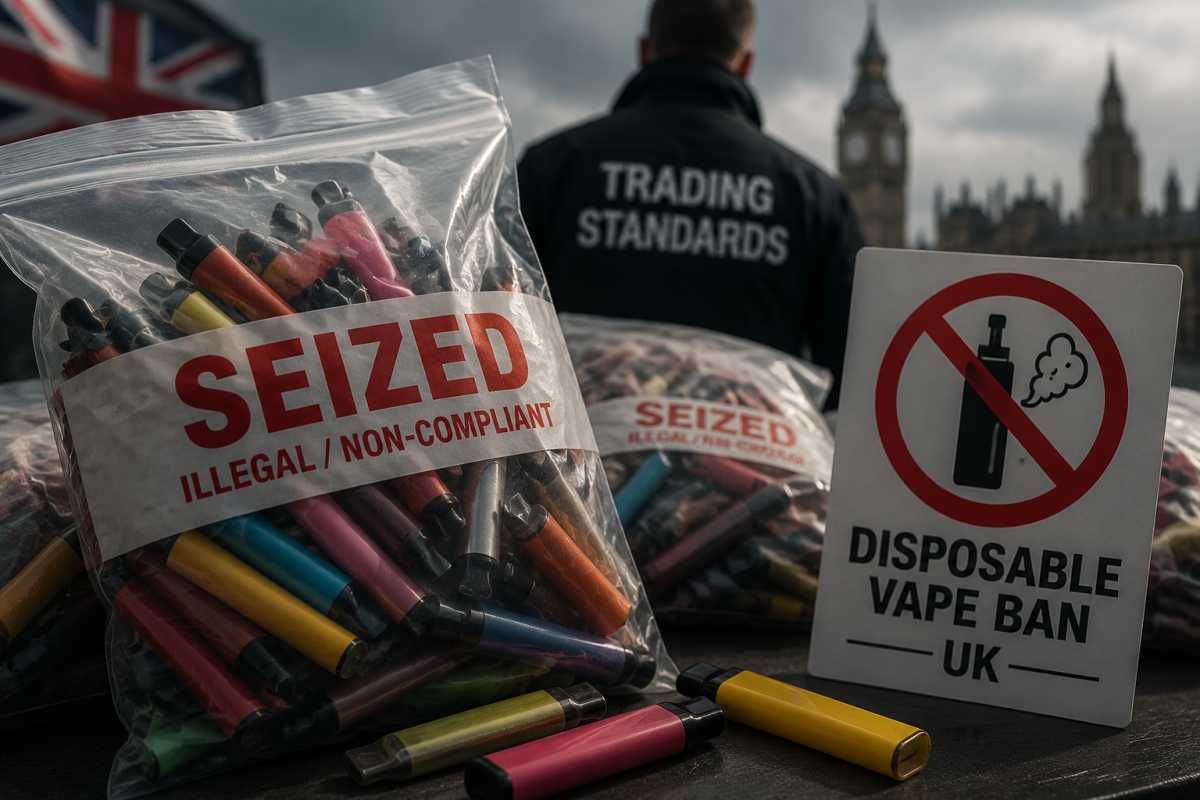
[2Firsts, Vincent reporting from Shenzhen] On June 1, 2025, the United Kingdom officially implemented its ban on disposable vapes. However, within just two months, the market has been flooded with large numbers of “copycat reusable vapes” that closely resemble disposables in appearance, flavor, and price. Despite being marketed as reusable, many consumers simply discard them after finishing the pre-filled pods.
The Daily Mail reported in August that the ban had already “failed.” Nielsen data revealed that in the first month of the ban, 5.3 million of these “copycat” products were sold, compared with only 1.4 million replacement pods—a nearly fourfold difference, underscoring that many users continue to treat these devices as single-use.
Nearly two months into the ban, what does the UK vape market really look like? Has the policy spurred compliance-driven restructuring, or merely unleashed a new form of chaos? To find out, 2Firsts spoke with UK brand owners and industry insiders to explore the real picture of the market under the ban.
Compliance Products Accelerate: High-Puff Pod Systems Take Shelf Space
The most immediate impact of the ban has been a rapid reshuffling of retail channels.
Lisa, a business development manager for a UK vape brand, told 2Firsts:
“Most retail shelves have already transitioned from disposables to compliant pod-based products after the ban.”
She noted that from May to July, supply shortages emerged:
“Every channel was pushing for stock; shelves were empty.”
Lisa said compliant high-puff pod systems are increasingly visible in stores, with some products advertising up to 50,000 or even 70,000 puffs. Her company is now focusing heavily on this high-puff segment and expanding into closed-system ecosystems.
Recently, INNOKIN and ELFBAR launched larger puff-count kits in the UK. Both feature three prefilled 2ml pods plus three 10ml refill bottles, enabling up to 50,000 puffs.

Reusables Favored, Limited Uptake for Nicotine Pouches
Consumer behavior is also shifting. The ban has accelerated the transition from disposables to reusable products.
Between July 28 and August 18 alone, MHRA’s notification database recorded 1,805 new vape SKUs, of which 1,656 were pods (91.75%). Most were 10mg/ml or 20mg/ml nicotine strength, focusing on fruit and cooling flavors.
According to research by Opinium, 85% of regular vapers have purchased reusable devices since the ban. Main reasons cited include:
- Comparable price (33%)
- Familiar design (31%)
- Convenience (30%)
Major tobacco firms are responding:
BAT’s Vuse launched its pod-based Vuse Ultra into UK convenience stores, retailing at £30 (~$40), with replacement pods (£9 per 2-pack) first available in 2,000 London outlets.
Imperial’s blu rolled out Summer Bundles—pod kits bundled with pods, priced between £19.84 and £23.16.
By contrast, nicotine pouches saw little change. Lisa explained:
“They serve a specific consumer group, and we haven’t observed significant growth since the ban.”
“The Right Rules, But Weak Enforcement”
Industry insiders stress that while the UK has established a necessary regulatory framework, enforcement remains insufficient.
Sarah Sabri, Global PR & Communications Manager for AIRSCREAM, told 2Firsts:
“We feel that the UK’s vaping regulations is a necessary framework to protect youth, safeguard the environment, and ensure that vaping remains a credible harm-reduction tool for adult smokers. However, regulations alone are not enough. Without robust enforcement, the illicit market continues to thrive, flooding the country with illegal disposables and undermining the efforts of fully compliant brands like ours.”
She added:
“ The UK has the right rules in place, but now it’s time to enforce them effectively so the industry can deliver on its promise of quality, safety, and public trust.”
Sabri noted:
"While changes are inevitable, what matters most is that any new regulations are matched with strong, consistent enforcement. Without it, even the best-intentioned policies risk being undermined by illicit products and irresponsible actors."
Policy Loopholes: Re-Export Exception Raises Alarm
Policy gaps are also enabling illegal trade. An Opinium survey found 64% of UK adults believe authorities must close the loophole allowing disposables to be legally imported or exported if intended for re-export.
2Firsts found that the UK government’s guidance document, “Single-use vapes ban: information for businesses”, specifies the ban applies only to selling or supplying disposables, with no explicit restrictions on re-export.
Regulation Heading Toward Cigarette-Like Controls?
Lisa predicts e-cigarettes will eventually be regulated like cigarettes, with licensing systems, usage restrictions, and taxation.
Indeed, the UK Treasury plans to introduce a new e-cigarette tax from October 2026, charging a flat rate of £0.22 per ml of e-liquid—meaning a 10ml refill bottle will carry £2.20 in tax.
At the legislative level, the government is advancing the Tobacco and Vapes Bill, which proposes:
- Prohibiting tobacco sales to anyone born on or after January 1, 2009;
- Strengthening retail licensing and registration requirements;
- Tightening advertising and promotion restrictions;
- Expanding smoke-free and vape-free zones.
The bill has cleared its third reading in the Commons and two readings in the Lords, now at committee stage.
Separately, The Guardian reported that government plans to enforce the “polluter pays principle”, requiring vape sellers and electronics retailers to fund recycling costs, with e-cigarettes listed as a distinct category.
Lisa concluded:
“If major public controversies arise in the future, the government may further tighten regulation under public pressure.”