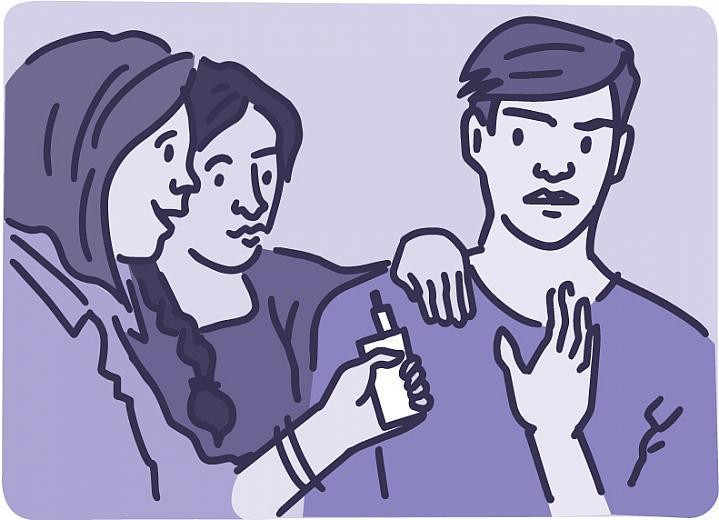
On August 14th, according to a report by the Kazakhstani media outlet Kursiv, the Ministry of Finance and the Ministry of Health in Kazakhstan have announced their reasons for supporting the prohibition of e-cigarettes. Both ministries believe that e-cigarettes have a detrimental impact on people's health, particularly among the younger generation. Consequently, they are in favor of banning e-cigarettes.
The consumption tax has brought significant budget revenue.
Earlier, the government of Kazakhstan decided to completely ban e-cigarettes and e-liquid products. If the Parliament of the Republic of Kazakhstan ultimately approves the amendment to the Health Law, this decision will take effect in 2024.
The proposed ban received support from two departments, including the Ministry of Finance, which stated that nicotine e-liquids have been subject to a consumption tax since 2018. Additionally, over the past three years, the tax rate has continuously increased.
Before 2020, the tax rate on liquids was 0 gyms/ milliliter. Starting from 2020, the tax rate increased to 5 gyms/milliliter. From 2022 to 2023, the tax rate further increased to 8 gyms/milliliter. And from 2023 onwards, the tax rate will be 53 gyms/milliliter. The total tax revenue from liquid consumption was 17 million gyms in 2020, 29 million gyms in 2021, 211 million gyms in 2022, and 680 million gyms in the first 8 months of 2023.
Despite stable growth in budget revenue, the Ministry of Finance is endorsing the proposal to implement a ban on e-cigarettes and e-liquids.
Teenagers and young adults typically opt for e-cigarettes due to their design, wide range of flavors, and compact size. However, using e-cigarettes can have detrimental effects on health, especially among the younger generation. This is why the Ministry of Finance supports a ban on e-cigarettes.
Concerns over history repeating itself, according to a study by the World Health Organization (WHO) in 2022, reveal that 9.8% of adolescents aged 11-15 in Kazakhstan are frequent consumers of e-cigarettes.
They believe that e-cigarettes are extremely harmful to health due to the presence of "unknown chemicals" and "large amounts" of nicotine. The respiratory system, cardiovascular system, and gastrointestinal system are all affected, and e-cigarettes can also lead to infertility. Despite these dangers, the consumption of e-cigarettes in the country continues to rapidly increase.
The Ministry of Health is concerned that a similar incident that occurred in the United States could happen again. In a statement, the ministry revealed that smokers have "more than ten times the amount of nicotine and thousands of unknown chemical substances" in their bodies.
The retailer violated regulations banning displays by making e-cigarettes visually vibrant and positioning them near the checkout counter alongside candies, which enticed sales to adolescents. Economically and geographically, almost all retail stores and nearby grocery stores are offering e-cigarettes at reasonable prices.
The Ministry of Health of the Republic of Kazakhstan has recently released a document on the "Open NPA" portal, announcing amendments to the "Citizens' Health Law," specifically prohibiting the use of e-cigarettes.
According to the document, it is proposed that the act of importing, manufacturing, purchasing, selling, or transporting e-cigarettes and e-cigarette liquid should be punishable by imprisonment of up to three years. Furthermore, engaging in the illegal buying and selling of goods prohibited or restricted by laws and regulations should incur a fine of 25 MRP (equivalent to 86250 Janko).
On July 29th, members of a cross-department committee in Kazakhstan almost unanimously voted to implement a comprehensive ban on the sale, import, export, and manufacturing of e-cigarettes within the country.
References: In standard journalistic English, this would be translated as: Sources:
In a joint statement issued by the Ministry of Health and the Ministry of Finance, officials have provided an explanation for their support of the ban on vaping in Kazakhstan.
Disclaimer
This article is provided solely for professional research, industry discussion, and informational purposes. Any references to brands, companies, products, technologies, or policies are made for factual reporting and analytical purposes only, and do not constitute endorsement, recommendation, promotion, or advertising by 2Firsts.
Nicotine-containing products, including but not limited to cigarettes, e-cigarettes, heated tobacco products, and nicotine pouches, carry significant health risks. Readers are responsible for complying with all applicable laws and regulations in their respective jurisdictions, including age restrictions and access limitations.
The information contained in this article should not be regarded as investment, legal, medical, regulatory, or commercial advice. While 2Firsts strives to ensure the accuracy and reliability of its content, it does not assume liability for any direct or indirect loss arising from errors, omissions, inaccuracies, or reliance on the information contained herein.
This article is not intended for individuals below the legal age for accessing tobacco or nicotine-related information in their jurisdiction.
Copyright Notice
This article is either original content produced by 2Firsts or content reproduced, translated, summarized, or adapted from third-party sources with attribution where applicable. The intellectual property rights of the original content remain with 2Firsts or the respective original rights holders.
No individual or organization may copy, reproduce, distribute, republish, modify, translate, or otherwise use this content without prior authorization. Any unauthorized use may result in legal action.
For copyright-related inquiries, corrections, or removal requests, please contact: info@2firsts.com.
AI-Assisted Translation and Editing Notice
Portions of this article may have been translated, edited, or reviewed with the assistance of artificial intelligence tools to improve efficiency and readability. Due to the limitations of AI-assisted translation and editing, discrepancies, omissions, or inaccuracies may exist when compared with the original source.
Where applicable, readers are advised to refer to the original source for the most complete and accurate information. If you identify any errors or believe that any content infringes upon your rights, please contact us at info@2firsts.com, and we will review and address the matter promptly.