Survey Report: Smoking Rates Among South Korean Adults 2019-2023

Aug.27.2024
Survey Report: Smoking Rates Among South Korean Adults 2019-2023
Korean study reveals rise in e-cigarette use among adults, with highest smokers in 40s men and 20s women.

According to a report by n.news on August 27th, the Korean Disease Control and Prevention Agency recently released a survey report on adult smoking rates from 2019 to 2023. The report shows that while the smoking rate of traditional cigarettes has remained stable, the use of e-cigarettes has significantly increased. The number of smokers is mainly concentrated in the 40-year-old male and 20-year-old female groups.


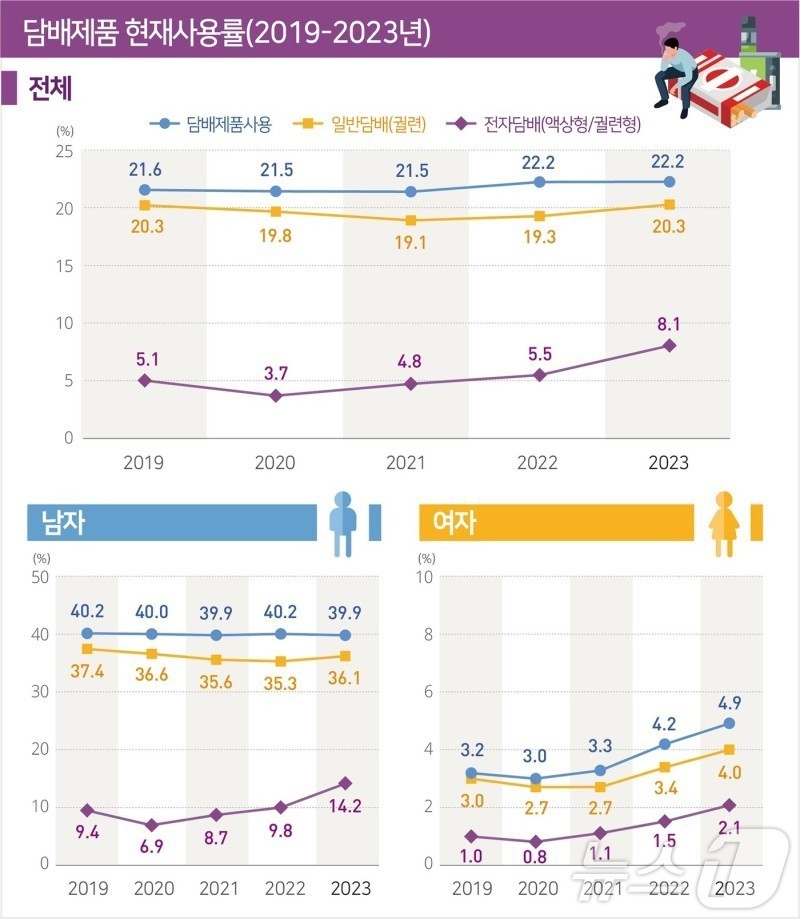
A report has indicated that the smoking rate in South Korea has increased from 21.6% in 2019 to 22.2%, a rise of 0.6 percentage points. The usage rate of traditional cigarettes has remained stable, while the usage rate of e-cigarettes has increased from 5.1% in 2019 to 8.1% last year.


In terms of gender, the overall smoking rate among men has slightly decreased, from 40.2% in 2019 to 39.9% last year. However, the use of e-cigarettes has seen a significant increase, rising from 9.4% in 2019 to 14.2%. Although the smoking rate among women is lower than that of men, it is also showing an upward trend, especially with e-cigarette usage doubling in the past three years.


The smoking rates among men and women also vary across different age groups, with the highest smoking rates observed among 40-year-old men and 20-year-old women.


In terms of regions, last year the area with the highest smoking rate was Chungbuk, reaching 25.0%; while the lowest smoking rate was in Sejong, only 14.8%.


The survey also revealed that the smoking rate is higher among non-office professions, with the highest smoking rate among skilled and manual laborers reaching 34.4%.


The Director of the Department of Disease Management, Ji Youngmi, stated that smoking is the main cause of various diseases such as lung cancer, heart disease, and stroke, and can also weaken the immune system, increasing the risk of infection. She emphasized that although e-cigarettes may have a different form, they pose just as much of a health risk as traditional cigarettes, containing multiple harmful chemicals. Users should remain vigilant about the potential dangers.


We welcome news tips, article submissions, interview requests, or comments on this piece.

Please contact us at info@2firsts.com, or reach out to Alan Zhao, CEO of 2Firsts, on LinkedIn


Notice

1.  This article is intended solely for professional research purposes related to industry, technology, and policy. Any references to brands or products are made purely for objective description and do not constitute any form of endorsement, recommendation, or promotion by 2Firsts.

2.  The use of nicotine-containing products — including, but not limited to, cigarettes, e-cigarettes, nicotine pouchand heated tobacco products — carries significant health risks. Users are responsible for complying with all applicable laws and regulations in their respective jurisdictions.

3.  This article is not intended to serve as the basis for any investment decisions or financial advice. 2Firsts assumes no direct or indirect liability for any inaccuracies or errors in the content.

4.  Access to this article is strictly prohibited for individuals below the legal age in their jurisdiction.


Copyright


This article is either an original work created by 2Firsts or a reproduction from third-party sources with proper attribution. All copyrights and usage rights belong to 2Firsts or the original content provider. Unauthorized reproduction, distribution, or any other form of unauthorized use by any individual or organization is strictly prohibited. Violators will be held legally accountable.

For copyright-related inquiries, please contact: info@2firsts.com


AI Assistance Disclaimer


This article may have been enhanced using AI tools to improve translation and editorial efficiency. However, due to technical limitations, inaccuracies may occur. Readers are encouraged to refer to the cited sources for the most accurate information.

We welcome any corrections or feedback. Please contact us at: info@2firsts.com

BAT Restructuring to Affect 9,000 Roles as Tobacco Group Pushes Cost Cuts and AI
British American Tobacco (BAT) plans to cut about 5,500 jobs globally and shift around 3,500 roles to strategic partners by the end of 2026, affecting about 9,000 roles in total, as the company seeks to simplify operations, strengthen technology capabilities and deliver £600 million in annual savings by 2028.
BAT
Jun.29
PMI Expands IQOS and VEEV Presence at Frankfurt Airport Through Travel Retail Pop-Ups
According to The Moodie Davitt Report, PMI Global Travel Retail and Frankfurt Airport Retail have launched new IQOS and VEEV retail spaces at Frankfurt Airport. The installations, located inside and outside duty-free areas, showcase IQOS heated tobacco products and VEEV e-vapor products through product education, consumer interaction and brand experiences. Frankfurt Airport Retail, operated by Fraport Group and Gebr. Heinemann, manages key retail activities at Frankfurt Airport. The initiative follows PMI’s broader strategy of expanding smoke-free products through global travel retail channels. PMI has previously introduced VEEV products across multiple European airports while continuing to expand IQOS and VEEV availability in international markets.
Jul.17
Special Report | Russia, Ukraine and Belarus Launch Fresh Push to Rein in Vaping
Russia, Ukraine and Belarus are tightening vape regulation through different tools, from Ukraine’s stronger enforcement push and Belarus’s proposed advertising restrictions to Russia’s new GOST standard and regional sales-ban mechanism. As black-market concerns persist, some Russian experts argue that China’s tightly controlled but legalised model — built around licensing, traceability and taxation — may offer a more effective alternative to blanket prohibition.
Jul.15
Germany Seizes 56 Pallets of Illegal Vapes, Probe Estimates €1.8 Million Tax Loss
German authorities have seized dozens of pallets of illegal disposable vapes in a criminal investigation, with the products estimated to have caused at least €1.8 million in tax losses. The case has also raised concerns over cross-border supply chains linked to unauthorized nicotine products entering the European market.
Jul.14
Australia’s TGA Places Nicotine Pouches Under Therapeutic Goods Rules From July 24, Blocking Imports of Unapproved Products
Australia is strengthening controls on nicotine pouches under its existing therapeutic goods regulatory framework. According to the Therapeutic Goods Administration (TGA), nicotine pouch products must meet regulatory requirements, and unapproved products cannot be legally imported. The move follows Australia’s broader approach of maintaining strict oversight of nicotine products, including nicotine-containing vapes. As nicotine pouches expand globally, Australia’s regulatory approach highlights growing differences in how countries manage emerging smoke-free nicotine products.
Regulations
Jul.27
BAT Regional Director Fred Monteiro Supports Spain’s Nicotine Rules but Opposes 0.99mg Nicotine Pouch Limit
Spanish newspaper El Confidencial interviewed Fred Monteiro, Regional Director for Americas and Europe at British American Tobacco (BAT). Monteiro said BAT supports setting regulatory limits for nicotine products but opposes Spain’s proposed 0.99mg nicotine-per-pouch limit, arguing that such a restriction could affect adult smokers’ transition to alternatives. He said nicotine regulation should be based on scientific evidence and harm reduction principles. Monteiro also said smoke-free products now account for around 25% of BAT’s Americas and Europe business and nearly 30% of its Europe business
BAT
Jul.30