In 2019, the UK government set a target of becoming smoke-free by 2030, which would mean only 5% of the population would be smoking by then. Failure to achieve this target would mean the government cannot fulfill its promise to extend healthy life expectancy by five years by 2035. This target is part of the new 10-year cancer plan and aims to help the government save more lives.
A review has found that the UK will be unable to achieve its smoke-free goal within seven years unless further action is taken. The poorest areas are not expected to achieve this goal until 2044, emphasizing the need to hasten the decline of smoking rates by 40%.
On March 8, 2022, the Secretary of Health and Social Welfare, Sagid Javid, gave a speech on healthcare reform.
As communities become wealthier, they also become healthier, and as communities become healthier, they become wealthier. Healthy individuals have greater opportunities for education, employment, and income.
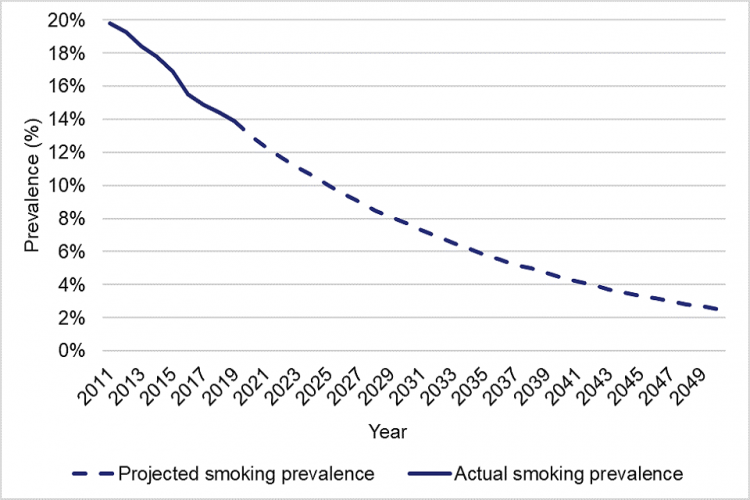
Figure 1: Smoking prevalence in the UK (trends and forecasts)
Figure 1 displays the smoking rates in England, which have decreased from 19.8% in 2011 to 13.9% in 2019. The chart further shows a projected further decrease to 2.5% by the year 2050.
Over the past decade, there has been a significant increase in public support for government measures to restrict smoking. The percentage of people who believe the government is not doing enough to address smoking-related issues has risen from 29% in 2009 to 46% in 2022.
Figure 2: Public Attitudes Towards Government Restrictions on Smoking Activities
Figure 2 compares the responses of participants aged 18 to 24 to a question asking whether they believe the government is taking sufficient measures to restrict smoking. The answers were:
The statistics reveal that 18 to 24-year-olds make up 4% of the population, which equates to about 6% of the total. More accurately, 24% of this age group makes up approximately 30% of the total population. However, there is a shortage, as 52% of the population falls under this age bracket, but only represents 46% of the total population. The remaining 20% of 18 to 24-year-olds are unsure of their classification, which represents 18% of the total population. In summary, it is recommended that further attention be paid to this age group.
Increase investment
An additional £125 million will be invested annually towards the 2030 smoke-free policy, to provide easy access to high-quality support for smokers to quit. This includes an annual extra investment of £70 million for smoking cessation services.
If the government is unable to provide funding for this, they should "make polluters pay", either by imposing a tobacco industry tax or immediately levying additional corporate taxes.
2. Increase the age of sales.
The government must prevent young people from starting smoking, which is why I propose raising the age of tobacco sales by one year every year until no one in the country can buy tobacco products.
Encourage the use of electronic cigarettes.
The government must promote electronic cigarettes as an effective tool to help people quit smoking. We understand that electronic cigarettes are not entirely risk-free, but smoking is much worse.
Improve the prevention of the NHS.
Prevention must become a part of the DNA of the UK's National Health Service (NHS). In order to reduce the £2.4 billion spent annually by the NHS, it must fulfill its commitments outlined in its long-term plan. The NHS must do more to provide advice and support for smokers, encouraging them to quit during every interaction with healthcare professionals, whether it be their GP, hospital, psychiatrist, midwife, pharmacist, dentist or optician. Furthermore, the NHS should invest resources in these efforts to ultimately save money in the long term.
Other suggestions
The report also puts forth several recommendations for an overall response to the 2030 Smoke-free Challenge and for the country to embark on a path to make smoking obsolete.
The report calls for the government to introduce tobacco licenses for retailers to limit tobacco supply nationwide. I propose a fundamental rethink of cigarette packaging to reduce their appeal. A smoke-free society should be the norm, which is why there should be more smoke-free spaces (both indoors and outdoors where children gather).
Investing in well-designed public media campaigns can help create a smoke-free culture while encouraging smokers to quit. Increasing tariffs on all tobacco products by more than 30% will also incentivize smokers to quit by raising the cost of smoking. Additionally, abolishing tax-free imports of all tobacco products at our borders will be implemented.
I also urge the government to expedite the process of regulating e-cigarettes and to provide free distribution in impoverished communities. Additionally, they should do everything possible to prevent children and young people from using e-cigarettes, including banning child-friendly packaging and descriptions.
The government must do more to support the most impoverished areas and groups affected by smoking. Particularly affected are pregnant women and those with mental health issues, who experience much higher negative health impacts from smoking. I am calling for integrated care systems (ICS) throughout the country to take the lead in achieving the goal of smoking cessation.
To accomplish this goal, the issue of illegal tobacco must also be addressed as it is often sold at discounted prices and to minors.
The government must also invest in new research and data, including commissioning further studies on the health disparities related to smoking.
The report recommends that planning for the UK should not just be the responsibility of the current government, but rather should be a plan carried on by all successive governments. As progress is made and recommendations are refined, spending should be adjusted to meet changing needs and address challenges and opportunities. Therefore, it is recommended that the government introduce progress review mechanisms in 2026, 2030, and 2035.
Source: Official website of the UK government.
Disclaimer
This article is provided solely for professional research, industry discussion, and informational purposes. Any references to brands, companies, products, technologies, or policies are made for factual reporting and analytical purposes only, and do not constitute endorsement, recommendation, promotion, or advertising by 2Firsts.
Nicotine-containing products, including but not limited to cigarettes, e-cigarettes, heated tobacco products, and nicotine pouches, carry significant health risks. Readers are responsible for complying with all applicable laws and regulations in their respective jurisdictions, including age restrictions and access limitations.
The information contained in this article should not be regarded as investment, legal, medical, regulatory, or commercial advice. While 2Firsts strives to ensure the accuracy and reliability of its content, it does not assume liability for any direct or indirect loss arising from errors, omissions, inaccuracies, or reliance on the information contained herein.
This article is not intended for individuals below the legal age for accessing tobacco or nicotine-related information in their jurisdiction.
Copyright Notice
This article is either original content produced by 2Firsts or content reproduced, translated, summarized, or adapted from third-party sources with attribution where applicable. The intellectual property rights of the original content remain with 2Firsts or the respective original rights holders.
No individual or organization may copy, reproduce, distribute, republish, modify, translate, or otherwise use this content without prior authorization. Any unauthorized use may result in legal action.
For copyright-related inquiries, corrections, or removal requests, please contact: info@2firsts.com.
AI-Assisted Translation and Editing Notice
Portions of this article may have been translated, edited, or reviewed with the assistance of artificial intelligence tools to improve efficiency and readability. Due to the limitations of AI-assisted translation and editing, discrepancies, omissions, or inaccuracies may exist when compared with the original source.
Where applicable, readers are advised to refer to the original source for the most complete and accurate information. If you identify any errors or believe that any content infringes upon your rights, please contact us at info@2firsts.com, and we will review and address the matter promptly.