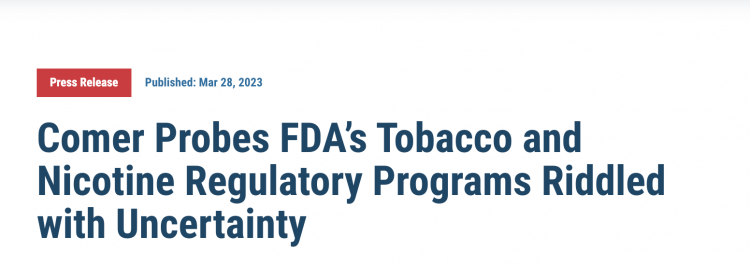
On March 28th, the House Oversight and Reform Committee of the United States launched an investigation into the Food and Drug Administration's Center for Tobacco Products (CTP). The chairman of the committee, Republican Representative James Comer of Kentucky, made the investigation public.
In a letter addressed to FDA Commissioner Robert Califf, Congressman Comer outlined several reasons for an investigation, mostly based on criticisms of the agency's tobacco regulation program by the Reagan-Udall Foundation. The evaluation found numerous flaws in CTP's processes and communication with stakeholders and the public.
Recently, the Reagan-Udall Foundation conducted an evaluation of the CTP and found that...
There is no clear definition of the fundamental elements of its tobacco and nicotine regulation plan, which promotes market uncertainty and allows unsafe and unregulated products to proliferate.
Therefore, the House Oversight and Accountability Committee is seeking documents and information regarding CTP activities to achieve transparency and ensure that CTP is performing its required functions.
The committee has requested that the FDA provide:
FDA staff's comments on the Reagan-Udall assessment; all communications with the White House and the Department of Health and Human Services (HHS) regarding tobacco or nicotine policies; documents and correspondence between FDA and the Centers for Disease Control and Prevention (CDC) regarding CTP policies; communication documents between FDA and "public health advocacy groups" regarding CTP policies; all documents regarding the "appropriate for the protection of public health" standard and specific analytical processes; enforcement work documents of FDA's removal of illegal tobacco or nicotine products from retail locations.
In the coming months, the committee will hold public hearings that may offer an opportunity for the electronic cigarette industry and consumer rights advocates to explain how the FDA's confusing regulatory process is harming small businesses and individuals who use low-risk nicotine products. The hearings may also address how the agency is responding to political pressure from anti-smoking youth organizations, Congress, and the White House.
Comer pointed out deficiencies in the FDA's enforcement ability, and urged the agency to release a list of authorized products and products currently under review for retailers to reference. He also called on the FDA to allocate necessary resources and promptly remove from the market those products that are most appealing to underage users.
References:
Congressman Comer investigates FDA's tobacco and nicotine regulatory programs characterized by ambiguity.
The House Oversight Committee has announced that it will investigate the regulations enforced by the FDA pertaining to tobacco.
Disclaimer
This article is provided solely for professional research, industry discussion, and informational purposes. Any references to brands, companies, products, technologies, or policies are made for factual reporting and analytical purposes only, and do not constitute endorsement, recommendation, promotion, or advertising by 2Firsts.
Nicotine-containing products, including but not limited to cigarettes, e-cigarettes, heated tobacco products, and nicotine pouches, carry significant health risks. Readers are responsible for complying with all applicable laws and regulations in their respective jurisdictions, including age restrictions and access limitations.
The information contained in this article should not be regarded as investment, legal, medical, regulatory, or commercial advice. While 2Firsts strives to ensure the accuracy and reliability of its content, it does not assume liability for any direct or indirect loss arising from errors, omissions, inaccuracies, or reliance on the information contained herein.
This article is not intended for individuals below the legal age for accessing tobacco or nicotine-related information in their jurisdiction.
Copyright Notice
This article is either original content produced by 2Firsts or content reproduced, translated, summarized, or adapted from third-party sources with attribution where applicable. The intellectual property rights of the original content remain with 2Firsts or the respective original rights holders.
No individual or organization may copy, reproduce, distribute, republish, modify, translate, or otherwise use this content without prior authorization. Any unauthorized use may result in legal action.
For copyright-related inquiries, corrections, or removal requests, please contact: info@2firsts.com.
AI-Assisted Translation and Editing Notice
Portions of this article may have been translated, edited, or reviewed with the assistance of artificial intelligence tools to improve efficiency and readability. Due to the limitations of AI-assisted translation and editing, discrepancies, omissions, or inaccuracies may exist when compared with the original source.
Where applicable, readers are advised to refer to the original source for the most complete and accurate information. If you identify any errors or believe that any content infringes upon your rights, please contact us at info@2firsts.com, and we will review and address the matter promptly.