EU Countries Push for New Tax Laws on E-cigarettes

Dec.09.2024
EU Countries Push for New Tax Laws on E-cigarettes
16 EU countries, led by the Netherlands, urge the EU Commission to propose new tax laws on e-cigarettes.

According to Business Standard's report on December 9th, 16 EU countries, including the Netherlands, have requested the European Commission to propose new tax laws in the coming months in order to tax new tobacco products such as e-cigarettes. Currently, these products are not covered by existing laws.


This initiative is led by the Netherlands and supported by Croatia, the Czech Republic, Denmark, Estonia, Finland, France, Germany, Latvia, Slovakia, Spain, Belgium, Bulgaria, Ireland, Slovenia, and Portugal.


Finance ministers from various countries expressed in a joint letter to the European Commission that the current EU Tobacco Tax Directive, established in 2011, is in urgent need of updating. Due to the lack of harmonized regulations for e-cigarettes, countries are currently implementing varying rules and levels of excise taxes, which is distorting the functioning of the EU single market.


According to the joint letter, most e-cigarette products are not taxed like traditional tobacco products under current regulations. Due to the continuous introduction of new products by the tobacco industry, the existing regulations are inadequate to address the challenges faced by member states governments.


The revised EU tobacco tax law, originally scheduled to be introduced by the end of 2022, has been delayed. Governments of various countries are hoping that the new European Commission, which took office on December 1st, will urgently address this issue.


Currently, the European Commission has set some regulatory standards for e-cigarettes, including restrictions on nicotine content and requirements for labels to indicate that they are not intended for non-smokers. Manufacturers must also register with the government before selling their products.


However, specific regulations still vary among countries. For example, in France, those under the age of 18 are prohibited from purchasing e-cigarettes, and their use is banned in certain public places such as universities and public transportation. In 2013, Italy lifted the ban on using e-cigarettes in public places, but their use near schools remains prohibited. France has proposed a total ban on disposable e-cigarettes. The German Federal Council has recommended that the government push for a similar ban on disposable e-cigarettes to be implemented across the entire European Union.


We welcome news tips, article submissions, interview requests, or comments on this piece.

Please contact us at info@2firsts.com, or reach out to Alan Zhao, CEO of 2Firsts, on LinkedIn


Notice

1.  This article is intended solely for professional research purposes related to industry, technology, and policy. Any references to brands or products are made purely for objective description and do not constitute any form of endorsement, recommendation, or promotion by 2Firsts.

2.  The use of nicotine-containing products — including, but not limited to, cigarettes, e-cigarettes, nicotine pouchand heated tobacco products — carries significant health risks. Users are responsible for complying with all applicable laws and regulations in their respective jurisdictions.

3.  This article is not intended to serve as the basis for any investment decisions or financial advice. 2Firsts assumes no direct or indirect liability for any inaccuracies or errors in the content.

4.  Access to this article is strictly prohibited for individuals below the legal age in their jurisdiction.


Copyright


This article is either an original work created by 2Firsts or a reproduction from third-party sources with proper attribution. All copyrights and usage rights belong to 2Firsts or the original content provider. Unauthorized reproduction, distribution, or any other form of unauthorized use by any individual or organization is strictly prohibited. Violators will be held legally accountable.

For copyright-related inquiries, please contact: info@2firsts.com


AI Assistance Disclaimer


This article may have been enhanced using AI tools to improve translation and editorial efficiency. However, due to technical limitations, inaccuracies may occur. Readers are encouraged to refer to the cited sources for the most accurate information.

We welcome any corrections or feedback. Please contact us at: info@2firsts.com

2Firsts Hosts China Market Forum at InterTabac as Global Industry Attention to China’s Tobacco Sector Deepens
On September 16, 2Firsts hosted a China-focused industry forum during InterTabac in Dortmund, bringing together more than 30 participants from North America, Europe, India, South Korea and other markets. The session covered traditional tobacco, next-generation products, exports, technology, regulation and supply chains, while examining how China’s tobacco sector operates, where its transformation may be heading, and why its growing role matters increasingly to companies across the global tobacco and nicotine industry.
Sep.21
Russia's Vape Ban Decisions Reach 17 Regions With 39 More Considering Laws, Putting Over 3,000 St. Petersburg Retail Outlets in Focus
Russia's regional vape retail restrictions are expanding. State Duma Speaker Vyacheslav Volodin said on November 7 that 17 regions had adopted decisions to ban vape sales, while another 39 were preparing or considering similar legislation. On November 12, lawmakers in Leningrad Oblast and the Republic of Karelia adopted bans scheduled to begin on March 1, 2027. A day earlier, St. Petersburg unanimously approved a five-year ban proposal in its first reading. The city has 615 specialist vape shops and more than 2,400 other retail outlets selling vaping products alongside other goods. Under Federal Law No. 186-FZ, enacted in June 2026, Russian regions may prohibit retail sales of electronic nicotine delivery systems and related liquids between March 2027 and March 2032. The legislation also restricts licensed suppliers from delivering covered products to retail premises in regions where bans apply.
Regulations
Nov.13
STIIIZY Redesign Fails to Escape PAX Labs Patent Import Ban as Section 337 Case Also Involves China ALD
U.S. Customs and Border Protection ruled that STIIIZY had not shown that the redesigned cannabis-vape products covered by its latest request fall outside an ITC limited exclusion order tied to PAX Labs patents. CBP accepted some of STIIIZY’s claim-construction and non-infringement arguments, but the company did not address two additional claims in the same patent. Earlier STIIIZY redesigned cartridges and certain associated components imported with them had received separate CBP clearance.
Sep.16
BAT Adds Former Apple General Counsel Bruce Sewell to Board as Finance, Legal, Marketing and Regional Leadership Shift
British American Tobacco has appointed former Apple Senior Vice President, General Counsel and Secretary Bruce Sewell as an independent non-executive director, effective January 1, 2027. He will also join BAT's Audit and Nominations Committees. BAT Chair Luc Jobin highlighted Sewell's experience in technology, government and regulatory affairs, public-company governance and AI-company boards. Over the past 18 months, BAT has changed or announced changes to its CFO, general counsel, CMO and APMEA regional leadership, while the main board has also seen multiple changes. The appointment comes as BAT advances Horizon 2030 and its Fit2Win transformation while expanding New Categories and reshaping parts of its digital, technology and operating structure.
Business
Oct.29
Product | Philip Morris Korea Launches Two TEREA ONYX Capsule Tobacco Sticks, Expanding Portfolio to Five Lines
Philip Morris Korea launched TEREA ONYX, a new tobacco stick line for IQOS ILUMA devices, on October 15, 2026. The initial products, AMANG PEARL and CALI PEARL, feature tropical-inspired flavors, Fresh Filters and capsules designed to deliver different flavor experiences before and after activation. Both are priced at KRW 4,800 per pack and are available at convenience stores nationwide and IQOS-operated stores in South Korea. The launch expands the Korean TEREA portfolio from four product lines to five, following earlier capsule tobacco stick additions in 2026.
product
Oct.23
Japan Survey Finds 49.5% Would Cut Tobacco Use if Prices Rise, 64.6% Show Interest in Nicotine-Free Alternatives
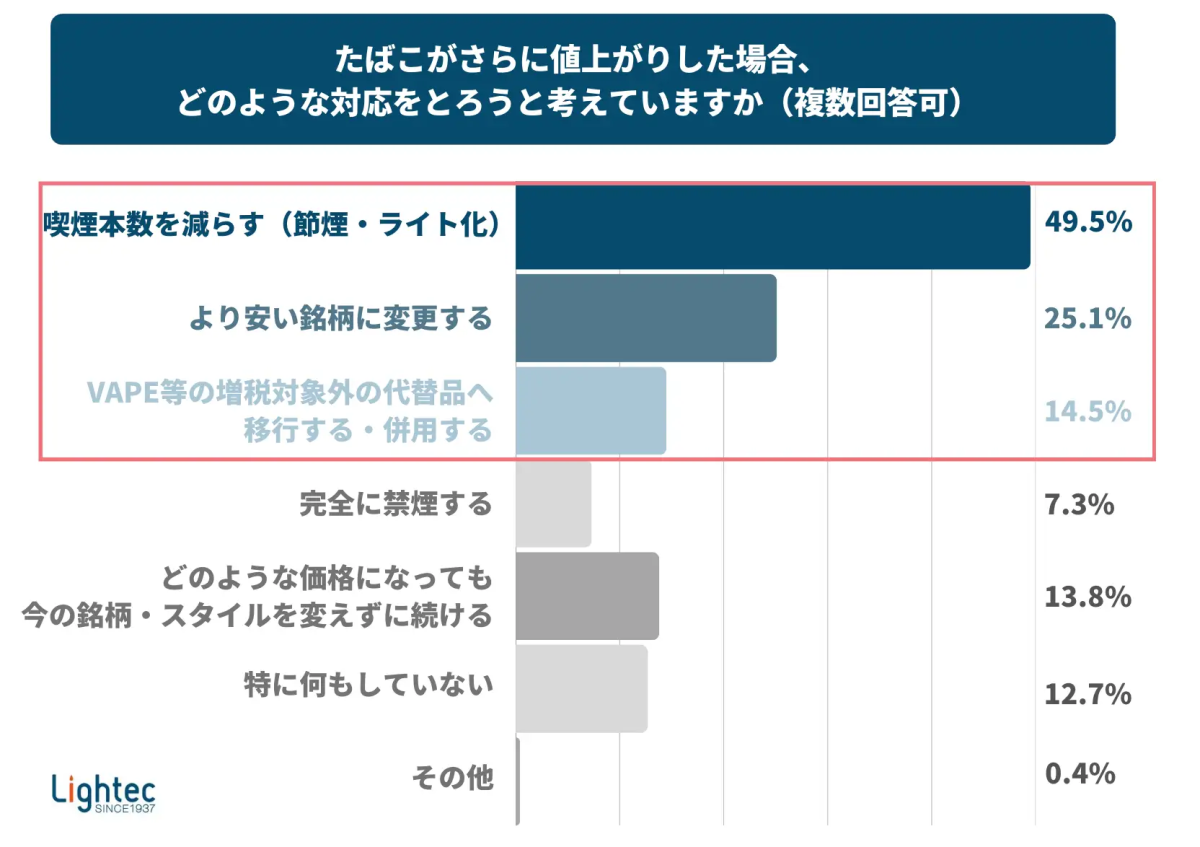
A September online survey commissioned by Japanese smoking-accessories company Lightec found that 49.5% of respondents would consider reducing tobacco use if prices rose further, while 25.1% would consider switching to cheaper brands and 14.5% would consider using or combining alternatives such as vapes and nicotine-free herbal sticks. Another 64.6% expressed some level of interest in such alternatives. The survey covered 1,088 respondents aged 20 to 70 and was conducted by a company that sells NICOLESS nicotine-free vaping and herbal-stick products, meaning its findings should not be treated as representative of Japan's smoking population.
DATA
Oct.12