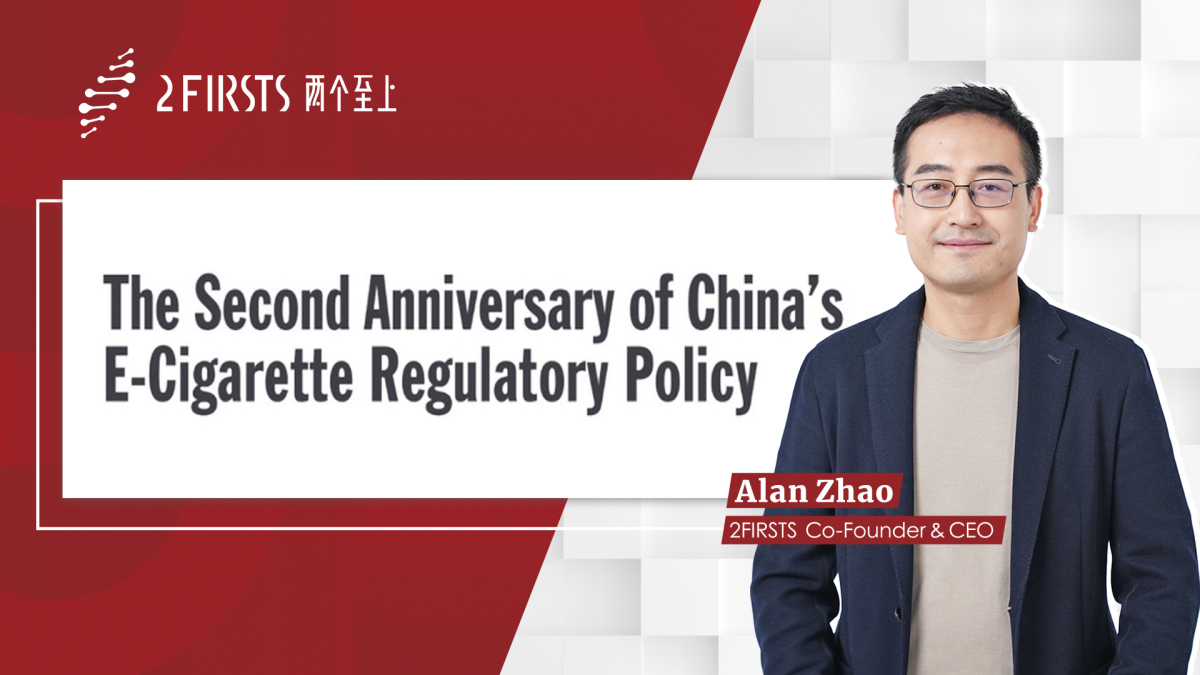
Alan Zhao, the co-founder and CEO of 2Firsts, has over 10 years of experience in the traditional tobacco and NGP industry. He has conducted extensive research in media, regulatory policies, and industrial economics. Alan holds a bachelor's degree in Information Management & Information Systems, and Law, as well as an MBA. Founded only a few years ago, 2Firsts.com has quickly become a globally leading media and consultancy platform with a declared focus on all matters NGP.
Tobacco Asia (TA): October 2024 marks the second anniversary of the formal implementation of the China Tobacco Monopoly Administration's (STMA's) e-cigarette regulatory policy. What are, in your opinion, the key points of that framework?
Alan Zhao (AZ): The framework encompasses several key components, such as legal system, administrative management, product standards, taxation, and enforcement actions.
The framework has established a comprehensive three-tier legal system, ranging from national laws to state council policies to STMA implementation methods, covering both existing but also potential future NGP.
In terms of administrative management, the production, distribution, and retail of e-cigarettes are all included in the licensing system. All companies engaged in the production, export, and beand export of e-cigarettes must obtain a license under strict requirements. Moreover, China places great emphasis on protecting minors and underage people from the harm of e-cigarettes, explicitly prohibiting sales to them.
Looking at product standards, the regulation has adopted a whitelist system, allowing only 101 substances to be legally added to e-cigarettes, while prohibiting flavors such as fruit. However, these standards apply exclusively to products sold domestically, but not to products manufactured for foreign markets.
Talking about taxation, China levies a tobacco consumption tax on domestic sales, collected at two stages: production (or import) with a tax rate of 36% and wholesale with a rate of 11%.
That leaves the enforcement actions. According to statistical data collated by 2Firsts from January to May 2024, STMA, public security bureau, and other government departments have conducted no less than 13 large-scale enforcement actions, with the value of illegal e-cigarettes investigated reaching a value of US$145 million.
TA: With China being the world's by far largest e-cigarette manufacturing hub, this rather comprehensive policy certainly must have a significant impact on the domestic e-cigarette industry...
AZ: Yes, indeed. It brought significant changes to the domestic supply chain and market. For developers and manufacturers, obtaining a production license is mandatory, and the entire production process must be registered, from procurement of raw materials all the way to sales. Moreover, any expansion of production capacity or introduction of capital by manufacturers also requires approval. All issued licenses are updated periodically, and any violations may result in the respective enterprise potentially losing its qualifications.
For distributors and retailers, the original distribution and retail systems previously established by e-cigarette brands within China have been replaced. All e-cigarette brands must adopt a sales system similar to that of conventional cigarettes. Brand-specific stores are prohibited.
For consumers, the most significant impact is the change in the products they can purchase and the channels through which they can buy them. They can no longer legally purchase fruit-flavored e-cigarettes, which are now illegal throughout China; and purchasing channels are also limited to retail stores that have obtained an e-cigarette retail license. While the local unavailability of fruit flavors may be "disappointing" to some consumers, the quality and safety of e-cigarettes are now assured, which is a more important aspect.
TA: Have there been any major adjustments or supplements to the framework over the past two years because the original policies proved impractical, burdensome, counterproductive, or outdated?
AZ: Yes. In fact, the e-cigarette regulatory system has been constantly "evolving." Regulating e-cigarettes was a completely new area for the regulatory authorities, too, mainly STMA, which required a learning curve. But over the past two years, STMA has introduced a series of supplementary nakes to make the entire regulatory system even more effective.
For example, on October 14, 2022, STMA issued the "Detailed Rules for the Management of E-cigarette Import and Export Trade and International Economic and Technical Cooperation," which provides more detailed regulations and guidance on e-cigarette import and export and international technical cooperation.
Then, on November 22, 2022, STMA in conjunction with the State Postal Bureau issued the "Notice on the Limited Delivery of E-cigarette Products, Acrosols, and Nicotine for E-cigarettes," which restricts domestic mailing of e-cigarettes, thereby effectively limiting the flow of illegal e-cigarettes within the country.
As well, on July 18, 2023, STMA issued the “Guidance on Promoting the Construction of Quality Assurance Systems for Exported E-cigarette Products.” This instrument further regulates Chinese e-cigarette manufacturing enterprises in terms of exports. For example, it further emphasizes that enterprises should ensure that their export products comply with the laws, regulations, and standard requirements of the destination country. It obliges enterprises to establish a quality assurance management system and sets requirements for the packaging of export products, including printing information such as the production license number, product names, and batch identifier on the outer packaging.
Then, as recently as February 4, 2024, STMA issued the "Notice on the Application Procedures for E-cigarette Production and Operation Entities to Apply for Licenses," which refines and optimizes the process of e-cigarette license applications, facilitating subsequent applications by enterprises.
But these really are only a few examples to demonstrate that STMA is very diligent in further optimizing the regulatory system by comprehensively considering various factors such as domestic market regulation, the development of international markets, and the operational needs of enterprises.
TA: What are the most positive actual effects of the policy and how can they be reliably evaluated?
AZ: The regulatory policies have achieved significant results domestically. The most notable is an effective crackdown on illegal e-cigarettes, which undoubtedly is a huge benefit for consumers, compliant e-cig manufacturers, and brand owners alike. One piece of evidence comes from the 2023 ESG report published by RELX, the company having actively assisted police in handling counterfeit product cases. The number of counterfeit and copycat products seized decreased from 797,891 in 2021 to 54,600 in 2022, a year-on-year reduction of 93.1%. The decrease is largely attributed to the implementation of the regulatory policies.
TA: Is there any impact of the regulatory policy on global markets outside China?
AZ: China's regulatory policies cannot exert direct influence on world markets. If there is any impact globally, it is indirect. For instance, if through international regulatory cooperation a non-compliant product can be traced back to originate from China, its manufacturer may be subject to penalties imposed by the local authorities. This would greatly enhance the regulatory cooperation efficiency between various countries, especially major e-cigarette consumers such as the United States and Europe. However, the realization of this effect requires consumer countries' regulatory agencies to establish in-depth cooperation with China's STMA.
TA: The EU and some other markets are moving to curb the overwhelming prevalence of disposable vaping devices with the goal of eventually phasing them out altogether in favor of reusables. Is that development likely to have an impact on China's regulatory framework?
AZ: Since China introduced her regulatory system for e-cigarettes and banned fruit flavors, this global wave of disposables has not become widespread in China. In fact, the Chinese market still primarily features pod systems. The considerations by the EU and other markets to curb or even eliminate disposables is a significant challenge, because they have already gained such a substantial market share and large consumer base. If a simple "ban" is issued without strong enforcement, the result may be an expanding illegal market similar to what the United States experienced during the alcohol prohibition era 100 years ago.
The EU and other markets should consider strengthening their regulatory cooperation with China. This could be achieved through sharing product standards, creating blacklists of violating companies, and joint enforcement actions, thereby improving regulatory efficiency and ensuring orderly market development.
TA: Regulatory cooperation aside, what lessons can other countries draw from China's policy to possibly strengthen their own frameworks?
AZ: It is hard to say whether there are "lessons" to be learned from China, though the fact is that the Chinese framework is working quite well. However, if we could turn back time, the e-cigarette regulatory system could have been introduced a year earlier, or even in 2020. If that had been the case, the compliance development process for e-cigarettes would have kicked in earlier, and some harmful products would have disappeared from the market sooner. But this is just my hypothesis. In reality, in 2020, regulatory authorities in various countries including China could not have anticipated the explosive development of e-cigarettes.