Australian Survey: Vape Shops in Poverty Areas 7 Times Higher than Affluent Areas, Highest Near Schools

Regulations by 2FIRSTS.ai
Feb.14.2024
Australian Survey: Vape Shops in Poverty Areas 7 Times Higher than Affluent Areas, Highest Near Schools
E-cigarette stores in Western Australia are disproportionately located in low-income areas, raising concerns about targeting vulnerable populations.

According to a report by Australian news outlet Pedestrian, researchers at the University of Western Australia have recently discovered that e-cigarette shops are disproportionately concentrated in disadvantaged areas of the state. In fact, nearly 90% of these shops are within walking distance of schools. When compared to wealthier areas within the state, impoverished areas have seven times more e-cigarette shops, with 88% of them being less than one kilometer away from schools.


Although the research is limited to Western Australia, researchers say that this is not surprising and similar situations may exist throughout the country, highlighting the need for further reforms in e-cigarette regulations.


We have learned from overseas studies that the tobacco industry often establishes stores in impoverished areas in order to target vulnerable populations. We have also found the same pattern here with e-cigarette retailers," said Dr. Matthew Taskan, a researcher.


The proximity of e-cigarette stores to schools has increased opportunities for young people to be exposed to e-cigarettes and marketing practices, ultimately normalizing their use. While our research was conducted in Western Australia, the density of e-cigarette retailers near schools and disadvantaged communities is expected to be a prevalent issue nationwide in Australia.


Researchers have described smoking as an "epidemic" and have stated that although disposable e-cigarettes are currently banned, the government still urgently needs to address some significant loopholes.


In recent years, e-cigarette retailers have seen rapid growth across the country," stated Professor Terry Sullivan. He welcomed the latest e-cigarette reforms while pointing out that they primarily target the supply chain and retailers, rather than the users themselves. "Smokers who have decided to quit and need the help of e-cigarettes can still obtain assistance through a prescription from healthcare professionals," he said. "We urge all state and federal legislators to prioritize the health of young people and support comprehensive e-cigarette reforms, as advocated by public health professionals, schools, and teachers.


The latest reform, which came into effect on January 1st, has successfully seized hundreds, and even thousands, of pre-ordered disposable e-cigarettes set to be launched. The government announced that they have confiscated millions of dollars' worth of e-cigarettes.


However, other experts argue that this may simply imply the influx of more illegal e-cigarettes into the country. They suggest that smoking will continue to be a harmful epidemic until the government adopts a health-based approach rather than a criminal one.


We welcome news tips, article submissions, interview requests, or comments on this piece.

Please contact us at info@2firsts.com, or reach out to Alan Zhao, CEO of 2Firsts, on LinkedIn


Notice

1.  This article is intended solely for professional research purposes related to industry, technology, and policy. Any references to brands or products are made purely for objective description and do not constitute any form of endorsement, recommendation, or promotion by 2Firsts.

2.  The use of nicotine-containing products — including, but not limited to, cigarettes, e-cigarettes, nicotine pouchand heated tobacco products — carries significant health risks. Users are responsible for complying with all applicable laws and regulations in their respective jurisdictions.

3.  This article is not intended to serve as the basis for any investment decisions or financial advice. 2Firsts assumes no direct or indirect liability for any inaccuracies or errors in the content.

4.  Access to this article is strictly prohibited for individuals below the legal age in their jurisdiction.


Copyright


This article is either an original work created by 2Firsts or a reproduction from third-party sources with proper attribution. All copyrights and usage rights belong to 2Firsts or the original content provider. Unauthorized reproduction, distribution, or any other form of unauthorized use by any individual or organization is strictly prohibited. Violators will be held legally accountable.

For copyright-related inquiries, please contact: info@2firsts.com


AI Assistance Disclaimer


This article may have been enhanced using AI tools to improve translation and editorial efficiency. However, due to technical limitations, inaccuracies may occur. Readers are encouraged to refer to the cited sources for the most accurate information.

We welcome any corrections or feedback. Please contact us at: info@2firsts.com

JAMA Issues First U.S. Clinical Guidance on Vaping for Smoking Cessation, Urging Complete Switch From Cigarettes
JAMA has published a Special Communication offering systematic recommendations for U.S.-based clinicians on the use of nicotine e-cigarettes in adult smoking cessation. Developed by the Harm Reduction Workgroup of the Society for Research on Nicotine and Tobacco’s Treatment Research Network, the paper recommends including e-cigarettes alongside FDA-approved cessation medications in risk-benefit discussions. It cites high-certainty evidence that nicotine e-cigarettes achieve higher quit rates than nicotine replacement therapy and evidence suggesting efficacy comparable to highly effective medications such as varenicline and cytisine. For adults who choose vaping to quit, the authors recommend FDA-authorized products, sufficient nicotine delivery and a rapid, complete transition away from cigarettes rather than prolonged dual use.
Aug.13
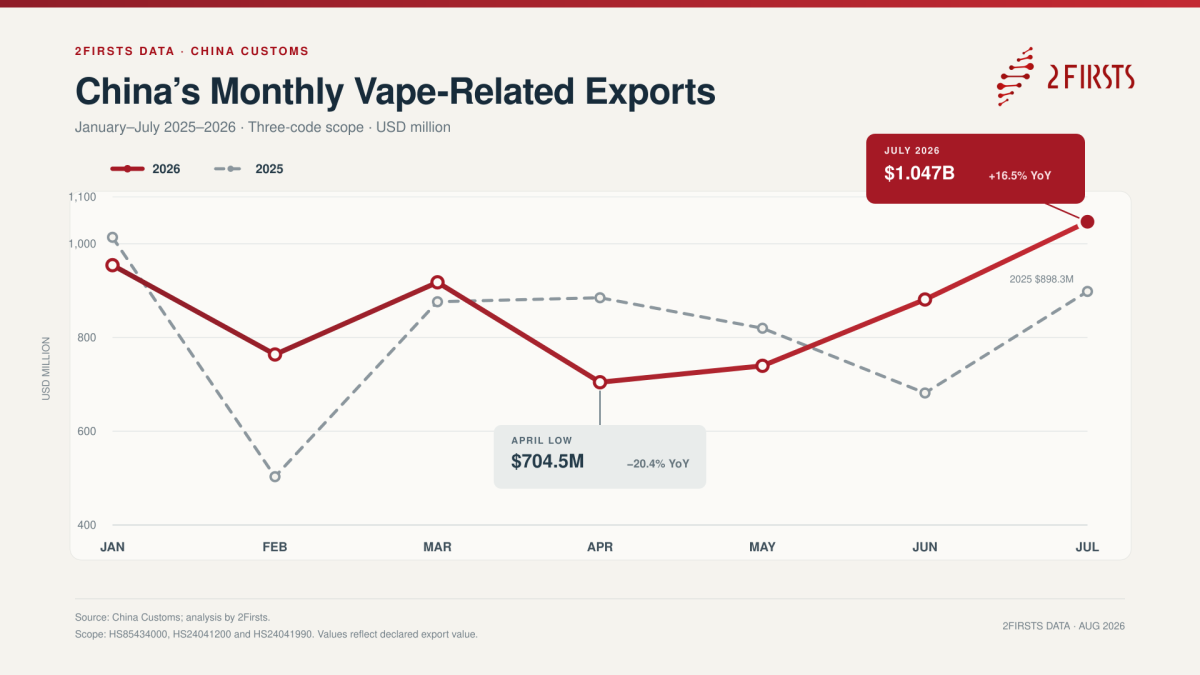
2Firsts Data | China’s Vape-Related Exports Rise 16.5% in July 2026 as U.S.-Bound Shipments Jump 53.5%
China’s vape-related exports reached $1.047 billion in July 2026, up 16.5% year on year and the highest monthly total of the year. Growth was heavily concentrated in the U.S., where exports jumped 53.5% to $404 million and accounted for 94.9% of the overall increase. Exports to all other markets rose just 1.2%. By category, nicotine-containing non-combustible products—primarily vapes—under HS24041200 rose 24.7% and generated 95.5% of the total increase. Vape-device exports under HS85434000 fell 0.4%, while other nicotine-substitute products under HS24041990 grew 88.9% but remained comparatively small.
DATA
Aug.24
Russian Strikes Destroy JTI and Imperial Brands Ukraine Warehouses, With Losses Reaching Tens of Millions of Hryvnias
According to Ukrainska Pravda, Russian strikes on the Kyiv region during the night of Aug. 4-5, 2026, damaged warehouses storing products of Japan Tobacco International (JTI) and Imperial Brands Ukraine. JTI said a finished goods warehouse in Kyiv Oblast was destroyed, with no employees injured, and that it did not expect disruptions to retail supplies. Imperial Brands Ukraine said products stored at warehouses of distributors and retail partners were affected and estimated losses from the strikes at “tens of millions of Ukrainian hryvnias” (roughly hundreds of thousands of U.S. dollars).
JTI
Aug.07
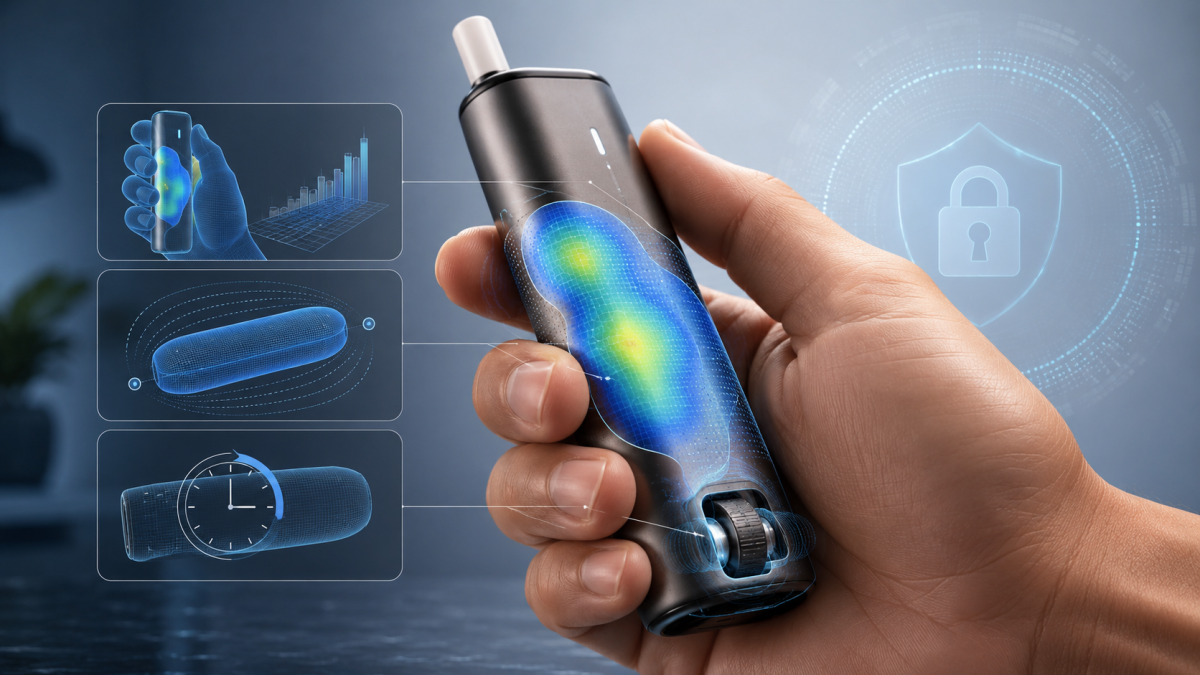
Hunan China Tobacco Industry files heated tobacco device patent featuring adult-user identification through pressure sensing
China-based Hunan China Tobacco Industry Co., Ltd. and Shenzhen Baisha Technology Co., Ltd. have filed a patent application covering an adult-user identification mechanism for heated tobacco devices. The patent proposes using flexible pressure sensors installed in the device grip area to collect pressure distribution patterns generated when users hold the device. The system evaluates factors including effective contact area, grip shape and contact duration, and combines roller movement detection to determine whether unlocking conditions are met. The filing reflects exploration of device-level user recognition and smarter interaction technologies for heated tobacco products (HTPs).
Aug.05
Ireland’s Vape Tax Raises €22 Million in Nine Months as Government Considers 2027 Budget Changes
According to Irish media outlets Highland Radio and BreakingNews.ie, the Irish government is considering whether to adjust vape tax policy in the 2027 Budget. The tax has generated about €22 million ($24 million) in revenue during its first nine months. While no increase has been confirmed, the revenue performance could influence future fiscal discussions. Any tax rise could increase product costs and potentially affect retail prices.
Aug.12
Smoore Seeks to Toss CCELL Price-Fixing Claim as Court Weighs Vertical Distribution Versus Horizontal Conspiracy
Smoore and four authorized U.S. CCELL distributors are asking a California federal court to permanently dismiss a core antitrust claim brought by direct purchasers. Plaintiffs allege that Smoore coordinated minimum wholesale prices, customer allocation and limits on price competition among distributors, amounting to a per se unlawful horizontal conspiracy. The defendants say the alleged conduct reflects ordinary vertical relationships between a manufacturer and its distributors. The court previously dismissed a similar claim, and the latest dispute centers on whether the second amended complaint adds sufficient facts to establish a horizontal agreement.
Sep.14