Key points
- Brazil’s Federal Public Prosecutor’s Office (MPF) filed a public civil action seeking to compel the federal government and Anvisa to create an enforceable control-and-oversight model for electronic smoking devices (DEFs).
- The lawsuit argues the current total prohibition has failed to stop use and has pushed the market underground, boosting smuggling and illegal sales.
- Requested measures include mandatory product registration, maximum nicotine limits, strict youth-protection marketing bans, and clear health warnings on packaging.
- MPF asks for a detailed national consumption report and a timetable to implement new rules within 90 days.
- MPF also seeks R$1 billion in collective moral damages for regulatory omission.
According to information released by Brazil’s Federal Public Prosecutor’s Office (MPF), prosecutors have filed a public civil action seeking to force the federal government and the National Health Surveillance Agency (Anvisa) to establish a robust regulatory and enforcement framework for electronic smoking devices (DEFs), commonly referred to as e-cigarettes or vaporizers.
The goal is to replace Brazil’s current total ban with stringent, cigarette-like rules that allow authorities to supervise manufacturing, sales, and marketing.
The action was brought by federal prosecutors Cléber Eustáquio Neves and Onésio Soares Amaral, who argue that the absence of a workable regulatory regime prevents sanitary control, facilitates youth access to devices containing unknown substances, and adds pressure to public healthcare spending.
MPF is asking the court to require rules that include mandatory product registration, maximum nicotine limits, a total prohibition of marketing aimed at children and adolescents, and clear health warnings on packaging. Prosecutors also want the federal government and Anvisa to submit—within 90 days—a detailed report on consumption in Brazil and a timeline for implementing the new regulatory model.
The lawsuit contends that despite the formal prohibition, vaping products remain widely available in Brazil’s clandestine market across multiple formats, flavors, and device types, sold openly through social networks, messaging apps, and leisure venues. MPF says enforcement struggles to keep pace with the market’s speed, leaving the state unable to protect vulnerable groups such as adolescents.
On health risks, MPF points to technical analyses indicating that illicit devices may contain high nicotine concentrations, heavy metals (including lead, nickel, and chromium), and chemical solvents or additives without safety assessment. Prosecutors also argue that a “ban on paper” can create a false sense of security, noting that many users may be unaware nicotine is present in the products they use.
The filing links vaping to serious pulmonary conditions—such as bronchitis, COPD, “popcorn lung,” and vaping-associated lung injury (EVALI)—as well as cardiovascular harms and early nicotine dependence.
MPF further argues that the illegal market profits from sales while Brazil’s public health system (SUS) pays for treatment. With regulation, the state could levy specific taxes to support healthcare costs, require corporate accountability for harms, and improve monitoring of public expenditures tied to vaping-related illness.
Finally, MPF requests that the federal government and Anvisa be ordered to pay R$1 billion in collective moral damages, alleging regulatory omission has left the public unprotected and violated the constitutional right to health and sanitary safety.
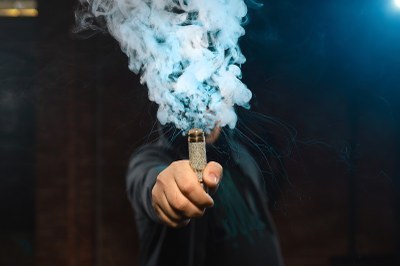
Image source: Freepik
We welcome news tips, article submissions, interview requests, or comments on this piece.
Please contact us at info@2firsts.com, or reach out to Alan Zhao, CEO of 2Firsts, on LinkedIn
Notice
1. This article is intended solely for professional research purposes related to industry, technology, and policy. Any references to brands or products are made purely for objective description and do not constitute any form of endorsement, recommendation, or promotion by 2Firsts.
2. The use of nicotine-containing products — including, but not limited to, cigarettes, e-cigarettes, nicotine pouchand heated tobacco products — carries significant health risks. Users are responsible for complying with all applicable laws and regulations in their respective jurisdictions.
3. This article is not intended to serve as the basis for any investment decisions or financial advice. 2Firsts assumes no direct or indirect liability for any inaccuracies or errors in the content.
4. Access to this article is strictly prohibited for individuals below the legal age in their jurisdiction.
Copyright
This article is either an original work created by 2Firsts or a reproduction from third-party sources with proper attribution. All copyrights and usage rights belong to 2Firsts or the original content provider. Unauthorized reproduction, distribution, or any other form of unauthorized use by any individual or organization is strictly prohibited. Violators will be held legally accountable.
For copyright-related inquiries, please contact: info@2firsts.com
AI Assistance Disclaimer
This article may have been enhanced using AI tools to improve translation and editorial efficiency. However, due to technical limitations, inaccuracies may occur. Readers are encouraged to refer to the cited sources for the most accurate information.
We welcome any corrections or feedback. Please contact us at: info@2firsts.com