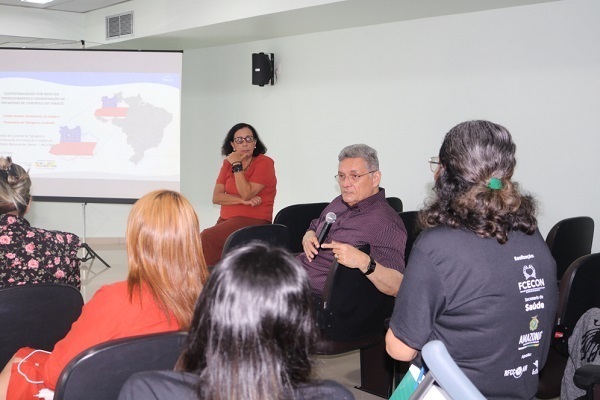
According to Brazilian media reports on May 15th, representatives from the local government of Amazonas and coordinators of national and state-level tobacco control programs met at the Amazonas State Cancer Control Foundation (FCecon) to discuss how to further advance the project. The meeting was attended by Gerson Mourão, director of the Amazonas State Cancer Control Foundation, and representatives from the Amazonas State Health Department (SES-AM).
The National Tobacco Control Program (PNCT) is a joint initiative of the Brazilian Ministry of Health and the Brazilian National Cancer Institute (Inca) with a 20-year history. The aim of the program is to reduce smoking rates and smoking- related death rates. In the Amazon region, these activities are primarily carried out by the Amazonas State Cancer Control Center Foundation (FCecon).
Aristóteles Alencar, the state coordinator of the Amazonas Tobacco Control Program, stated that Amazonas ranked third in the country for the number of tobacco consumers who quit smoking, achieving remarkable results. He mentioned that the visit from the team of the Brazilian National Cancer Institute (Inca) was to understand the effective actions that have led to Amazonas reaching high quit smoking rates.
He pointed out, "Despite the vast expanse of the region and the many logistical challenges, the Brazilian National Cancer Institute (Inca) chose the Amazonas state as its research subject because we have achieved the lowest smoking rates nationwide. Our model can be replicated in other places. The key factors to success include the Amazonas State Cancer Control Center Foundation disseminating information to the public, as well as collaborating with the city and state education departments (Seduc and Semed) to host events promoting anti-smoking campaigns with children, and so on.
Alanaca added that, currently, the project is in its second phase. The project aims to expand anti-smoking activities to other areas and places a strong emphasis on understanding the unique environmental factors of each location in order to improve the health of the local population. The purpose of this meeting is to gather the strength of various organizations and individuals to enhance the effectiveness and sustainability of the anti-smoking project. The meeting also aims to raise awareness among regional representatives of the significant economic costs of the diseases and loss of life caused by smoking.
This type of epidemic has caused losses of up to 125 billion reais to our country, and we can only recover 10% of that amount from taxes. The amount itself is already unacceptable," expressed Alencar.
In addition, consultants Lucas Cabral and Érica Cavalcante from the Brazilian National Cancer Institute emphasized the efforts of institutions such as the Brazilian Ministry of Health (MS) in safeguarding public health and combating tobacco consumption.
Lucas Cabral stated: "We need to learn and understand from ourselves as the foundation for improving and integrating public policies, which are implemented by the Brazilian Ministry of Health and the Brazilian National Cancer Institute.
The project aims to ensure the strength of domestic tobacco control actions while also taking sustainability into consideration.
Due to limited health budget, we first chose five states, one in each region. Now, through discussions with state coordinating bodies, we hope to understand their weaknesses and strengths, and together advance anti-smoking campaigns," explained Kaval Kant.
Next, a team from the Brazilian National Cancer Institute and local partners will hold a meeting with professionals responsible for assisting smokers in quitting. They will discuss topics such as tobacco prevention, creating smoke-free environments, and treatment for e-cigarette use.
We welcome news tips, article submissions, interview requests, or comments on this piece.
Please contact us at info@2firsts.com, or reach out to Alan Zhao, CEO of 2Firsts, on LinkedIn
Notice
1. This article is intended solely for professional research purposes related to industry, technology, and policy. Any references to brands or products are made purely for objective description and do not constitute any form of endorsement, recommendation, or promotion by 2Firsts.
2. The use of nicotine-containing products — including, but not limited to, cigarettes, e-cigarettes, nicotine pouchand heated tobacco products — carries significant health risks. Users are responsible for complying with all applicable laws and regulations in their respective jurisdictions.
3. This article is not intended to serve as the basis for any investment decisions or financial advice. 2Firsts assumes no direct or indirect liability for any inaccuracies or errors in the content.
4. Access to this article is strictly prohibited for individuals below the legal age in their jurisdiction.
Copyright
This article is either an original work created by 2Firsts or a reproduction from third-party sources with proper attribution. All copyrights and usage rights belong to 2Firsts or the original content provider. Unauthorized reproduction, distribution, or any other form of unauthorized use by any individual or organization is strictly prohibited. Violators will be held legally accountable.
For copyright-related inquiries, please contact: info@2firsts.com
AI Assistance Disclaimer
This article may have been enhanced using AI tools to improve translation and editorial efficiency. However, due to technical limitations, inaccuracies may occur. Readers are encouraged to refer to the cited sources for the most accurate information.
We welcome any corrections or feedback. Please contact us at: info@2firsts.com