Canadian Smoke Control Organizations Urge Quick Removal of Flavored E-Cigarettes

Dec.10.2024
Canadian Smoke Control Organizations Urge Quick Removal of Flavored E-Cigarettes
Canadian anti-smoking groups urge Minister Ya'ara Saks to swiftly remove flavored e-cigarette products to protect youth from addiction.

According to News Wire on December 9th, three anti-smoking organizations in Canada are once again urging Minister of Mental Health and Addiction Issues Ya'ara Saks to fulfill her promise and quickly remove flavored e-cigarette products from shelves.


Flory Doucas, Co-Director and Spokesperson of the Quebec Coalition for Tobacco Control, stated that...


Flavoring is the main driver of e-cigarette use among teenagers. Removing these enticing flavored products as early as possible can protect more young people from the harmful effects of addiction. Delayed protection is equivalent to lost protection.


Cynthia Callard of the Canadian Smokers' Rights Association pointed out that


These new studies further demonstrate that teenagers are at risk, and e-cigarette products are both dangerous and highly addictive. However, Minister Sachs appears to be delaying the implementation of flavor restrictions rather than speeding up protective measures.


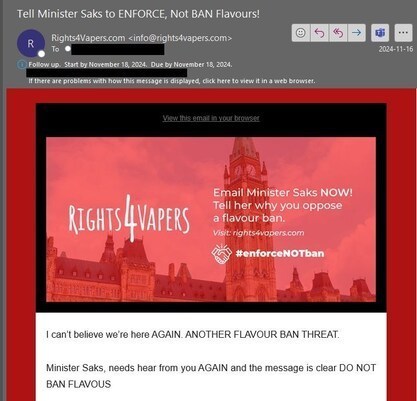
According to reports, the federal government has indicated that restrictions on e-cigarettes will be introduced in the "near future," possibly in November. This news has prompted lobbying groups in support of e-cigarettes to launch a new round of activities to obstruct regulation, such as writing letters to all ministers, generating thousands of form letters from their customer base, and planning press conferences. This week, their spokesperson revealed on Twitter that the office of Minister Saks has invited them to provide alternative proposals for flavor restrictions.


Carad added that


Despite e-cigarette companies and their funded groups having the right to express their interests, we urge Minister Sachs to resist these lobbying tactics and prioritize the health of the younger generation and all consumers by swiftly advancing e-cigarette flavor restrictions.


In September of last year, the Canadian e-cigarette industry teamed up with one of Canada's largest online retailers, 180Smoke.ca, to meet with Health Canada and express concerns about declining sales and the black market issues.


Dukas stated,


180smoke.ca is one of several retailers that shipped illegal e-cigarette products to Quebec between April and October of this year, violating the province's flavoring ban and tax system. Not only is it a member of the Canadian Vaping Association, but its actions are reflective of industry interests, making it difficult to imagine the seriousness with which Minister Sachs' office or the Canadian Department of Health would address any statements made by the industry or any impact produced by their front groups or entities.


Les Hagen, Executive Director of ASH Canada, compared Canada's delay with progress in other countries.


More and more jurisdictions, including China, the Netherlands, Finland, and Hungary, have banned flavored e-cigarette products other than "tobacco." There are indications that the European Union will implement a ban across the board. However, despite Canada having one of the highest rates of youth e-cigarette use, the Canadian Department of Health has been dragging its feet and failing to provide a way for provinces to defend their provincial restrictions and prevent retailers from transporting flavored products across provinces.


We welcome news tips, article submissions, interview requests, or comments on this piece.

Please contact us at info@2firsts.com, or reach out to Alan Zhao, CEO of 2Firsts, on LinkedIn


Notice

1.  This article is intended solely for professional research purposes related to industry, technology, and policy. Any references to brands or products are made purely for objective description and do not constitute any form of endorsement, recommendation, or promotion by 2Firsts.

2.  The use of nicotine-containing products — including, but not limited to, cigarettes, e-cigarettes, nicotine pouchand heated tobacco products — carries significant health risks. Users are responsible for complying with all applicable laws and regulations in their respective jurisdictions.

3.  This article is not intended to serve as the basis for any investment decisions or financial advice. 2Firsts assumes no direct or indirect liability for any inaccuracies or errors in the content.

4.  Access to this article is strictly prohibited for individuals below the legal age in their jurisdiction.


Copyright


This article is either an original work created by 2Firsts or a reproduction from third-party sources with proper attribution. All copyrights and usage rights belong to 2Firsts or the original content provider. Unauthorized reproduction, distribution, or any other form of unauthorized use by any individual or organization is strictly prohibited. Violators will be held legally accountable.

For copyright-related inquiries, please contact: info@2firsts.com


AI Assistance Disclaimer


This article may have been enhanced using AI tools to improve translation and editorial efficiency. However, due to technical limitations, inaccuracies may occur. Readers are encouraged to refer to the cited sources for the most accurate information.

We welcome any corrections or feedback. Please contact us at: info@2firsts.com

Product | Philip Morris Korea Launches TEREA Limona Pearl, Expanding Fresh Blend Capsule Lineup to Five
Philip Morris Korea launched TEREA Limona Pearl in South Korea on August 31, 2026, expanding the TEREA Fresh Blend capsule tobacco stick lineup from four variants to five. Designed for the IQOS ILUMA series, the new stick combines a capsule with what the company calls a Fresh Filter. Philip Morris Korea describes the product as offering an aromatic, refreshing flavor profile with a cooling sensation, with an additional fresh note released when the capsule is crushed. The recommended retail price is KRW 4,800 per pack, with sales through IQOS stores and convenience stores nationwide. No reliable evidence has been found that the same Limona Pearl SKU was previously officially launched in another major IQOS market.
Sep.01
F1 Faces Renewed Pressure Over Tobacco and Nicotine Sponsorships as 67 Groups Target ZYN and VELO Ahead of Madrid Race
Ahead of the Formula 1 race in Madrid, 67 Spanish and international public-health, medical and consumer organizations have sent an open letter to F1 President and CEO Stefano Domenicali calling for an end to sponsorships linked to the tobacco and nicotine industry, including nicotine pouches, vaping products and heated tobacco. The letter focuses on Philip Morris International’s ZYN partnership with Ferrari and British American Tobacco’s long-running partnership with McLaren and exposure for VELO. The campaign follows a March letter in which more than 160 organizations worldwide made a similar request to Formula 1.
Sep.10
EU ‘TPD3’ Enters Next Phase on Aug. 14 as Fragmented Vape and Nicotine Pouch Rules Push the Single Market Toward Regulatory Overhaul
A 12-week European Commission consultation on revising the Tobacco Products Directive and Tobacco Advertising Directive is due to close on Aug. 14, 2026. The Commission has identified e-cigarette flavours, disposable vapes, tobacco heating devices, nicotine pouches, nicotine-free e-cigarettes, packaging and digital marketing among areas for possible new EU rules. National regulations already vary significantly across the bloc, a fragmentation the Commission says creates internal-market barriers and distorts competition. No formal revised TPD/TAD legislative text has yet been published, with the Commission currently indicating December 2026 for the legislative initiative.
Aug.14
Kelly White Bets on Female Consumers as Nicotine Pouch Competition Intensifies | 2Firsts Interview
Swedish nicotine pouch brand Kelly White is building its strategy around adult female consumers. Founder and CEO Sophia Wilsby told 2Firsts that women accounted for around 70% of the brand’s repeat customers on HAYPP in Sweden in 2025. The interview explores female consumer segmentation, product and design differentiation, gender stereotypes, packaging regulation, and how independent brands can compete with global players such as ZYN and VELO while considering funding, partnerships and future ownership options.
Business
Sep.24
Juul Sublicense Reshapes Vuse Alto Patent Bill as Court Ends R.J. Reynolds’ 5.25% Royalty Obligation to Altria
According to Law360 on August 31, 2026, a federal judge in North Carolina ruled that a patent sublicense between R.J. Reynolds Vapor Co. and Juul Labs Inc. relieves Reynolds of its obligation to continue paying royalties to Altria Client Services LLC over Vuse Alto. A jury had previously found that Vuse Alto infringed three Altria patents and awarded approximately $95.2 million in past damages, after which Reynolds was ordered to pay an ongoing royalty equal to 5.25% of positive net sales. The new ruling finds that a valid sublicense can eliminate future infringement, potentially ending what Altria described as hundreds of millions of dollars in future royalties.
Sep.01
As JUUL2 Wins FDA Authorization, Harm Reduction Journal Highlights the Role of Real-World Evidence in Nicotine Product Regulation
A commentary published in the international open-access, peer-reviewed Harm Reduction Journal argues that randomized controlled trials remain central to evaluating smoking cessation efficacy but cannot alone capture real-world uptake, complete switching, longer-term use and population impact of non-combustible nicotine products such as e-cigarettes, heated tobacco and nicotine pouches. The authors frame impact as “reach × efficacy” and call for real-world evidence to complement RCTs. Three days after publication, the FDA authorized three JUUL2 products and highlighted complete switching among adult smokers in explaining its decision, providing a timely regulatory backdrop to the debate.
Sep.08