COVID-19 Spurs Decrease in Tobacco Consumption among Danish Smokers

Sep.01.2022
COVID-19 Spurs Decrease in Tobacco Consumption among Danish Smokers
A new study from Copenhagen University found Danish smokers purchased less tobacco and smoking cessation rates increased during the COVID-19 pandemic.

Photo by Sezerozger.


A new study from the University of Copenhagen has found that, from the lockdown in March 2020 until the end of this year, Danish smokers purchased less tobacco and more people quit smoking during the COVID-19 pandemic than usual. The research shows that even heavy smokers bought significantly less tobacco.


Apart from other factors, these data show that people who smoke regularly are buying 20% less cigarettes per week compared to before the pandemic. Meanwhile, the number of people quitting smoking increased by 10% compared to the previous year.


According to the research author and associate professor of the Department of Food and Resource Economics at the University of Copenhagen, Torben Reinhard Foosgaard, "Overall, cigarette consumption has decreased during the COVID-19 pandemic." He went on to say, "This is somewhat surprising, as people would expect to see an increase in smoking during a pandemic when people's psychological state is worse and opportunities for action are fewer. However, the opposite has occurred.


Fosgaard attributes the decrease in tobacco consumption to the higher risk of severe COVID-19 symptoms for smokers. "For smokers, the consequences of smoking have become more immediate rather than something that only manifests in old age, as they are more susceptible to severe cases of COVID-19," he said.


Statement:


This article is compiled from third-party information and is intended solely for industry exchange and learning purposes.


This article does not represent the viewpoint of 2FIRSTS and 2FIRSTS cannot confirm the authenticity and accuracy of the content. The translation of this article is only for industry communication and research.


Due to limitations in our compiling ability, the translated article may not accurately reflect the original text. Please refer to the original article for accuracy.


2FIRSTS maintains complete alignment with the Chinese government regarding any domestic, Hong Kong, Macau, Taiwan, and international issues and stances.


The copyright of compiled information belongs to the original media and author. If there is any infringement, please contact us for deletion.


Disclaimer

This article is provided solely for professional research, industry discussion, and informational purposes. Any references to brands, companies, products, technologies, or policies are made for factual reporting and analytical purposes only, and do not constitute endorsement, recommendation, promotion, or advertising by 2Firsts.

Nicotine-containing products, including but not limited to cigarettes, e-cigarettes, heated tobacco products, and nicotine pouches, carry significant health risks. Readers are responsible for complying with all applicable laws and regulations in their respective jurisdictions, including age restrictions and access limitations.

The information contained in this article should not be regarded as investment, legal, medical, regulatory, or commercial advice. While 2Firsts strives to ensure the accuracy and reliability of its content, it does not assume liability for any direct or indirect loss arising from errors, omissions, inaccuracies, or reliance on the information contained herein.

This article is not intended for individuals below the legal age for accessing tobacco or nicotine-related information in their jurisdiction.


Copyright Notice

This article is either original content produced by 2Firsts or content reproduced, translated, summarized, or adapted from third-party sources with attribution where applicable. The intellectual property rights of the original content remain with 2Firsts or the respective original rights holders.

No individual or organization may copy, reproduce, distribute, republish, modify, translate, or otherwise use this content without prior authorization. Any unauthorized use may result in legal action.

For copyright-related inquiries, corrections, or removal requests, please contact: info@2firsts.com.


AI-Assisted Translation and Editing Notice

Portions of this article may have been translated, edited, or reviewed with the assistance of artificial intelligence tools to improve efficiency and readability. Due to the limitations of AI-assisted translation and editing, discrepancies, omissions, or inaccuracies may exist when compared with the original source.

Where applicable, readers are advised to refer to the original source for the most complete and accurate information. If you identify any errors or believe that any content infringes upon your rights, please contact us at info@2firsts.com, and we will review and address the matter promptly.


Germany Probes 7.6 Million Illegal Vape Case With Estimated €33.3 Million Tax Loss; Four Chinese Manufacturer Employees Under Investigation, Some Packaging in Enforcement Images Resembles FUMOT Products
German prosecutors and customs authorities are conducting a criminal investigation into an alleged cross-border organised vape network. Authorities say that between January 2024 and March 2025, four employees of an unnamed Chinese e-cigarette manufacturer allegedly built a network of sales agents and wholesalers that brought more than 7.6 million nicotine disposable vapes into Germany, causing an estimated €33.3 million in excise-tax losses. The manufacturer has not been named. Some products visible in enforcement images have packaging resembling products from FUMOT’s portfolio. European regulatory records from 2024, FUMOT’s public overseas-sales materials and records involving German vape importer and distribution company Zamu-Pro GmbH also show FUMOT/RandM products and German distribution activity during the period covered by the investigation.
Sep.21
After Apple Business Decline, South Korea’s ITM Semiconductor Expands KT&G Vape Supply Chain as Vape Revenue Rises 24.8%
South Korean electronics component supplier ITM Semiconductor is reshaping its business portfolio after a decline in Apple-related protection circuit business, expanding its supply of vape devices and cartridges to KT&G. According to News1 on August 18, 2026, ITM’s vape-related revenue rose 24.8% year on year to 75.5 billion won in the first half of 2026. The company began mass production of vape devices at its Cikarang, Indonesia facility in January 2026, strengthening export manufacturing capacity. Meanwhile, Samsung-related protection circuit sales continued to grow, providing support during the transition.
Aug.20
China’s Jinhua Tobacco Launches CNY 2.7 Million Procurement for E-Cigarette Violation Lead Monitoring Services
Jinhua Tobacco, a municipal tobacco company in China’s Zhejiang province, has launched a public tender for e-cigarette-related violation lead monitoring and consulting services. The project is valued at CNY 2.7 million and covers data resource integration and analytical consulting services for 36 months from contract signing. The procurement reflects the use of external data and analysis services to support local tobacco companies’ market oversight activities related to e-cigarettes.
Aug.07
Reynolds Seeks to Join Altria Lawsuit Challenging FDA PMTA Rule and Calculation of 180-Day Deadline
Three R.J. Reynolds companies are seeking to intervene in a lawsuit filed by Altria subsidiaries Helix Innovations and NJOY challenging the FDA's 2021 PMTA final rule. The companies dispute how the agency uses Acceptance and Filing reviews and completeness determinations to establish when the Tobacco Control Act's 180-day decision period begins. Reynolds has also linked prolonged PMTA reviews to competition from unauthorized vaping products. The FDA, meanwhile, has been accelerating reviews and reducing its backlog.
Sep.14
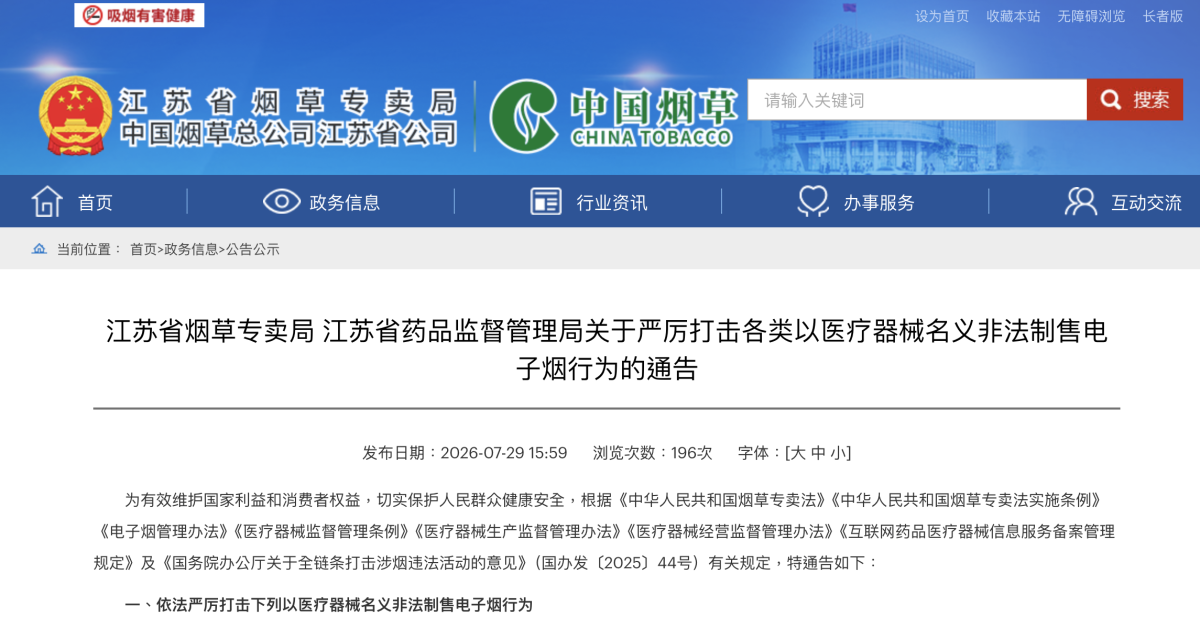
China’s Jiangsu Tobacco Monopoly Bureau and Drug Regulator Target Illegal Vape Sales Disguised as Medical Devices, Define Six Violations
China’s Jiangsu Tobacco Monopoly Bureau and Jiangsu Provincial Medical Products Administration have issued a joint notice targeting illegal production and sales of vape products disguised as medical devices. The notice identifies six categories of violations, including obtaining medical licenses through false materials, misusing medical device credentials, expanding production beyond approved scopes, and using medical device-related online platforms to promote or sell vape products. The action is based on China’s tobacco and medical device regulations and aims to strengthen vape oversight and consumer protection.
Aug.04
South Korea Extends Vape Rules to Unmanned Stores After Bringing Synthetic Nicotine Under Tobacco Law
South Korea's Ministry of Gender Equality and Family said on September 14 that it plans to designate unmanned e-cigarette stores as businesses where minors are prohibited from entering or working. Operators would be required to verify customers' ages and display notices restricting access by minors. The proposal is open for public comment through October 6. The move follows an April expansion of South Korea's statutory tobacco definition that brought products made with natural or synthetic nicotine under the Tobacco Business Act. Nicotine-free liquids and products using nicotine analogues such as 6-methylnicotine, however, remain an emerging regulatory issue.
Sep.21