Key Points
- DOJ’s Trade Fraud Task Force has been linked to more than $1 billion in cases within less than one year.
- U.S. trade enforcement is expanding from shipment-level reviews to supply-chain accountability.
- DOJ created the Global Trade & Commerce Enforcement Section to strengthen trade crime investigations.
- Vape products are part of broader cross-border supply-chain risk discussions.
- Brands, importers, OEM suppliers and distributors may face greater compliance requirements.
2Firsts
July 23, 2026
The U.S. Department of Justice (DOJ) is expanding its enforcement capabilities against cross-border trade fraud. The DOJ’s Trade Fraud Task Force (TFTF) has been linked to more than $1 billion in recoveries, penalties, forfeitures and publicly charged losses in less than one year.
According to the DOJ, Fox News and other reports, the task force works with the Department of Homeland Security (DHS) and U.S. Customs and Border Protection (CBP) to investigate trade violations including country-of-origin fraud, illegal transshipment, false declarations and tariff evasion.
The $1 billion figure includes civil recoveries, criminal recoveries, penalties, forfeitures and publicly charged losses, rather than cash recovered alone.
For the vape industry, which relies heavily on global manufacturing and cross-border imports, the enforcement expansion signals a shift from product compliance toward supply-chain accountability.
U.S. Trade Enforcement Moves Beyond Customs Violations
Historically, U.S. import enforcement focused largely on customs compliance, including shipment declarations, tariff payments and documentation requirements.
Companies could face penalties for issues such as incorrect classification, incomplete records or inaccurate declarations.
However, the TFTF reflects a broader shift in enforcement strategy.
U.S. authorities are increasingly treating certain trade violations as potential fraud matters, using civil enforcement and criminal investigations to address intentional efforts to evade trade rules.
The shift means risks may extend beyond whether a shipment is detained at the border and into broader questions around business conduct and supply-chain responsibility.
DOJ Builds Long-Term Trade Crime Enforcement Capability
A key development is DOJ’s expansion of dedicated trade crime enforcement resources.
The department created the Global Trade & Commerce Enforcement Section (GTCES) within the National Fraud Enforcement Division to handle cases involving international trade fraud, customs fraud and import-related crimes.
DOJ and DHS also released the A Resource Guide to Trade Fraud Enforcement, outlining common trade fraud patterns including false origin claims, misclassification, undervaluation and illegal transshipment.
The move reflects a broader shift from traditional customs oversight toward judicial enforcement.
“The Port Is Only the Beginning”: Enforcement Expands Across Supply Chains
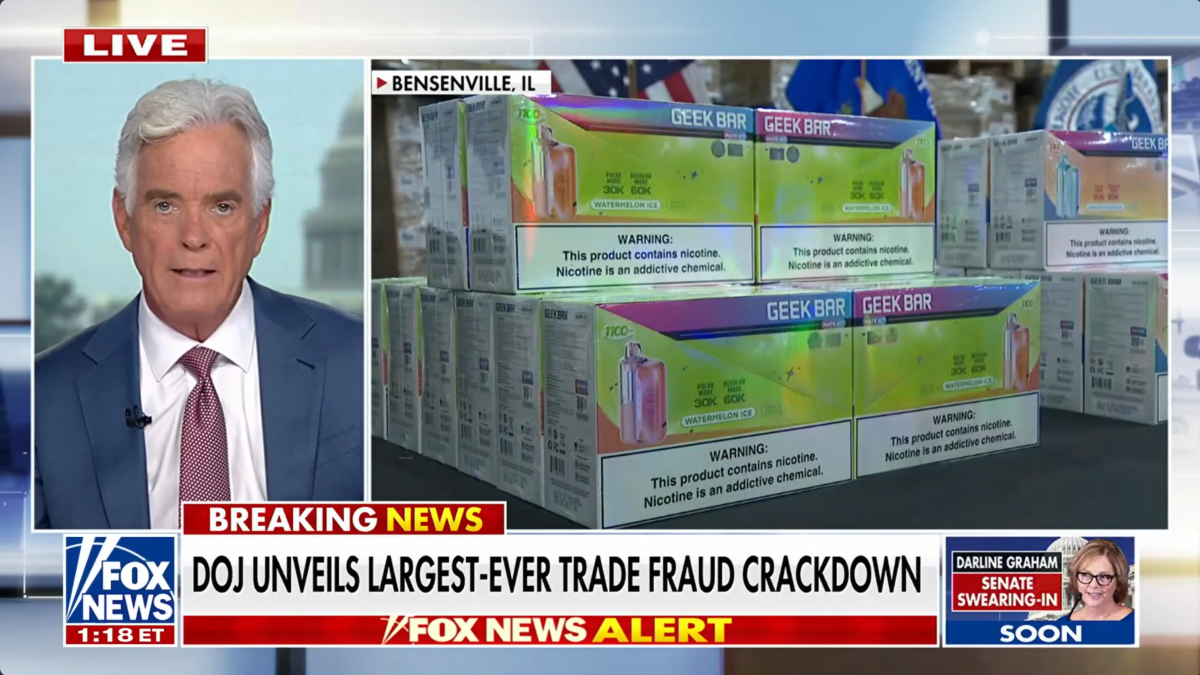
The DOJ announcement was held at CBP’s Centralized Examination Station in Bensenville, Illinois.
The location highlighted closer coordination between border inspections and federal investigations.
U.S. authorities have emphasized that the import stage is not necessarily the end of an investigation. Future enforcement may extend to importers, customs brokers, distributors and other supply-chain participants.
For the vape industry, the shift is particularly relevant.
Many cross-border vape businesses operate under a “U.S. brand plus overseas manufacturing” model. As trade enforcement expands, authorities may increasingly examine manufacturing sources, import documentation and the responsibilities of supply-chain participants.
Trade Fraud Risks Include Origin, Transshipment and Declaration Issues
DOJ has identified several major trade fraud areas.
Country-of-Origin Fraud
Companies may misrepresent product origins to avoid tariffs, anti-dumping duties or other trade measures.
For cross-border vape supply chains, origin claims are particularly relevant.
A supply chain involving:Overseas manufacturing——Third-country transit——U.S. import
may face scrutiny over whether “substantial transformation” occurred.
Illegal Transshipment
U.S. authorities have increasingly examined whether companies use third countries simply to change declared origins.
Warehousing, repackaging or limited processing may not be sufficient to alter origin determination.
False Declarations
Potential issues include:
- incorrect HS codes;
- inaccurate product descriptions;
- incomplete manufacturer information;
- false valuation.
For complex products such as vapes, accurate classification and consistent documentation are becoming increasingly important.
Why Vape Companies Should Pay Attention
Vape products are not the primary source of TFTF’s more than $1 billion figure, but the industry shares characteristics with the broader trade risks targeted by U.S. authorities.
Global vape supply chains often involve overseas manufacturers, OEM/ODM suppliers, U.S. brands, importers and distributors. The complexity of these structures means companies must address both product regulation and trade compliance.
Areas likely to receive greater attention include origin claims, manufacturer information, import documentation and product classification.
For example, if products move through third countries before entering the U.S., authorities may examine whether meaningful “substantial transformation” occurred rather than simple repackaging or logistical movement.

U.S. Vape Oversight Expands Across FDA, CBP and DOJ
U.S. vape regulation has historically focused heavily on FDA oversight, including product authorization, tobacco regulations and youth-related concerns.
As trade enforcement expands, vape companies face a broader regulatory framework:
Agency | Focus |
FDA | Product authorization and tobacco compliance |
CBP | Import declarations, origin and tariff compliance |
DOJ | Fraud investigations and legal accountability |
Entering the U.S. market therefore requires not only tobacco compliance but also reliable import procedures and transparent supply chains.
Responsibilities Across Brands, Importers and OEMs Are Changing
As U.S. trade fraud enforcement expands, responsibility across the cross-border vape supply chain may face greater scrutiny.
Authorities may examine:
who controls product design;
who selects manufacturers;
who provides import information;
who benefits from sales.
For brands, having a U.S. identity alone may not eliminate supply-chain responsibility. For importers and OEM suppliers, manufacturing records, origin documentation and accurate trade declarations may become increasingly important.
Cross-Border Vape Regulation Moves Toward Supply-Chain Accountability
From FDA product oversight to CBP import reviews and DOJ trade fraud investigations, the U.S. is developing a multi-layer regulatory framework covering products, imports and corporate responsibility.
Previously, the key question for vape companies was:
Can the product legally be sold?
Increasingly, regulators may ask:
How did the product enter the U.S. market, and is the supply chain transparent and compliant?
For cross-border vape businesses, future competitiveness will depend not only on products, pricing and distribution, but also on supply-chain management and compliance systems.
The U.S. is increasingly moving cross-border vape issues beyond traditional tobacco regulation and into trade fraud, import compliance and supply-chain accountability.
Follow 2Firsts for the latest updates on global tobacco and nicotine regulation, industry developments and market trends.
Cover Image source: Fox News