FDA Commissioner Urges DEA to Classify 7-OH Ingredient Used in E-Cigarettes as a Schedule I Controlled Substance

Jul.30.2025
FDA Commissioner Urges DEA to Classify 7-OH Ingredient Used in E-Cigarettes as a Schedule I Controlled Substance
FDA Commissioner Robert Califf urged the DEA to classify 7-OH, an opioid-like compound found in vapes, drinks, and gummies, as a Schedule I substance. The FDA plans national warnings for doctors and tighter control of high concentrations.

Key points:


·FDA recommends: FDA Commissioner Marty Makary announced that 7-hydroxymitragynine (7-OH) will be classified as a controlled substance due to its opioid-like properties. 


·Widespread availability: 7-OH can be found in e-cigarette stores, beverages, and children's gummies. 


·Regulatory measures: FDA recommends that 7-hydroxymitragynine above a certain concentration threshold be classified as a Schedule I controlled substance. 


·Public education: FDA has issued a report and warned healthcare providers, emphasizing the risks of abuse associated with 7-OH.


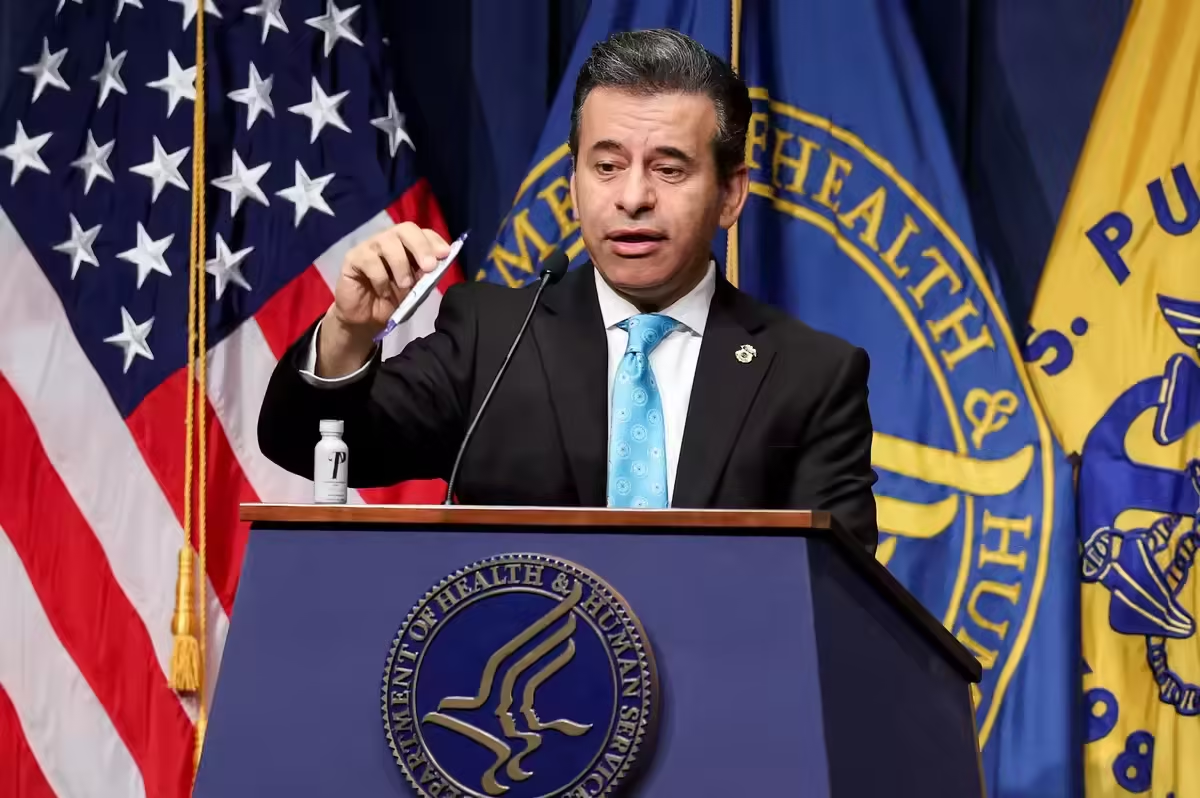
【2Firsts News Flash】On July 30th, according to Reuters, Marty Makary, director of the FDA, suggested that 7-hydroxymitragynine (7-OH) be classified as a controlled substance due to its opiate-like properties.


He stated at a press conference held at the Department of Health and Human Services in Washington D.C. that many products containing 7-OH are sold in e-cigarette stores, and this compound is also present in beverages and children's gummy candies.


The FDA's letter to the DEA will recommend classifying 7-OH above a certain concentration threshold as a Schedule I controlled substance.


The FDA stated that the abuse potential of 7-OH is increasingly being scrutinized due to its ability to bind to opioid receptors.


"It is sold in e-cigarette shops, tobacco shops, convenience stores, and gas stations across the United States," said Macari.


The FDA is in the process of releasing a report and sending warning letters to every doctor in America. Markari stated that the FDA will continue its efforts to educate the public.


We welcome news tips, article submissions, interview requests, or comments on this piece.

Please contact us at info@2firsts.com, or reach out to Alan Zhao, CEO of 2Firsts, on LinkedIn


Notice

1.  This article is intended solely for professional research purposes related to industry, technology, and policy. Any references to brands or products are made purely for objective description and do not constitute any form of endorsement, recommendation, or promotion by 2Firsts.

2.  The use of nicotine-containing products — including, but not limited to, cigarettes, e-cigarettes, nicotine pouchand heated tobacco products — carries significant health risks. Users are responsible for complying with all applicable laws and regulations in their respective jurisdictions.

3.  This article is not intended to serve as the basis for any investment decisions or financial advice. 2Firsts assumes no direct or indirect liability for any inaccuracies or errors in the content.

4.  Access to this article is strictly prohibited for individuals below the legal age in their jurisdiction.


Copyright


This article is either an original work created by 2Firsts or a reproduction from third-party sources with proper attribution. All copyrights and usage rights belong to 2Firsts or the original content provider. Unauthorized reproduction, distribution, or any other form of unauthorized use by any individual or organization is strictly prohibited. Violators will be held legally accountable.

For copyright-related inquiries, please contact: info@2firsts.com


AI Assistance Disclaimer


This article may have been enhanced using AI tools to improve translation and editorial efficiency. However, due to technical limitations, inaccuracies may occur. Readers are encouraged to refer to the cited sources for the most accurate information.

We welcome any corrections or feedback. Please contact us at: info@2firsts.com

South Korea’s New Vape Rules Raise Bar for E-Liquid Makers and China-Linked Supply Chains, Expert Says
South Korea’s new vape regulations are reshaping the e-liquid market, raising compliance requirements for manufacturers, retailers and overseas suppliers. In an interview with 2Firsts, Korean nicotine products specialist Sam Kim discusses licensing barriers, inventory impacts, China-linked supply chains, and emerging regulatory challenges around nicotine analogues, nicotine-free products and DIY mixing. The Korean case may offer broader insights as governments worldwide adapt to rapidly evolving nicotine products.
Jul.16
Product | Summo 150K Introduces Refillable Design With Up to 150,000 Puffs, Exploring a New High-Capacity Vape Format
Summo has introduced the Summo 150K Refillable Disposable Vape, entering the ultra-high-puff vape segment with a claimed capacity of up to 150,000 puffs. The device combines a 40ml dual e-liquid system, transparent tank design, dual mesh coils and a 900mAh rechargeable battery, using a refillable structure to differentiate itself from conventional disposable vapes. The product appeared on overseas online retail channels including Vapesourcing and VapeBarTime between late June and early July 2026.
Jul.22
Reuters: Shopify May Ban All Vape Sales This Week Amid Illegal Market Crackdown
Reuters reported that Shopify may ban all vape products from its platform as soon as this week, signaling that U.S. enforcement against the illegal vape market is expanding from retailers and importers to e-commerce platforms and payment networks.
MarketBAT
Jun.23 by 2Firsts Perspectives
How AI Is Rewriting the Talent Playbook for the Nicotine Industry: JTI’s Case
AI is moving from a back-office tool to a core organizational capability in the nicotine industry. Based on JTI’s responses, this 2Firsts feature examines how AI is reshaping talent strategy, internal mobility, decision-making and human accountability as global tobacco companies compete in the shift toward new nicotine categories.
Jun.17
U.S. Appeals Court Says BAT Must Face Class Action Over Cigarette Labels
A U.S. appeals court ruled that British American Tobacco (BAT) must continue facing a consumer class action lawsuit over cigarette labels. The ruling allows the case to proceed but does not determine that BAT violated the law or is liable for damages. The case highlights ongoing legal risks facing major tobacco companies related to product labeling, consumer disclosures and product liability claims.
Jul.31
South Korea Rejects 16 Trillion Won Tax-Evasion Claim Over Chinese Synthetic Nicotine
The South Korean government rejected allegations that Chinese synthetic-nicotine e-liquids were linked to about 16 trillion won in tobacco tax evasion, saying China does not ban synthetic nicotine exports and the estimate is difficult to verify, while acknowledging that pre-law synthetic-nicotine inventory is effectively difficult to tax.
Market
Jun.25