Improving Safety in E-cigarette Stores for Korean Youth

Mar.25.2025
Improving Safety in E-cigarette Stores for Korean Youth
Over half of e-cigarette shops in South Korea's Gyeonggi Province fail to display age restrictions, prompting calls for change.

Key points:

  • More than half of the e-cigarette stores in Gyeonggi Province, South Korea have not posted signs prohibiting individuals under the age of 19 from entering, and one unmanned store even lacks an adult verification device.
  • Although e-cigarettes have been recognized as harmful products for teenagers, e-cigarette shops are not classified as harmful places, and current laws do not require them to have a no-entry sign.
  • Officials in Gyeonggi Province have proposed designating e-cigarette shops as harmful places for youth. The Gyeonggi Special Judicial Police Department has pledged to promote institutional improvements in order to protect the health of young people.

According to a report by N.News on March 25, a survey found that over half of the e-cigarette stores in Gyeonggi Province, South Korea, did not display signs prohibiting individuals under the age of 19 from entering.


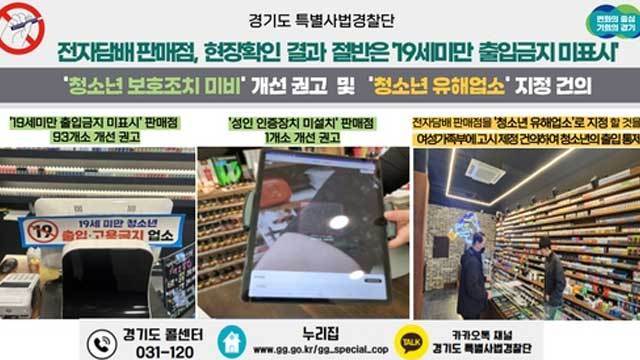
The Gyeonggi Provincial Special Judicial Police Department (JSP) conducted on-site inspections at 182 e-cigarette stores from February 12-23 and found that 93 stores (51%) did not have signs posted prohibiting individuals under the age of 19 from entering. One store, which had no staff present, was even operating normally without installing an adult verification device.


Despite being recognized as harmful products for teenagers by the Women and Family Department since 2011, e-cigarette shops are not classified as harmful places, therefore there are no restrictions on teenagers entering. In addition, current laws separate e-cigarettes from regular cigarettes, allowing these shops to not have to establish no entry signs.


Officials in Gyeonggi Province have proposed to the Ministry of Gender Equality and Family to designate e-cigarette stores as harmful places for young people. The head of the Gyeonggi Special Judicial Police Department (JSP) stated that this on-site inspection is aimed at proactively protecting the health of adolescents during their growth period and pledged to promote system improvements to prevent young people from entering e-cigarette stores.


We welcome news tips, article submissions, interview requests, or comments on this piece.

Please contact us at info@2firsts.com, or reach out to Alan Zhao, CEO of 2Firsts, on LinkedIn


Notice

1.  This article is intended solely for professional research purposes related to industry, technology, and policy. Any references to brands or products are made purely for objective description and do not constitute any form of endorsement, recommendation, or promotion by 2Firsts.

2.  The use of nicotine-containing products — including, but not limited to, cigarettes, e-cigarettes, nicotine pouchand heated tobacco products — carries significant health risks. Users are responsible for complying with all applicable laws and regulations in their respective jurisdictions.

3.  This article is not intended to serve as the basis for any investment decisions or financial advice. 2Firsts assumes no direct or indirect liability for any inaccuracies or errors in the content.

4.  Access to this article is strictly prohibited for individuals below the legal age in their jurisdiction.


Copyright


This article is either an original work created by 2Firsts or a reproduction from third-party sources with proper attribution. All copyrights and usage rights belong to 2Firsts or the original content provider. Unauthorized reproduction, distribution, or any other form of unauthorized use by any individual or organization is strictly prohibited. Violators will be held legally accountable.

For copyright-related inquiries, please contact: info@2firsts.com


AI Assistance Disclaimer


This article may have been enhanced using AI tools to improve translation and editorial efficiency. However, due to technical limitations, inaccuracies may occur. Readers are encouraged to refer to the cited sources for the most accurate information.

We welcome any corrections or feedback. Please contact us at: info@2firsts.com

Philip Morris Romania Executive on Smoke-Free Strategy: How IQOS Spaces Are Moving Beyond Retail to Consumer Connection
In an interview with Romanian marketing publication IQads, Marek Gębski, Director of Smoke-Free Products at Philip Morris Romania, said IQOS experience spaces are evolving from traditional retail locations into platforms for consumer engagement and brand connection. Through locations such as IQOS Boutique Victoriei, PMI aims to use design, culture and consumer experiences to strengthen communication with adult consumers about smoke-free products. The interview highlights how tobacco companies are expanding smoke-free strategies beyond products toward experiential marketing and consumer relationships.
Aug.11
ATF Cancels Webloc Contract, Raising Questions Over Commercial Location Data in Enforcement
The U.S. Bureau of Alcohol, Tobacco, Firearms and Explosives (ATF) has stopped using Webloc, a commercial phone-tracking tool, after lawmakers, a prosecutor and a judge raised legal and privacy concerns over warrantless use of ad-tech location data, a development that may affect data-use boundaries in U.S. enforcement against illicit tobacco, nicotine products and cross-border distribution networks.
Jun.29
2FIRSTS EXCLUSIVE|China Breaks Up $6.8 Million Illegal Hookah Tobacco Operation as Market Expands
Chinese authorities have dismantled an illegal hookah tobacco operation worth more than 46 million yuan ($6.8 million), detaining five foreign suspects and seizing over 500,000 boxes of tobacco paste. The case comes as hookah expands across China’s nightlife sector and attracts overseas operators, including former vaping entrepreneurs. It also raises a central regulatory question: whether waterpipe tobacco will follow China’s private-sector e-cigarette licensing model or be reserved for the state tobacco system, as with nicotine pouches, in the years ahead.
Jul.31
DOJ Trade Fraud Task Force Tops $1 Billion in Cases, Putting Vape Supply Chains at Risk of Fraud Enforcement
According to the U.S. Department of Justice (DOJ), Fox News and other reports, the DOJ’s Trade Fraud Task Force (TFTF) has been linked to more than $1 billion in recoveries, penalties, forfeitures and publicly charged losses in less than one year. The task force focuses on trade fraud issues including country-of-origin fraud, illegal transshipment, false declarations and tariff evasion. While vape products are not the main source of the $1 billion figure, the industry’s reliance on global manufacturing and cross-border supply chains places it within broader U.S. trade enforcement scrutiny. The development suggests that U.S. oversight of cross-border vape products may increasingly extend beyond product authorization into import compliance, supply-chain transparency and corporate accountability.
Jul.23
EU Tobacco Rules Face Pushback as Analysis Says 90% of Consultation Responses Raised Objections
An analysis by We Are Innovation says more than 90% of over 82,000 responses to the European Commission’s public consultation on the Tobacco Products Directive revision raised at least one substantial objection to the proposed regulatory direction.
Jul.13
Japan’s Heated Tobacco Tax Reform Drives Price Increase as JT Raises All Ploom Sticks by ¥40
Japan Tobacco Inc. (JT) has applied to Japan’s finance minister for approval to revise retail prices of its Ploom heated tobacco sticks following planned changes to the heated tobacco tax system from October 1, 2026. If approved, all 31 Ploom stick products will increase by ¥40. After the adjustment, EVO products will cost ¥620 per 20-stick pack, MEVIUS products ¥590 and CAMEL products ¥570. JT said the price revision is intended to respond to tax changes while maintaining product quality and brand value. The tax reform is expected to narrow the tax gap between combustible cigarettes and heated tobacco products, potentially reshaping pricing strategies in Japan’s heated tobacco market.
Jul.22