JTI-MC and Other Tobacco Companies Reach Settlement in Quebec

Mar.04.2025
JTI-MC and Other Tobacco Companies Reach Settlement in Quebec
JTI-Macdonald Corp. reaches preliminary settlement agreement in Quebec smoking and health lawsuit, agreeing to pay $3.25 billion.

Key points:


Japan Tobacco International's Canadian subsidiary JTI-MC has reached a preliminary settlement agreement with two other tobacco companies in the Quebec smoking and health lawsuit, agreeing to pay a settlement amount of 3.25 billion Canadian dollars.


In 2019, the Quebec Court of Appeal rejected a request from the defendant tobacco company. Subsequently, the defendant company applied to continue operating under the Companies' Creditors Arrangement Act and entered into a mediation process with creditors. In January 2025, the mediator proposed a settlement agreement, and JTI-MC and other companies reached an agreement on the payment terms for the settlement amount.


JTI plans to include litigation loss reserves related to the settlement fund in its 2024 operating expenses. The restructuring plan will be finalized after court approval, and JTI's dividend plan of 194 yen per share remains unchanged.


On March 3rd, Japan Tobacco International (JTI) announced on its official website that its Canadian subsidiary, JTI-Macdonald Corp. (hereafter referred to as JTI-MC), along with two other tobacco companies, Rothmans, Benson & Hedges Inc. and Imperial Tobacco Canada Limited, have reached a preliminary agreement on the mediation process for the smoking and health lawsuit in Quebec, Canada. They submitted relevant documents to the Ontario Superior Court on February 27th.


The background of this lawsuit dates back to March 1, 2019, when the Quebec Court of Appeal rejected the requests of three tobacco companies who were defendants in a class action lawsuit related to smoking and health. Following this, the tobacco companies applied to the Superior Court of Ontario to utilize the Companies' Creditors Arrangement Act to ensure they could continue operating within this legal framework. Subsequently, the tobacco companies began a mediation process with various creditors, including the plaintiffs in the Quebec class action lawsuit, in hopes of eventually resolving these pending lawsuits.


In January 2025, the court held a hearing on the proposed CAD 32.5 billion (USD 23.3 billion) settlement payment plan put forth by mediators. JTI-MC and other defendants have agreed on the terms of the settlement payment. The companies plan to include the provision for litigation losses related to this settlement payment in their operating expenses for 2024.


JTI stated that the restructuring plan will be finalized after necessary procedures, including court approval. Even if the arrangement of this provision fund is confirmed, the previously announced dividend plan of 194 yen (scheduled) per share for 2024 on February 13 will remain unchanged.


We welcome news tips, article submissions, interview requests, or comments on this piece.

Please contact us at info@2firsts.com, or reach out to Alan Zhao, CEO of 2Firsts, on LinkedIn


Notice

1.  This article is intended solely for professional research purposes related to industry, technology, and policy. Any references to brands or products are made purely for objective description and do not constitute any form of endorsement, recommendation, or promotion by 2Firsts.

2.  The use of nicotine-containing products — including, but not limited to, cigarettes, e-cigarettes, nicotine pouchand heated tobacco products — carries significant health risks. Users are responsible for complying with all applicable laws and regulations in their respective jurisdictions.

3.  This article is not intended to serve as the basis for any investment decisions or financial advice. 2Firsts assumes no direct or indirect liability for any inaccuracies or errors in the content.

4.  Access to this article is strictly prohibited for individuals below the legal age in their jurisdiction.


Copyright


This article is either an original work created by 2Firsts or a reproduction from third-party sources with proper attribution. All copyrights and usage rights belong to 2Firsts or the original content provider. Unauthorized reproduction, distribution, or any other form of unauthorized use by any individual or organization is strictly prohibited. Violators will be held legally accountable.

For copyright-related inquiries, please contact: info@2firsts.com


AI Assistance Disclaimer


This article may have been enhanced using AI tools to improve translation and editorial efficiency. However, due to technical limitations, inaccuracies may occur. Readers are encouraged to refer to the cited sources for the most accurate information.

We welcome any corrections or feedback. Please contact us at: info@2firsts.com

Philip Morris Malaysia Again Meets Religious Authority Over Cigarette Alternatives as Perlis Mufti Responds on Halal Criteria
Philip Morris Malaysia Managing Director Naeem Shahab Khan met Perlis Mufti Mohd Asri Zainul Abidin on September 17 and presented the company's shift from conventional cigarettes toward alternative products. The mufti said a product could be considered halal if it is clean, its side effects are not harmful or can be controlled, and it does not involve excessive waste. His remarks did not mention IQOS or any other specific PMI product and did not amount to a new product-specific religious ruling. It was at least the second publicly reported engagement between Philip Morris Malaysia and a Malaysian religious institution over cigarette alternatives within six months.
Regulations
Sep.18 by 2Firsts Perspectives
Pennsylvania Vape Directory Law Survives Court Challenge From Nova Distro and Others Amid Similar Rulings Across States
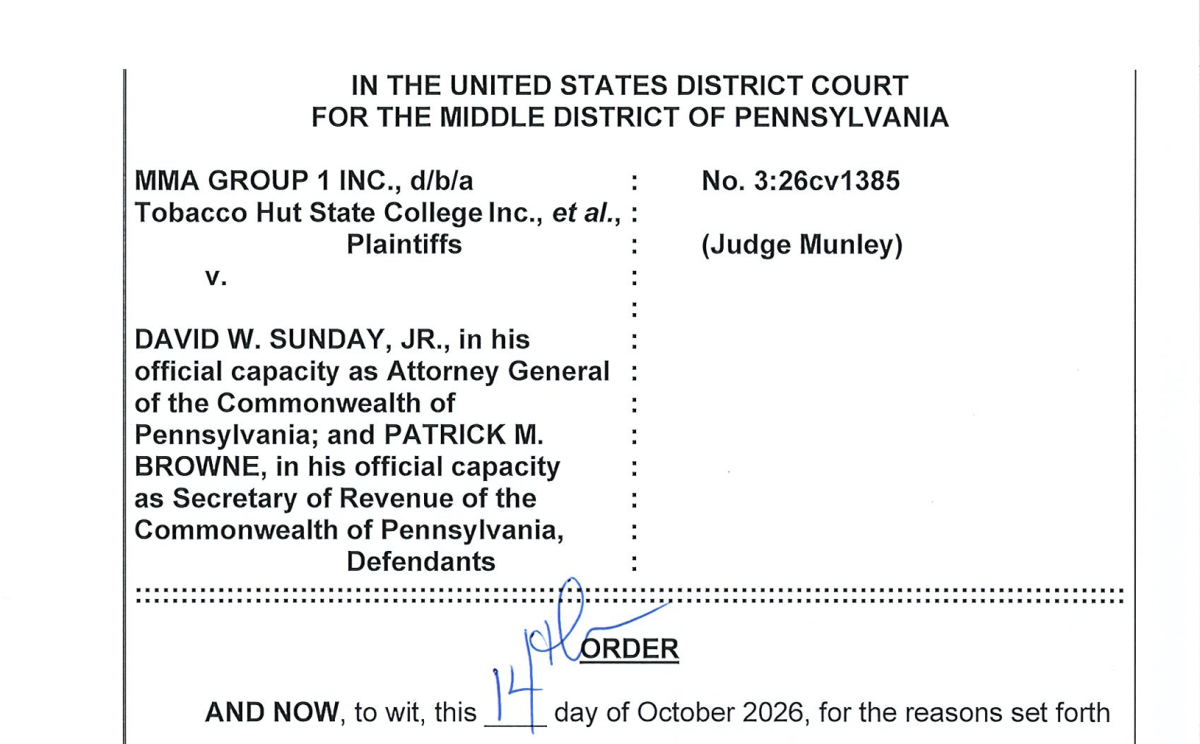
A U.S. federal court upheld Pennsylvania's vape directory law on October 14, rejecting a challenge brought by Nova Distro, 101 Distributors and companies operating Tobacco Hut retail stores. Court records show that vaping accounts for about 60% of Tobacco Hut's profits and that the chain held approximately $2 million in inventory potentially subject to seizure under the law as of June 2. Pennsylvania began enforcement on October 19. The ruling follows similar appellate decisions in other states, even as new research shows that unlisted vaping products continue to account for substantial sales in states with established directories.
Regulations
Oct.22
Special Report | How Capital Is Reassessing the Global Tobacco and Modern Nicotine Industry: Lessons from a New York Forum
Capital is reassessing the global tobacco and modern nicotine industry as heated tobacco, vaping and nicotine pouches reshape demand, profitability and regulation. At the 2026 New Approaches Summit in New York, investors and analysts examined whether smoke-free growth can sustain earnings, how regulation shapes startup value, and whether shareholder engagement can be more effective than divestment. The debate points to a broader shift: tobacco transition is increasingly becoming a capital-allocation, governance and valuation question.
Capital Markets
Oct.05
NAS 2026 | FDA CTP Director Says PMTA Pathway Is “Predicated on Tobacco Harm Reduction”
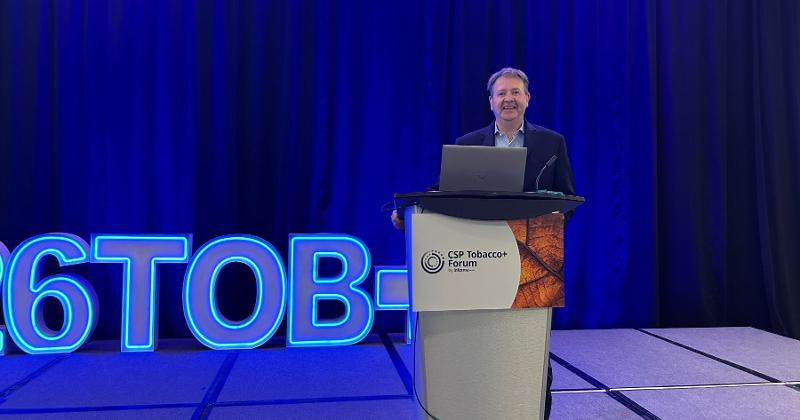
At the 2026 New Approaches Summit in New York, FDA Center for Tobacco Products Director Bret Koplow said the PMTA pathway is “predicated on tobacco harm reduction.” He outlined four CTP priorities: youth prevention, helping adults quit or switch to lower-risk products, improving relative-risk communication, and reducing unauthorized products. Koplow also addressed flavored e-cigarettes, public risk perceptions, industry credibility and efforts to make PMTA reviews more efficient and predictable.
Sep.26
R.J. Reynolds Vapor Company Launches Flavored Vuse Pro Pods in U.S. Without FDA Marketing Authorization
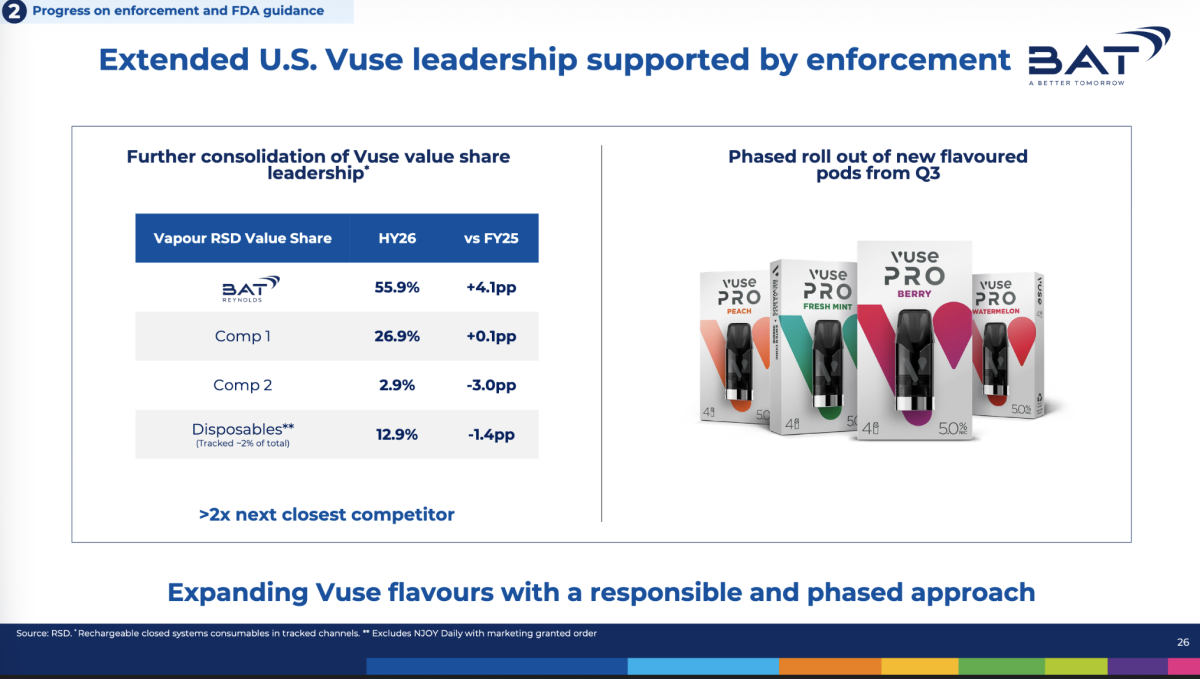
R.J. Reynolds Vapor Company has begun selling four flavored Vuse Pro pods — Peach, Berry, Watermelon and Fresh Mint — in Ohio and selected other U.S. markets. According to the Vuse U.S. FAQ, Vuse Pro contains approximately 5.0% nicotine by weight, and Vuse Pro pre-filled pods are intended for use with Vuse Alto devices. Reynolds told 2Firsts that product labeling lists an e-liquid capacity of 2.0 mL per pod. The Vuse Alto Power Unit received FDA marketing authorization in 2024, while the new Vuse Pro pods themselves have not received marketing granted orders. The rollout follows the FDA’s May 2026 revision of enforcement priorities for certain unauthorized vaping products with qualifying pending applications.
BAT
Sep.10
NATO Executive Director David Spross Sees U.S. Vape Regulation Improving, Calls for More PMTA Authorizations and Warns of 2027 State Tax Pressure
The National Association of Tobacco Outlets is calling for more FDA marketing authorizations, greater transparency in the PMTA process and continued enforcement against unauthorized e-cigarettes, even as its executive director, David Spross, points to recent regulatory developments as signs of progress. At the state level, excise taxes, flavor restrictions and vapor product directories remain major issues for tobacco retailers. By August 2026, 17 states had enacted laws establishing state-managed e-cigarette directories or similar systems.
Innovation
Sep.29 by 2Firsts Perspectives