Latvia Plans to Ban e-cigarette Use at Residential Windows

Dec.12.2024
Latvia Plans to Ban e-cigarette Use at Residential Windows
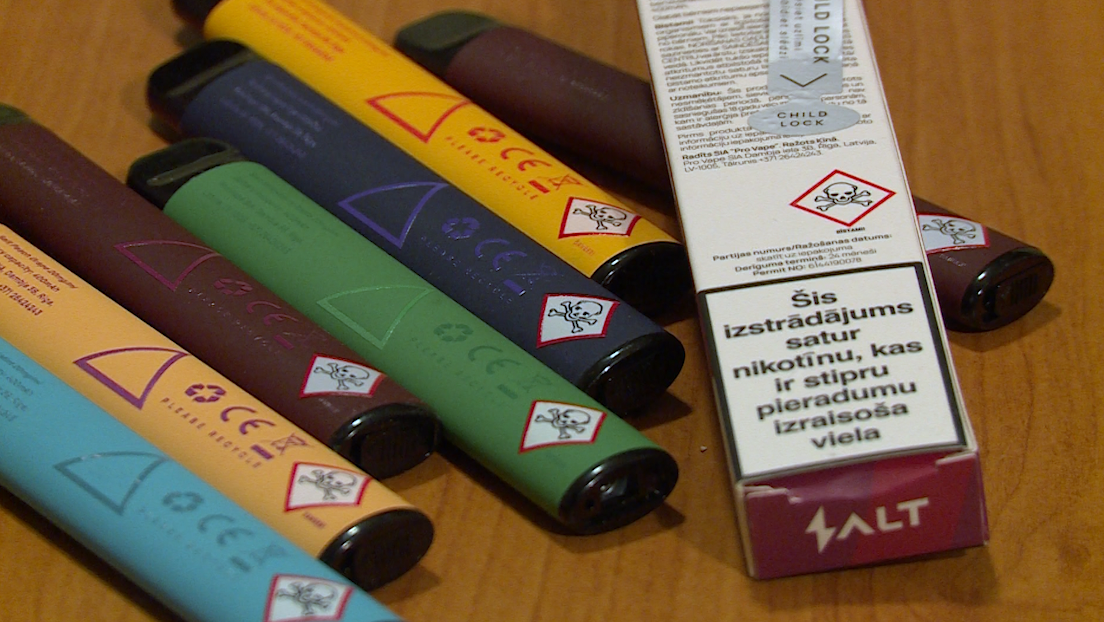
Latvia Health Ministry plans to restrict e-cigarette use near residential windows, following EU council call for extended public exposure limits.

According to a report from Latvian Radio on December 10th, the Latvian Ministry of Health plans to propose new restrictions, prohibiting the use of e-cigarettes in residential building windows.


The Council of Employment, Social Affairs, Health and Consumer Affairs of the European Union is calling for an expansion of restrictions on public exposure to e-cigarettes. Currently, Latvia prohibits smoking or using e-cigarettes on balconies, stairwells, train platforms, bus stops, and other public areas including educational institutions and workplaces. National police and municipal police are responsible for monitoring whether the public is smoking in unauthorized areas, with violators facing warnings or fines of up to 100 euros. In the future, Latvia may also ban the use of e-cigarettes in residential windows, public spaces, and dining establishments.


The Secretary of the Latvian Ministry of Health, Artjoms Uršuļskis, stated that they will be implementing regulations targeting smoking in windows, with the aim of protecting the public from the impact of both tobacco and e-cigarette smoke.


Currently it is not clear when this regulation will take effect, but the Ministry of Health has indicated that it may be discussed next year.


We welcome news tips, article submissions, interview requests, or comments on this piece.

Please contact us at info@2firsts.com, or reach out to Alan Zhao, CEO of 2Firsts, on LinkedIn


Notice

1.  This article is intended solely for professional research purposes related to industry, technology, and policy. Any references to brands or products are made purely for objective description and do not constitute any form of endorsement, recommendation, or promotion by 2Firsts.

2.  The use of nicotine-containing products — including, but not limited to, cigarettes, e-cigarettes, nicotine pouchand heated tobacco products — carries significant health risks. Users are responsible for complying with all applicable laws and regulations in their respective jurisdictions.

3.  This article is not intended to serve as the basis for any investment decisions or financial advice. 2Firsts assumes no direct or indirect liability for any inaccuracies or errors in the content.

4.  Access to this article is strictly prohibited for individuals below the legal age in their jurisdiction.


Copyright


This article is either an original work created by 2Firsts or a reproduction from third-party sources with proper attribution. All copyrights and usage rights belong to 2Firsts or the original content provider. Unauthorized reproduction, distribution, or any other form of unauthorized use by any individual or organization is strictly prohibited. Violators will be held legally accountable.

For copyright-related inquiries, please contact: info@2firsts.com


AI Assistance Disclaimer


This article may have been enhanced using AI tools to improve translation and editorial efficiency. However, due to technical limitations, inaccuracies may occur. Readers are encouraged to refer to the cited sources for the most accurate information.

We welcome any corrections or feedback. Please contact us at: info@2firsts.com

R.J. Reynolds Vapor Company Launches Flavored Vuse Pro Pods in U.S. Without FDA Marketing Authorization
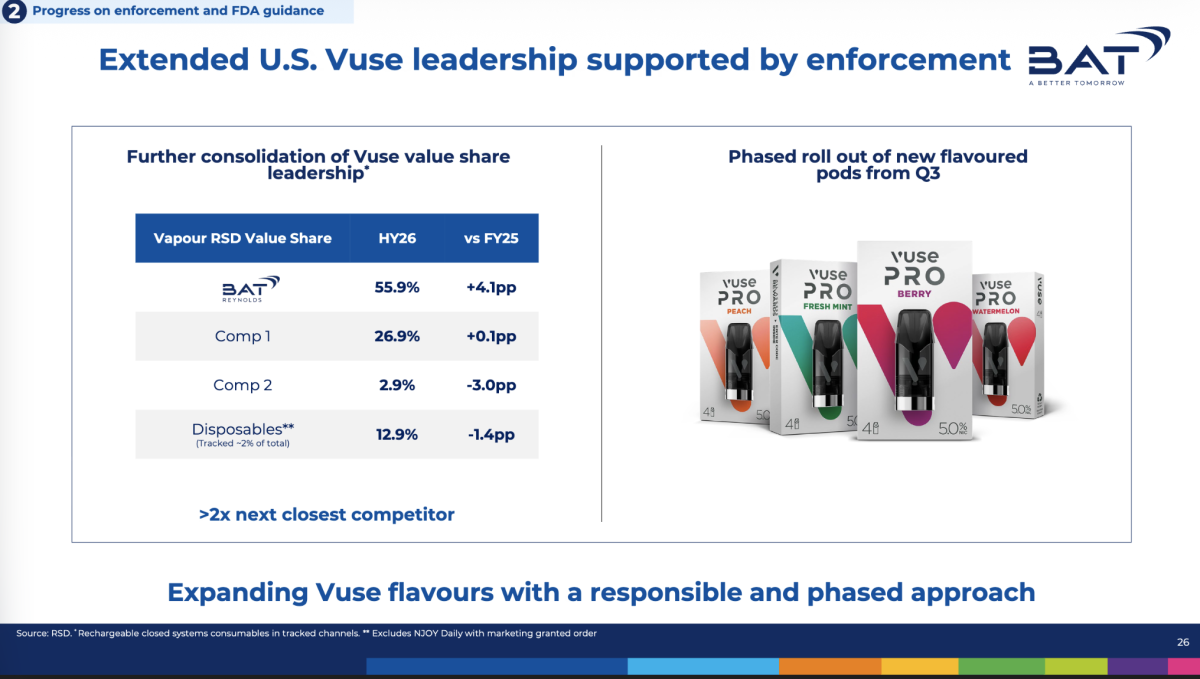
R.J. Reynolds Vapor Company has begun selling four flavored Vuse Pro pods — Peach, Berry, Watermelon and Fresh Mint — in Ohio and selected other U.S. markets. According to the Vuse U.S. FAQ, Vuse Pro contains approximately 5.0% nicotine by weight, and Vuse Pro pre-filled pods are intended for use with Vuse Alto devices. Reynolds told 2Firsts that product labeling lists an e-liquid capacity of 2.0 mL per pod. The Vuse Alto Power Unit received FDA marketing authorization in 2024, while the new Vuse Pro pods themselves have not received marketing granted orders. The rollout follows the FDA’s May 2026 revision of enforcement priorities for certain unauthorized vaping products with qualifying pending applications.
BAT
Sep.10
Ispire Q4 Revenue Rebounds 33% but Full-Year Sales Still Fall 25% as FY2027 Focus Shifts to Malaysia Manufacturing, ODM, Nicotine Pouches and Age Verification
Ispire Technology reported FY2026 revenue of about $96 million, down 24.7% year over year, as U.S. cannabis-vapor hardware and European e-cigarette sales declined by $17.4 million and $12.7 million, respectively. Fourth-quarter revenue rose 32.5% to $26.7 million, while quarterly gross margin fell to 6.3%. For FY2027, the company is prioritizing Malaysia manufacturing and vapor ODM while continuing to develop nicotine pouches, IKE Tech age-verification technology and G-Mesh licensing. Ispire has not separately disclosed the revenue or profit contribution of those newer businesses.
Regulations
Sep.17 by 2Firsts Perspectives
EU ‘TPD3’ Enters Next Phase on Aug. 14 as Fragmented Vape and Nicotine Pouch Rules Push the Single Market Toward Regulatory Overhaul
A 12-week European Commission consultation on revising the Tobacco Products Directive and Tobacco Advertising Directive is due to close on Aug. 14, 2026. The Commission has identified e-cigarette flavours, disposable vapes, tobacco heating devices, nicotine pouches, nicotine-free e-cigarettes, packaging and digital marketing among areas for possible new EU rules. National regulations already vary significantly across the bloc, a fragmentation the Commission says creates internal-market barriers and distorts competition. No formal revised TPD/TAD legislative text has yet been published, with the Commission currently indicating December 2026 for the legislative initiative.
Aug.14
China Tobacco Yunnan files patent for cellulose-free nicotine pouch scaffold to replace microcrystalline cellulose
China Tobacco Yunnan Industrial Co., Ltd. has filed a patent application for a cellulose-free scaffold material for nicotine pouches, proposing a combination of bioceramic material, polydextrose and sugar alcohols to replace conventional microcrystalline cellulose and cellulose derivatives. The filing aims to address issues including powdery mouthfeel, residue and limited release control, while also reducing reliance on existing cellulose-based patent portfolios. In patent examples, one fast-release formulation reached a nicotine release rate of 50% at 10 minutes and more than 90% at 20 minutes.
Sep.02
Nicotine Pouches Gain Ground in U.S. Convenience Stores as Vape Unit Sales Fall 14%
According to convenience retail publication CStore Decisions, U.S. convenience store tobacco categories are undergoing a structural shift. Based on Circana OmniMarket Total U.S. Convenience data for the 52 weeks ending June 14, 2026, cigarettes remained the largest category with $50.8 billion in sales, but unit sales declined 5.3%. Electronic smoking devices and vaping products also declined, while modern oral nicotine products continued to grow, with nicotine pouch sales rising 29% in dollars and 17% in units. Retailers said changing consumer preferences are reshaping tobacco product assortments at convenience stores.
Regulations
Aug.07
Russia’s Vape Device Labeling Regime Enters Force: Registration Starts in September, Mandatory Coding in December
Russia's digital labeling regime for reusable e-cigarettes and similar personal vaping devices entered its first mandatory phase in September 2026. From September 1, manufacturers, importers and other market participants must register with the national Chestny ZNAK tracking system. From December 1, newly manufactured and imported covered devices will be required to carry digital identification codes and be reported as entering circulation. Russia has also issued new operational guidance for imports, marking the transition from a voluntary pilot to phased mandatory implementation.
Sep.15