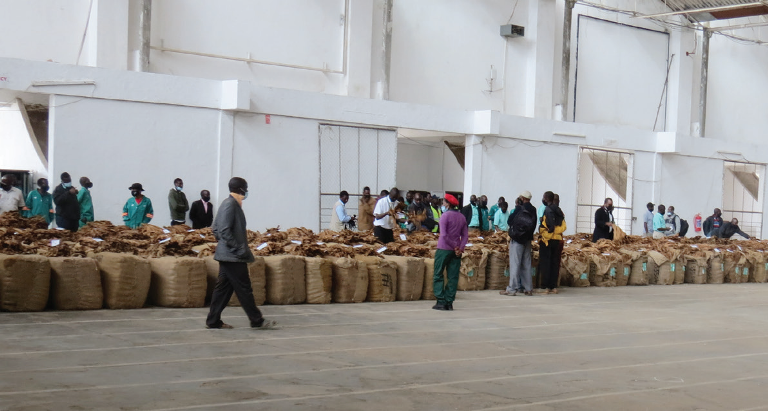
According to a report by mwnation on January 28, despite facing a wave of anti-tobacco protests, Malawi remains adamant on continuing tobacco cultivation and aims to become the largest tobacco producing region in Southern Africa by 2028.
Joseph Chidanti-Malunga, Director of the Tobacco Commission (TC) in Malawi, stated in an interview during a tree-planting event on Saturday, January 27, that Malawi's short-term to long-term goal is to produce a minimum of 200 million kilograms of tobacco leaves annually.
He pointed out that despite some people opposing tobacco cultivation, much like there are people opposing coffee or sugar, it will not deter Malawi from continuing to grow tobacco. President Mutharika referred to tobacco as Malawi's lifeline, believing that without it, the country's economy would collapse.
It is ironic that Malawi, despite fully joining the World Health Organization's Framework Convention on Tobacco Control (FCTC) and approving it in August 2023, continues to insist on tobacco cultivation. The convention, which will come into effect on November 16, 2023, lays out specific steps for dealing with tobacco use and production, and addresses the issue of stabilizing health and reducing tobacco production through international coordination.
However, Maronga states that despite the ratification of the treaty, Malawi remains one of the world's economies reliant on tobacco.
William Chadza, the Executive Director of the Mwapata Institute, emphasized that the approval of this convention should serve as encouragement for Malawi to explore alternative agricultural products.
According to the guidelines in Malawi, tobacco is the country's main cash crop, contributing approximately 60% of foreign exchange earnings and contributing 15% to the economy. It directly or indirectly employs millions of people.
Last year, Malawi generated a revenue of $282.61 million from 120 million kilograms of tobacco, with an average price of $2.35 per kilogram. In comparison, the previous year's revenue from 85 million kilograms of tobacco was $182 million, with an average price of $2.14 per kilogram.
We welcome news tips, article submissions, interview requests, or comments on this piece.
Please contact us at info@2firsts.com, or reach out to Alan Zhao, CEO of 2Firsts, on LinkedIn
Notice
1. This article is intended solely for professional research purposes related to industry, technology, and policy. Any references to brands or products are made purely for objective description and do not constitute any form of endorsement, recommendation, or promotion by 2Firsts.
2. The use of nicotine-containing products — including, but not limited to, cigarettes, e-cigarettes, nicotine pouchand heated tobacco products — carries significant health risks. Users are responsible for complying with all applicable laws and regulations in their respective jurisdictions.
3. This article is not intended to serve as the basis for any investment decisions or financial advice. 2Firsts assumes no direct or indirect liability for any inaccuracies or errors in the content.
4. Access to this article is strictly prohibited for individuals below the legal age in their jurisdiction.
Copyright
This article is either an original work created by 2Firsts or a reproduction from third-party sources with proper attribution. All copyrights and usage rights belong to 2Firsts or the original content provider. Unauthorized reproduction, distribution, or any other form of unauthorized use by any individual or organization is strictly prohibited. Violators will be held legally accountable.
For copyright-related inquiries, please contact: info@2firsts.com
AI Assistance Disclaimer
This article may have been enhanced using AI tools to improve translation and editorial efficiency. However, due to technical limitations, inaccuracies may occur. Readers are encouraged to refer to the cited sources for the most accurate information.
We welcome any corrections or feedback. Please contact us at: info@2firsts.com