Philippine Standard Authority Issues First PS License to E-Cigarette Manufacturers

Jun.04.2024
Philippine Standard Authority Issues First PS License to E-Cigarette Manufacturers
The Philippines issues first PS licenses to e-cigarette manufacturers, requiring products to have proper certification by 2024.

According to a report by the Manila Standard on June 4th, the Department of Trade and Industry (DTI)'s agency, the Bureau of Philippine Standards (DTI-BPS), has issued the first batch of Philippine Standards (PS) permits to manufacturers of heated tobacco products.
Philippine Standard Authority Issues First PS License to E-Cigarette Manufacturers
Edival brand  Image source: Tianchacha


Deputy Secretary-General of the Consumer Protection Group of the Ministry of Commerce, Amanda Nograles, stated that


Starting from June 5, 2024, any e-cigarette products that do not carry the Product Standard (PS) mark, license, or ICC mark will be unable to enter the Philippine market.


The companies that have obtained PS licenses this time include Technocom System Sdn. Bhd. and Shenzhen Adwell Technology Co., Ltd. Both companies have successfully passed a rigorous review process and comply with the technical specifications of Republic Act No. 11900 of the Philippines, specifically the "Electronic Nicotine and Non-Nicotine Product Management Act.


According to the certification product list on the DTI-BPS website, the manufacturers of the IQOS ILUMA heated tobacco device, Venture Technocom System and Shenzhen Adwell Technology Co., Ltd., have both obtained licenses valid for three years, with a requirement to renew six months before expiration. It is worth noting that Venture Technocom System and Adwell Technology are the only two factories that have obtained PS logo approval for any products under the "e-cigarette law," with PMFTC Inc. and Royal Connections Inc. as authorized importers of IQOS ILUMA devices.


Furthermore, Noglares disclosed that in January 2025, the Ministry of Commerce will conduct random inspections of e-cigarette products without PS or ICC markings in the market. Sellers will have at least six months to deal with their inventory.


During a public lecture in October 2022, the DTI-BPS clearly stated that certification work is carried out to ensure that all products, equipment, and systems undergo rigorous analysis to meet quality standards and prevent illegal trade.


The Department of Trade and Industry (DTI) has announced that all heated tobacco and e-cigarette products will be required to obtain certification starting from June 5, 2024. Distributors and retailers can still sell uncertified electronic nicotine and non-nicotine products until January 5, 2025. After that date, only products with a valid PS mark or ICC label will be allowed for sale. The DTI has the authority to issue immediate recall, prohibition, or confiscation orders for businesses that do not comply with the regulations, to prevent their products from being sold or distributed in the public market.


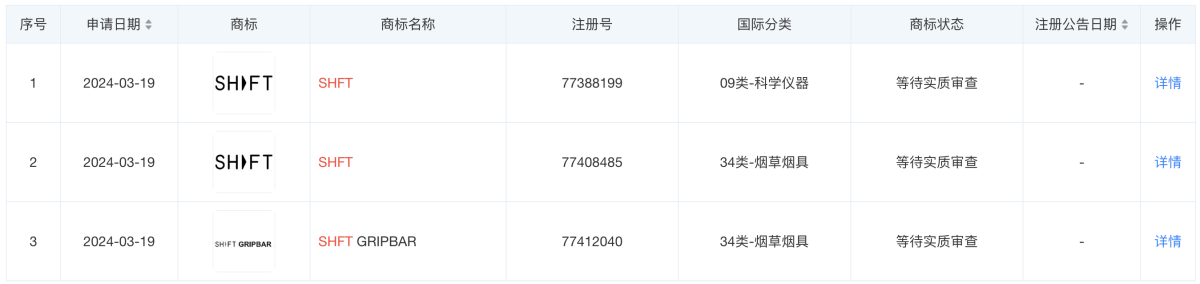
According to Tianyancha, Shenzhen Adiver Technology Co., Ltd. was established in 2019 and is located in Shenzhen, Guangdong Province. It is primarily engaged in the service industry. The legal representative is Zhang Zehong, with a registered capital of 1 million RMB. The business scope includes research and development, technical consultation, and sales of electronic atomization equipment, electronic atomizers and their components, and related equipment. In addition, records show that Adiver registered the SHFT trademark on March 19, 2024, and is currently awaiting substantive examination.


We welcome news tips, article submissions, interview requests, or comments on this piece.

Please contact us at info@2firsts.com, or reach out to Alan Zhao, CEO of 2Firsts, on LinkedIn


Notice

1.  This article is intended solely for professional research purposes related to industry, technology, and policy. Any references to brands or products are made purely for objective description and do not constitute any form of endorsement, recommendation, or promotion by 2Firsts.

2.  The use of nicotine-containing products — including, but not limited to, cigarettes, e-cigarettes, nicotine pouchand heated tobacco products — carries significant health risks. Users are responsible for complying with all applicable laws and regulations in their respective jurisdictions.

3.  This article is not intended to serve as the basis for any investment decisions or financial advice. 2Firsts assumes no direct or indirect liability for any inaccuracies or errors in the content.

4.  Access to this article is strictly prohibited for individuals below the legal age in their jurisdiction.


Copyright


This article is either an original work created by 2Firsts or a reproduction from third-party sources with proper attribution. All copyrights and usage rights belong to 2Firsts or the original content provider. Unauthorized reproduction, distribution, or any other form of unauthorized use by any individual or organization is strictly prohibited. Violators will be held legally accountable.

For copyright-related inquiries, please contact: info@2firsts.com


AI Assistance Disclaimer


This article may have been enhanced using AI tools to improve translation and editorial efficiency. However, due to technical limitations, inaccuracies may occur. Readers are encouraged to refer to the cited sources for the most accurate information.

We welcome any corrections or feedback. Please contact us at: info@2firsts.com

Malaysia Withdraws Appeal Against Liquid Nicotine Ruling as Vape Regulation Framework Enters New Phase
Malaysia’s government has withdrawn its appeal against a High Court ruling concerning the regulatory status of liquid nicotine used in vape and e-cigarette products, according to reports by New Straits Times, Free Malaysia Today and CodeBlue on August 18, 2026. The Kuala Lumpur High Court ruled on May 15 that the government’s decision to remove liquid nicotine from the scheduled poisons list under the Poisons Act 1952 was irrational and made without proper consultation with the Poisons Board. The withdrawal ends the government’s appeal process, while the future regulatory framework for nicotine vape products remains under discussion.
Aug.21
German Tobacco Tax Revenue Falls 10.8% Through August as Tax-Paid Cigarette Volume Drops 12.6%
Germany collected €9.789 billion in total tobacco tax revenue from January through August 2026, down 10.8% from a year earlier, according to the Federal Ministry of Finance. Germany's tobacco tax base covers not only cigarettes and fine-cut tobacco but also heated tobacco and vaping liquids taxed as tobacco substitutes. The German Association of the Tobacco Industry and Novel Products, or BVTE, citing federal statistical data, said tax-paid cigarette volume fell 12.6% to 40.6 billion sticks. BVTE is using the latest figures to argue against further tax increases planned from 2027 through 2030, while Germany's parliament is scheduled to hold a first reading of the bill on September 24.
Sep.23
GSTHR Estimates 200 Million People Use Non-Combustible Nicotine Products as 28 Countries Show Rising Use Alongside Falling Smoking Rates
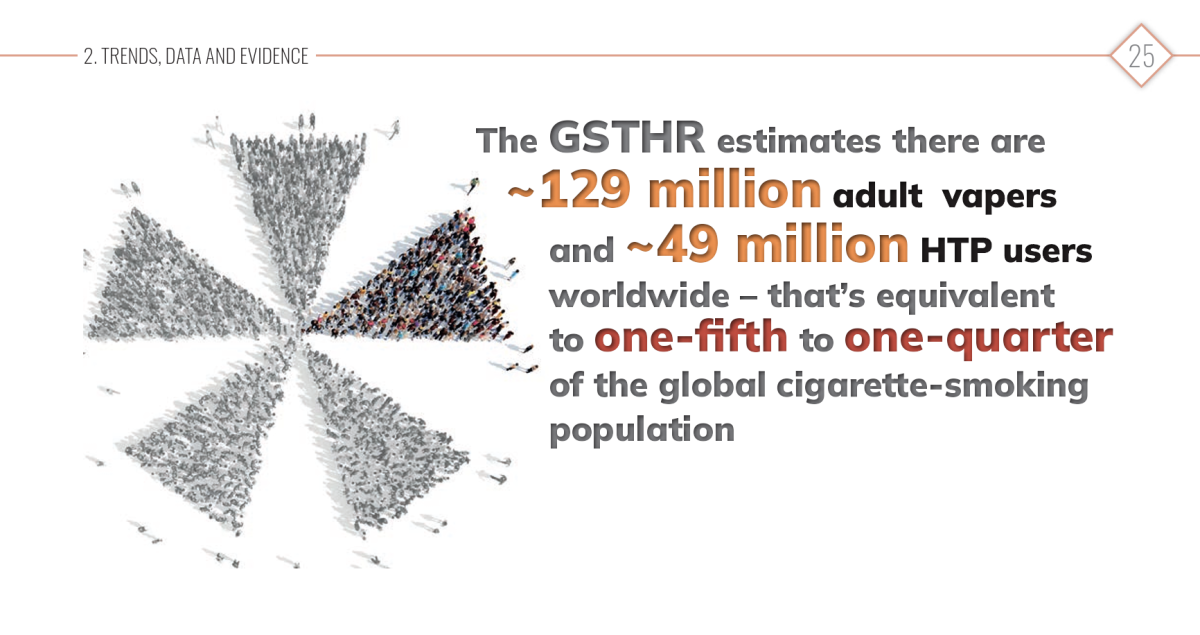
The Global State of Tobacco Harm Reduction, a project operated by Knowledge·Action·Change, estimates that about 200 million people worldwide use non-combustible nicotine products including vapes, heated tobacco, nicotine pouches and snus. Its 2026 report says use of these products rose alongside declining smoking rates in 28 countries it analyzed. The data do not establish that all 200 million users have quit smoking, nor do they prove a direct causal relationship. GSTHR also says regulatory restrictions on the products continue to expand in many markets.
Sep.10
HG Innovation, linked to IMiracle and ELFBAR, wins China patent for 6-methylnicotine salts covering vaping and oral products
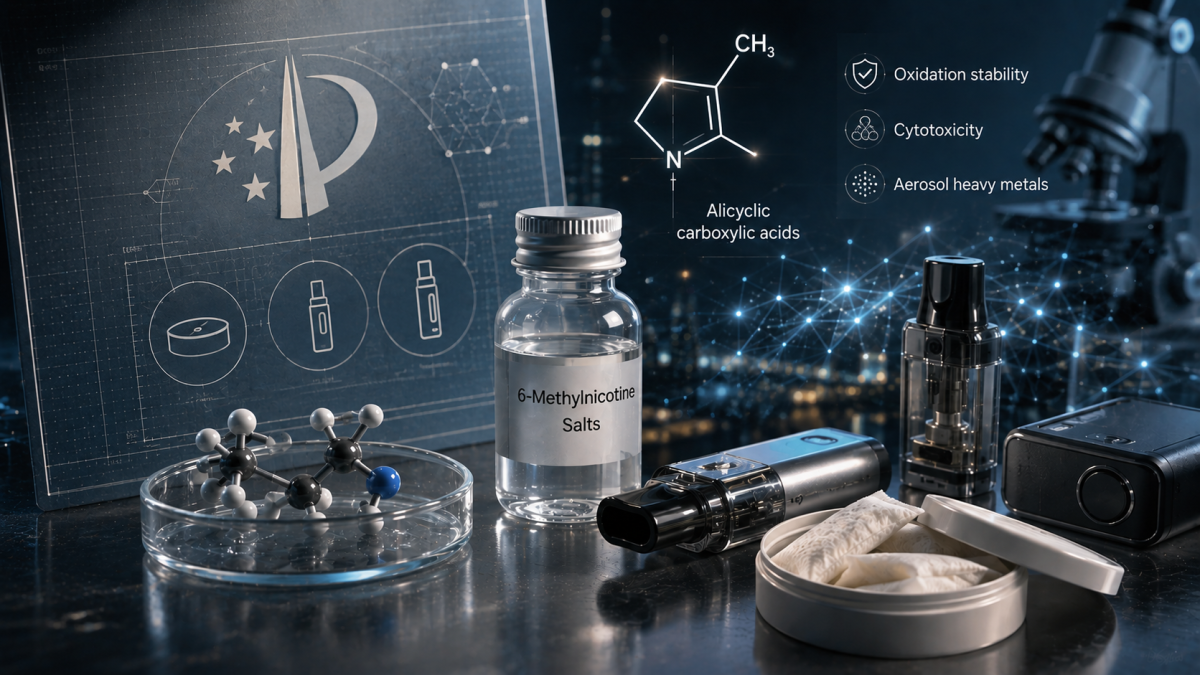
HG Innovation Limited has been granted a Chinese invention patent covering 6-methylnicotine salt formulations and their use in oral and vaping products. The technology forms salts between 6-methylnicotine and alicyclic carboxylic acids, with granted claims extending to oral products, atomization substrates and electronic atomization devices. Applicant-generated tests reported differences in oxidation stability, in-vitro cytotoxicity and aerosol heavy-metal performance compared with selected benzoate or lactate controls. HG Innovation is directly linked to the broader IMiracle and ELFBAR business network.
Sep.04
China Tobacco Regulator Deputy Head Visits Laos as Both Sides Strengthen Cooperation on Illegal Tobacco Trade
China’s official Xinhua News Agency reported that Liu Sanjiang, deputy head and Party group member of China’s tobacco regulator, led a delegation to Laos from July 31 to Aug. 2, 2026, for discussions with Lao authorities on combating cross-border illegal tobacco trade. The two sides discussed areas including law enforcement cooperation, information sharing and efforts to address tobacco-related illegal activities such as counterfeiting and smuggling. The visit highlights cooperation between Chinese and Lao authorities on illicit tobacco control.
News
Aug.05
Malaysia Liquid Nicotine Returns to Poisons List, Leaving Vape Retail and RM354 Million Tax Collection in Legal Uncertainty
Malaysia’s withdrawal of its appeal in a landmark liquid-nicotine case has left a High Court ruling that struck down the 2023 nicotine exemption in force, bringing liquid and gel nicotine used in vaping products back under the Poisons Act 1952. At the same time, the Control of Smoking Products for Public Health Act 2024 continues to provide a regulatory framework for vaping products, creating uncertainty over retail sales, taxation and existing inventory. MPs are calling for nicotine vape sales and excise collection to stop, including refunds of more than RM354 million collected since 2023, while industry and consumer groups are asking the government to clarify the current legal position.
Sep.04