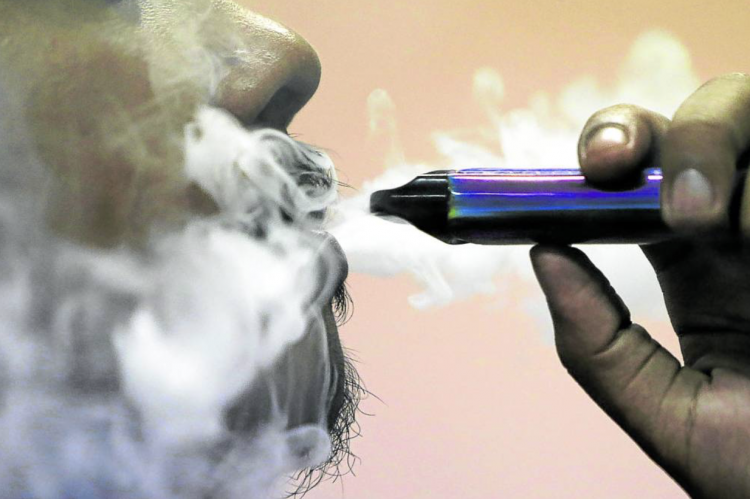
The Philippine capital Manila will be apprehending individuals who use electronic cigarettes in indoor public places such as government offices, schools, airports, and churches. The offenders will be subjected to a strict penalty ranging from 5,000 to 20,000 Philippine pesos (approximately 631-2528 Chinese yuan).
The Department of Trade and Industry (DTI) in the Philippines issued a department administrative order implementing the rules and regulations (IRR) of Republic Act No. 11900, also known as the "Vaporized Nicotine and Non-Nicotine Products Regulation Act.
The FDA will set the minimum age requirement for purchasing, selling or using e-cigarettes to 18 years old. Legal critics have previously warned that the e-cigarette market will expand to include more young people of high school age.
According to data from the Department of Education (DepEd), for the academic year 2020-2021, there are approximately 1.1 million students aged between 18 and 20 years old. The DepEd released a warning statement opposing the measure, stating that "under the e-cigarette law, it is legally allowed to sell harmful products to students aged 18-20.
The IRR will come into effect 15 days after its publication in the Official Gazette or at least two widely circulated newspapers.
According to Rule 8 of the IRR, all indoor public areas are prohibited from using vaporization and non-nicotine products, with the exception of designated electronic cigarette areas or selling points for product demonstrations.
Shopping mall kiosks will be allowed to conduct electronic cigarette product demonstrations in designated testing areas.
Public places where electronic cigarettes are prohibited include youth activity centers such as gaming schools, high school preparatory programs, colleges, universities, youth dormitories, and entertainment facilities for individuals under the age of 18.
The IRR also includes elevators, stairwells, and gas stations that are designated as non-electronic smoking areas.
Buildings and premises of public and private hospitals, medical, dental and optical clinics, healthcare centers, nursing homes, pharmacies and laboratories are also considered public spaces.
Public transportation and facilities such as airports, cruise terminals, train and bus stations, restaurants, conference halls, churches and other places of worship, as well as government buildings and offices, are also included on the list.
First-time offenders will be fined 5,000 Philippine pesos (approximately 631 yuan), while those caught using e-cigarettes indoors in public places for a second time will be fined 10,000 Philippine pesos (approximately 1,264 yuan).
The third offense will result in a fine of 20,000 pesos (approximately 2,528 yuan) being imposed.
Electronic cigarette businesses or entities that engage in wrongdoings also face the risk of having their business license revoked.
According to the court's discretionary ruling for first-time offenses, enterprises and retailers selling to minors will be fined 10,000 pesos (approximately 1,264 yuan) or face a maximum of 30 days in prison.
Criminals will face the same fines, but the business entities involved will have their licenses or permits revoked.
Brick-and-mortar and online retailers must also register with the government to sell e-cigarette products. Those who fail to comply will be fined 100,000 Philippine pesos (approximately 1,264 USD) for the first offense and 200,000 Philippine pesos (approximately 2,528 USD) for the second offense.
Any third party that violates the regulations will face a fine of 400,000 pesos (approximately 50,559 yuan in Chinese currency) and will also have their commercial license revoked.
Manufacturers, importers, distributors or retailers found to be in violation of product packaging requirements, which require health warning labels to be included, will face fines ranging from 2 to 5 million pesos (approximately 250,000 to 630,000 RMB) and imprisonment of two to six years.
The regulation known as RA 11900, or the Vaporized Nicotine and Non-Nicotine Products Regulation Act, became law on July 25th of last year after 30 days had passed without the president signing or vetoing the document.
According to data from the Department of Health (DOH), a law was approved by the previous Congress in January last year which is deemed to have significant trade implications for the Philippines. It is estimated that 16.6 million Filipino adults smoke.
Mr. Marcos has decided to allow the e-cigarette bill to become law, much to the disappointment of its critics. Senator and staunch opponent of the bill, Pia Cayetano, a public health advocate, places most of the blame on the previous administration.
She stated, "I am disappointed by the 18th Congress for passing this bill and also disappointed in the president for not vetoing it, as it will prevent justice for the millions of lives harmed by the electronic cigarette law.
During the Senate deliberations, the bill was introduced by Ralph Recto, the former Senate President and current representative of Batangas.
A new law has granted the Department of Trade and Industry (DTI) regulatory jurisdiction over electronic cigarettes and other new tobacco products, rather than the Food and Drug Administration (FDA), which had previously claimed to be the "legitimate authority with the professional knowledge, capacity, and manpower to establish standards, regulate, and monitor new tobacco products.
The U.S. Food and Drug Administration, the Department of Health, and the Department of Education are all urging the President to veto the measure.
Earlier, the Philippine Standards Authority (PSA), a subsidiary of the Department of Trade and Industry (DTI), included electronic cigarettes and heated tobacco products (HTP) on the list of consumer goods that require mandatory certification in order to ensure compliance with national standards in the Philippines.
According to Series 22-06 of the DTI department in 2022, electronic cigarettes, electronic liquids, HTP, and tobacco heating devices will be subjected to mandatory certification starting on January 4, 2024.
According to the Department of Trade and Industry (DTI), including electronic cigarettes and heated tobacco products (HTP) in the list of consumer goods that require mandatory certification will ensure the quality of these products and prevent illegal trade.
BPS has announced that the mandatory certification will cover equipment and systems, including the e-liquid used in e-cigarettes.
The Bureau of Philippine Standards (BPS) has announced that before mandatory certification takes effect in 2024, importers and manufacturers will have the option to voluntarily apply for the Philippine Standard Mark or import commodity clearance.
Disclaimer
This article is provided solely for professional research, industry discussion, and informational purposes. Any references to brands, companies, products, technologies, or policies are made for factual reporting and analytical purposes only, and do not constitute endorsement, recommendation, promotion, or advertising by 2Firsts.
Nicotine-containing products, including but not limited to cigarettes, e-cigarettes, heated tobacco products, and nicotine pouches, carry significant health risks. Readers are responsible for complying with all applicable laws and regulations in their respective jurisdictions, including age restrictions and access limitations.
The information contained in this article should not be regarded as investment, legal, medical, regulatory, or commercial advice. While 2Firsts strives to ensure the accuracy and reliability of its content, it does not assume liability for any direct or indirect loss arising from errors, omissions, inaccuracies, or reliance on the information contained herein.
This article is not intended for individuals below the legal age for accessing tobacco or nicotine-related information in their jurisdiction.
Copyright Notice
This article is either original content produced by 2Firsts or content reproduced, translated, summarized, or adapted from third-party sources with attribution where applicable. The intellectual property rights of the original content remain with 2Firsts or the respective original rights holders.
No individual or organization may copy, reproduce, distribute, republish, modify, translate, or otherwise use this content without prior authorization. Any unauthorized use may result in legal action.
For copyright-related inquiries, corrections, or removal requests, please contact: info@2firsts.com.
AI-Assisted Translation and Editing Notice
Portions of this article may have been translated, edited, or reviewed with the assistance of artificial intelligence tools to improve efficiency and readability. Due to the limitations of AI-assisted translation and editing, discrepancies, omissions, or inaccuracies may exist when compared with the original source.
Where applicable, readers are advised to refer to the original source for the most complete and accurate information. If you identify any errors or believe that any content infringes upon your rights, please contact us at info@2firsts.com, and we will review and address the matter promptly.