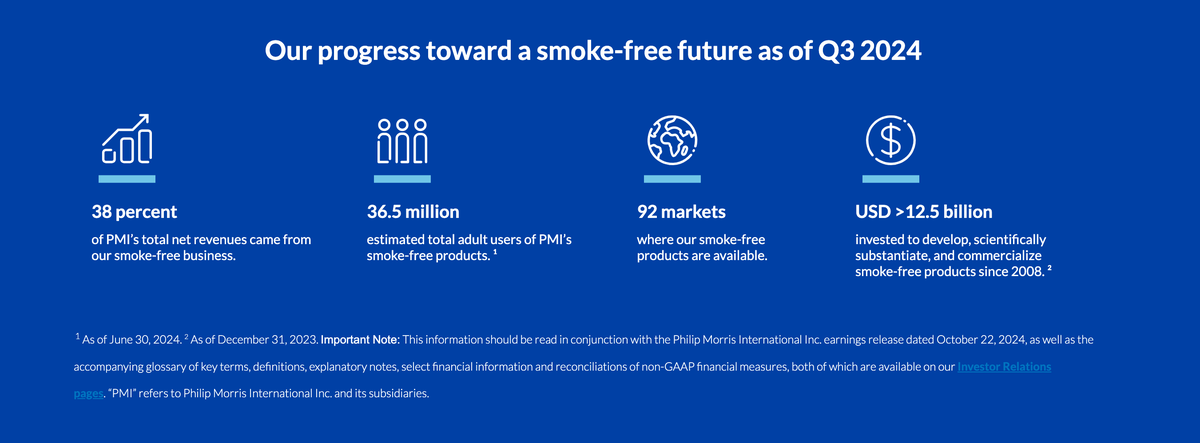
Philip Morris International (PMI) released its third-quarter performance report on 22 October, revealing that it shipped nearly 40 billion units of its non-tobacco products in 92 markets worldwide during the period.
The Non-Smoke business accounted for 38% of PMI's total net sales and 40% of its gross profit, increasing by 1.9 and 2.2 percentage points respectively compared to the same quarter last year. Net sales and gross profit grew by 14.2% and 15.9% respectively. The total number of users of Smokeless products reached 36.5 million.
IQOS, accounting for nearly 77% of global sales of HNB products.
In its performance report, PMI stated that IQOS, as the second largest nicotine brand, saw a further increase in market share, driving growth in the HNB product category, accounting for nearly 77% of global sales of similar products. Adjusted market sales volume (excluding inventory fluctuations) is estimated to have increased by 14.8%.
Japan Market: ILUMA i drives growth of IQOS, with adjusted sales increasing by 14.3%, marking the eighth consecutive quarter of double-digit growth. IQOS's HTU market share has increased to nearly 30%, driving the category to capture at least 50% of nicotine consumption share in 8 major cities including Tokyo and Yokohama.
European Market: IQOS increases market share of HTU to 9.5%, with adjusted sales growth accelerating to 11.3%. The Italian market shows strong recovery, with growth exceeding 20% in markets such as Greece and Germany. IQOS continues to expand its range of consumable products, with DELIA and LEVIA now available in 9 markets and plans for further expansion in the fourth quarter.
Outside of Europe and Japan: IQOS has seen significant market share growth in major cities around the world such as Seoul, Toronto, Mexico City, Cairo, and Jakarta, particularly in Indonesia, due to expanded geographic coverage and product offerings.
VEEV: Leading the switchable cartridge brand in European markets such as Italy and Romania.
According to PMI, in the European market, VEEV's closed-loop refill products continue to capture market share from disposable products and are in a leading position. VEEV is leading the closed-loop refill market in several markets including Italy, Romania, and the Czech Republic.
ZYN: Sales in the US market reach 149 million cans and have penetrated over 30 markets.
The shipment volume of canned ZYN nicotine pouches increased by 24.7%, driven mainly by the growth of ZYN nicotine pouches in the United States - with US shipments reaching 149.1 million cans, a 41.4% year-on-year increase. The growth in markets outside of the US was nearly 70%, with significant contributions from Pakistan and South Africa. ZYN has now entered 30 markets, including recently entering Greece and the Czech Republic.
PMI CEO Jacek Olczak stated that in the third quarter, we achieved extremely strong performance, achieving record quarterly net income and earnings per share. This reflects strong momentum in all regions and categories, with accelerated in-market sales growth of IQOS, strong sales of ZYN, and steady performance of combustible products. Due to our strong performance year-to-date, we are raising our full-year adjusted diluted earnings per share growth expectations to a range of 14% to 15% (excluding currency impacts).
We welcome news tips, article submissions, interview requests, or comments on this piece.
Please contact us at info@2firsts.com, or reach out to Alan Zhao, CEO of 2Firsts, on LinkedIn
Notice
1. This article is intended solely for professional research purposes related to industry, technology, and policy. Any references to brands or products are made purely for objective description and do not constitute any form of endorsement, recommendation, or promotion by 2Firsts.
2. The use of nicotine-containing products — including, but not limited to, cigarettes, e-cigarettes, nicotine pouchand heated tobacco products — carries significant health risks. Users are responsible for complying with all applicable laws and regulations in their respective jurisdictions.
3. This article is not intended to serve as the basis for any investment decisions or financial advice. 2Firsts assumes no direct or indirect liability for any inaccuracies or errors in the content.
4. Access to this article is strictly prohibited for individuals below the legal age in their jurisdiction.
Copyright
This article is either an original work created by 2Firsts or a reproduction from third-party sources with proper attribution. All copyrights and usage rights belong to 2Firsts or the original content provider. Unauthorized reproduction, distribution, or any other form of unauthorized use by any individual or organization is strictly prohibited. Violators will be held legally accountable.
For copyright-related inquiries, please contact: info@2firsts.com
AI Assistance Disclaimer
This article may have been enhanced using AI tools to improve translation and editorial efficiency. However, due to technical limitations, inaccuracies may occur. Readers are encouraged to refer to the cited sources for the most accurate information.
We welcome any corrections or feedback. Please contact us at: info@2firsts.com