Proposal to Ban Certain Tobacco and Nicotine Products in Uzbekistan

Jan.07.2025
Proposal to Ban Certain Tobacco and Nicotine Products in Uzbekistan
Uzbekistan parliament considers bill to ban certain types of tobacco products and nicotine consumption devices to combat illegal trade.

On January 6, the news department of the Uzbekistan Liberal Democratic Party (O'zLiDeP) announced on the social media platform Telegram that the country's parliament is currently reviewing a draft law that aims to prohibit certain types of tobacco products and nicotine consumption devices, including e-cigarettes, and establish administrative and criminal liabilities.
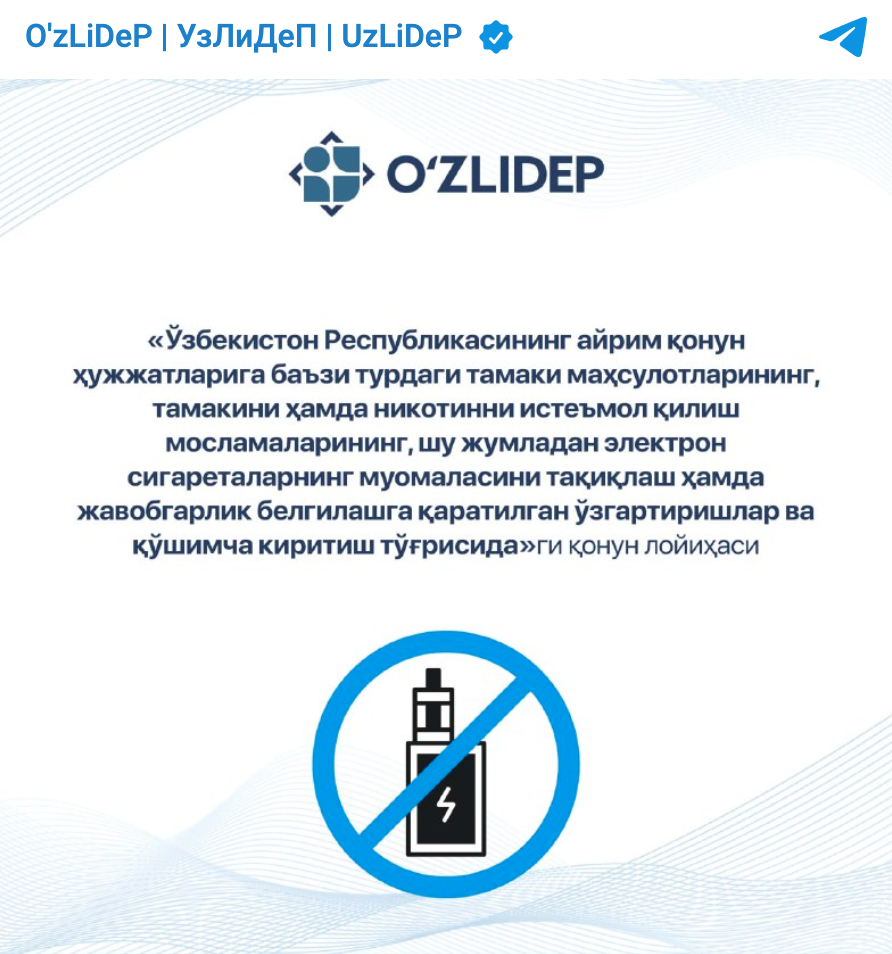
Proposal to Ban Certain Tobacco and Nicotine Products in Uzbekistan
Uzbekistan Liberal Democratic Party's news department releases draft proposal to ban the circulation of e-cigarettes | Image source: Telegram


It has been pointed out that in recent years, there has been an increase in the illegal entry and circulation of "modern" and "innovative" types of tobacco and nicotine products, especially nicotine supplies, e-cigarettes and their e-liquids, and heated tobacco products in the country. Additionally, consumption of these products, particularly among young people, is on the rise.


The draft law prohibits the production, manufacture, storage, transportation, or sale of certain specific types of tobacco products and devices used for tobacco and nicotine consumption (including e-cigarettes) within the territory of Uzbekistan.


In addition, the draft proposal also suggests imposing administrative and criminal liability for the import and export of such products within Uzbekistan.


We welcome news tips, article submissions, interview requests, or comments on this piece.

Please contact us at info@2firsts.com, or reach out to Alan Zhao, CEO of 2Firsts, on LinkedIn


Notice

1.  This article is intended solely for professional research purposes related to industry, technology, and policy. Any references to brands or products are made purely for objective description and do not constitute any form of endorsement, recommendation, or promotion by 2Firsts.

2.  The use of nicotine-containing products — including, but not limited to, cigarettes, e-cigarettes, nicotine pouchand heated tobacco products — carries significant health risks. Users are responsible for complying with all applicable laws and regulations in their respective jurisdictions.

3.  This article is not intended to serve as the basis for any investment decisions or financial advice. 2Firsts assumes no direct or indirect liability for any inaccuracies or errors in the content.

4.  Access to this article is strictly prohibited for individuals below the legal age in their jurisdiction.


Copyright


This article is either an original work created by 2Firsts or a reproduction from third-party sources with proper attribution. All copyrights and usage rights belong to 2Firsts or the original content provider. Unauthorized reproduction, distribution, or any other form of unauthorized use by any individual or organization is strictly prohibited. Violators will be held legally accountable.

For copyright-related inquiries, please contact: info@2firsts.com


AI Assistance Disclaimer


This article may have been enhanced using AI tools to improve translation and editorial efficiency. However, due to technical limitations, inaccuracies may occur. Readers are encouraged to refer to the cited sources for the most accurate information.

We welcome any corrections or feedback. Please contact us at: info@2firsts.com

Brazil’s Teen E-Cigarette Experimentation Rate Rises to 29.6% Over Five Years
Brazil’s National School Health Survey (PeNSE) 2024 found that e-cigarette experimentation among students aged 13 to 17 rose from 16.8% in 2019 to 29.6% in 2024, while use in the previous 30 days increased from 8.6% to 26.3%. Over the same period, conventional cigarette experimentation fell from 22.6% to 18.5%, and hookah use declined from 26.9% to 16.4%.
Mar.26 by 2FIRSTS.ai
France’s ANSES Report Reframes the Vape Debate: Harm Reduction Confirmed, Regulatory Barriers Rising
France’s top health agency has confirmed that vaping is less harmful than smoking — but not risk-free — reshaping the country’s regulatory trajectory. As Paris withdraws a proposed vape tax and debates stricter ingredient, emissions and youth-protection rules, the ANSES report signals not prohibition, but tighter technical oversight. For manufacturers, retailers and EU policymakers, France may be previewing Europe’s next phase of nicotine governance.
Special Report
Feb.23
FDA Authorizes Glas Vape but Flavor Hopes Fall Short
The FDA has added Glas products to its authorized electronic nicotine delivery systems (ENDS) list, granting Marketing Granted Orders (MGOs) to the Glas G DEVICE and a BLONDE TOBACCO pod. The decision expands the number of FDA-authorized ENDS products to 41, marking the first new authorization since Juul’s approvals in July 2025. However, widely anticipated non-tobacco flavored products were not approved.
Mar.13
Thai Vape User Numbers Rose More Than 11-Fold in Three Years, Group Says Ban Should Be Reassessed
A network of e-cigarette users in Thailand has urged the new government to review the country’s vape ban, saying official data show that use has risen sharply despite more than a decade of prohibition.
Mar.27 by 2FIRSTS.ai
FDA Details Carcinogenicity Tiering and ELCR Framework as Small Manufacturers Press for Predictability
During the “Toxicological Profile” session at FDA’s Feb 10 PMTA roundtable, officials outlined the carcinogenicity tiering system and Excess Lifetime Cancer Risk (ELCR) framework used in ENDS reviews under the APPH standard. Small manufacturers questioned database transparency, exposure assumptions, and the existence of clear compliance benchmarks. FDA reiterated toxicological risk is assessed case by case within a broader population-level determination.
Feb.11
BENDSTA Urges Prime Minister to Review Bangladesh’s 2025 Tobacco Control Ordinance
The Bangladesh Electronic Nicotine Delivery System Traders Association (BENDSTA) has urged the prime minister to initiate a comprehensive parliamentary review of the Smoking and Tobacco Products Use (Control) Ordinance, 2025.
Mar.12 by 2FIRSTS.ai