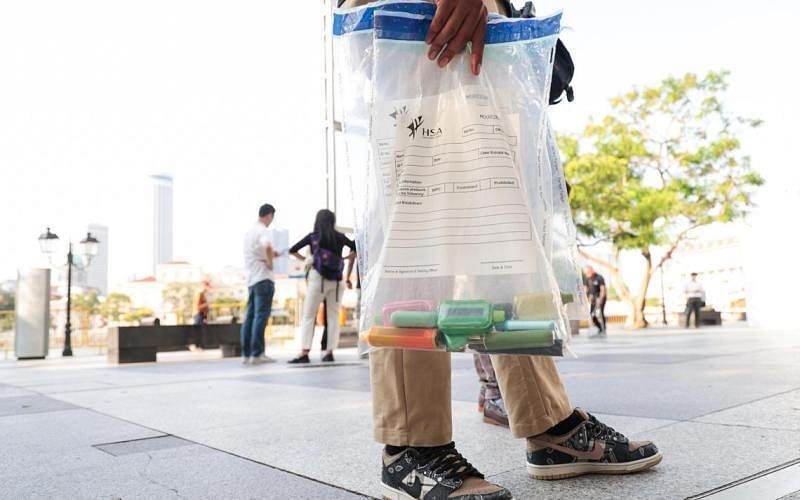
According to a report in Lianhe Zaobao on August 1st, the Singapore Health Sciences Authority announced that in the second quarter of this year, 3,279 people were caught on the spot for using or possessing e-cigarettes. This is a 46% increase from the 2,240 people caught in the first quarter. A total of over 5,500 people were caught in the first half of the year.
According to data from the second quarter, 2530 individuals were arrested in the community (such as in public entertainment venues and shopping malls); 690 students were investigated and fined for using or possessing e-cigarettes. Authorities also conducted operations near higher education institutions, where 40 individuals were found to have or use e-cigarettes.
In terms of checkpoints, the Health Sciences Authority and Immigration Authority conducted a joint operation at Woodlands, Tuas checkpoints, and Changi Airport, inspecting over 5000 passengers, with 19 individuals found to be in possession of e-cigarettes.
Authorities have reminded travelers that it is strictly prohibited to bring banned tobacco products, such as e-cigarettes, into Singapore. Anyone found in possession of these items will face fines. Despite the success of the ban, efforts to prevent the spread of e-cigarettes locally will continue through ongoing collaboration between various departments and agencies. Multiple actions will be taken in communities, schools, universities, and checkpoints to combat the proliferation of e-cigarettes.
In terms of educating the public and youth, the Health Promotion Board of Singapore will continue to raise awareness of the dangers of e-cigarettes through various platforms, while reiterating that e-cigarettes are prohibited locally. In recent years, an increasing number of students have been arrested for possessing or using e-cigarettes, prompting the Health Promotion Board to provide various forms of assistance to help students quit smoking and using e-cigarettes. From April to June this year, nearly 400 young people participated in a smoking cessation program and about half of them successfully reduced or quit smoking and using e-cigarettes after a month of counseling.
Singapore's Minister of Health, Ong Ye Kung, took to Facebook on August 1st to reiterate his concerns about the dangers of e-cigarettes, as previously discussed in a video he released on July 7th. He urged the public, especially young people, to steer clear of e-cigarettes and avoid breaking the law. He emphasized that the Ministry of Health and other agencies will be working together to crack down on the use of e-cigarettes.
Wang Yikang revealed that the fine for closing cases issued by the authorities has increased from 300 in January to 1000 in June. He stated that he hopes this measure will send a clear signal.
According to the Tobacco Act of Singapore, importing, distributing, or selling e-cigarettes is illegal. First-time offenders may face a maximum fine of 10,000 Singapore dollars (approximately 7,500 USD) or up to six months in prison, with the possibility of both penalties. Repeat offenders could be fined up to 20,000 Singapore dollars (approximately 15,000 USD) or imprisoned for up to one year, or both. Individuals found to be in possession of, using, or purchasing e-cigarettes could face fines of up to 2,000 Singapore dollars (approximately 1,500 USD).
We welcome news tips, article submissions, interview requests, or comments on this piece.
Please contact us at info@2firsts.com, or reach out to Alan Zhao, CEO of 2Firsts, on LinkedIn
Notice
1. This article is intended solely for professional research purposes related to industry, technology, and policy. Any references to brands or products are made purely for objective description and do not constitute any form of endorsement, recommendation, or promotion by 2Firsts.
2. The use of nicotine-containing products — including, but not limited to, cigarettes, e-cigarettes, nicotine pouchand heated tobacco products — carries significant health risks. Users are responsible for complying with all applicable laws and regulations in their respective jurisdictions.
3. This article is not intended to serve as the basis for any investment decisions or financial advice. 2Firsts assumes no direct or indirect liability for any inaccuracies or errors in the content.
4. Access to this article is strictly prohibited for individuals below the legal age in their jurisdiction.
Copyright
This article is either an original work created by 2Firsts or a reproduction from third-party sources with proper attribution. All copyrights and usage rights belong to 2Firsts or the original content provider. Unauthorized reproduction, distribution, or any other form of unauthorized use by any individual or organization is strictly prohibited. Violators will be held legally accountable.
For copyright-related inquiries, please contact: info@2firsts.com
AI Assistance Disclaimer
This article may have been enhanced using AI tools to improve translation and editorial efficiency. However, due to technical limitations, inaccuracies may occur. Readers are encouraged to refer to the cited sources for the most accurate information.
We welcome any corrections or feedback. Please contact us at: info@2firsts.com