South Dakota Senate Committee Advances Bill Tightening Nicotine Retail Rules

Regulations
Feb.22
South Dakota Senate Committee Advances Bill Tightening Nicotine Retail Rules
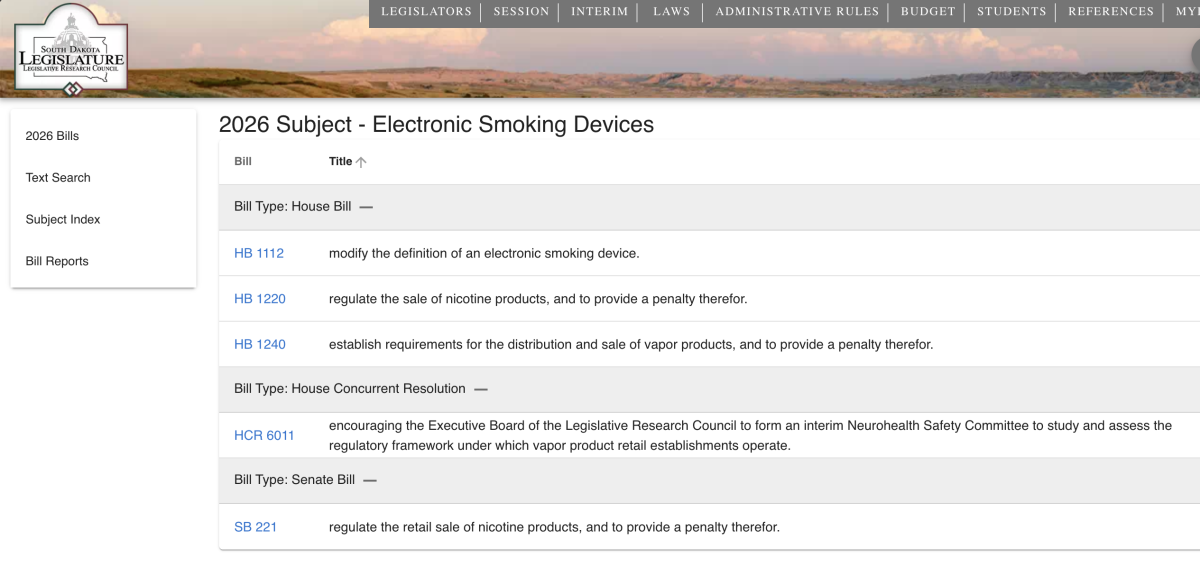
South Dakota Senate Bill 221 (SB 221), which seeks to regulate the retail sale of nicotine products, has passed the Senate Health and Human Services Committee with a unanimous 7–0 recommendation. The bill was significantly amended, expanding from three to nine pages and shifting its focus from vapor products alone to all nicotine products.

Key Points


  • Senate Bill 221 would require retailers to obtain a state license to sell nicotine products in South Dakota.


  • The amended bill expands its scope from vapor products to all nicotine products.


  • Licensed retailers would be restricted from vending machine sales, direct shipping, phone sales and free samples.


  • The measure establishes a 500-foot distance requirement from schools for new nicotine retail locations.


  • The Senate committee advanced the bill on a 7–0 vote.


2Firsts, February 22, 2026 


 According to KELO, A South Dakota Senate committee has advanced Senate Bill 221 (SB 221), legislation aimed at tightening regulations on nicotine product sales in the state.


The Senate Health and Human Services Committee recommended passage of the amended bill on a 7–0 vote. Originally introduced as a three-page measure focused on vapor products, the bill was revised into a nine-page proposal covering all nicotine products.


Under the amended legislation, retailers would be required to secure a state license to sell nicotine products. The bill specifies that license holders would be prohibited from selling nicotine products through vending machines, shipping products directly to individuals, conducting sales by phone, or providing free samples. Sales to individuals under 21 would remain illegal under existing South Dakota law.


The proposal also establishes a location restriction, preventing licensed nicotine retailers from operating within 500 feet of an elementary or secondary school. An exception would apply to businesses that sold nicotine products at the same location prior to July 1, 2026.


Republican Sen. Chris Kar, the bill’s prime sponsor, said the measure addresses what he described as an evolving nicotine delivery market, particularly disposable vapes, which he said has developed faster than state statutes.


Supporters, including representatives from the American Heart Association and the South Dakota Nurses Association, cited youth usage rates. Opponents, including representatives of South Dakota Retailers for Better Alternatives and the South Dakota Retailers Association, argued that the bill could impose additional regulatory burdens on law-abiding businesses.


Lawmakers in favor of the bill said it introduces “guardrails” while not preventing adults aged 21 and over from legally purchasing nicotine products.


(Cover Image Source: sdlegislature.gov)


This document has been generated through artificial intelligence translation and is provided solely for the purposes of industry discourse and learning. Please note that the intellectual property rights of the content belong to the original media source or author. Owing to certain limitations in the translation process, there may be discrepancies between the translated text and the original content. We recommend referring to the original source for complete accuracy. In case of any inaccuracies, we invite you to reach out to us with corrections. If you believe any content has infringed upon your rights, please contact us immediately for its removal.
West Virginia Senate Backs Vape Tax Increase to Offset Income Tax Cut
The West Virginia Senate approved a 10% personal income tax cut on February 22, 2026, with part of the revenue offset coming from increased excise taxes on vape and e-cigarette products.
News
Feb.23
PMTA Roundtable Opens with Industry Questioning Product Characterization Standards, FDA Defends Regulatory Boundaries
At the opening of FDA’s PMTA roundtable, small ENDS manufacturers warned that unclear product characterization standards are limiting their ability to invest and raise capital. FDA officials acknowledged industry concerns but said regulatory flexibility is constrained by statutory and procedural boundaries.
Feb.11
FDA Commissioner Stresses “Predictability” as Science Chief Addresses Industry Uncertainty
FDA Commissioner Marty Makary briefly appeared at the February 10 PMTA roundtable, underscoring the importance of regulatory predictability. At the close of the session, Office of Science Director Matthew Farrelly responded to industry concerns over review uncertainty, stating the agency will issue a written summary of feedback, while reiterating that no fixed quantitative risk benchmark governs authorization decisions.
Feb.11
Nicotine Becomes Second-Largest Revenue Source for Couche-Tard in Fiscal 2025
Alimentation Couche-Tard reported that nicotine products accounted for 9% of total revenue in fiscal 2025, making it the company’s second-largest revenue source after fuel, according to its latest Business Strategy Update.
Market
Feb.19
Michigan Senate Bill 786 Seeks to Ban Sale of Vapes With Metal Heating Elements
Michigan lawmakers introduced Senate Bill 786 on February 18, 2026, proposing to prohibit the sale or transfer of vapor products that contain heating elements unless those elements are made of or encased in glass or ceramic materials
Regulations
Feb.21
New Nicotine Products Added to Tax List in Delaware Budget Proposal
Delaware Governor Matt Meyer’s proposed FY2027 budget would significantly raise cigarette and nicotine product taxes to help close a $500 million budget gap and generate new revenue. The cigarette tax would rise from $2.10 to $3.60 per pack, with increases on moist snuff, e-liquids and other tobacco products. Supporters say the move is justified, while small businesses warn of potential sales losses.
Feb.17