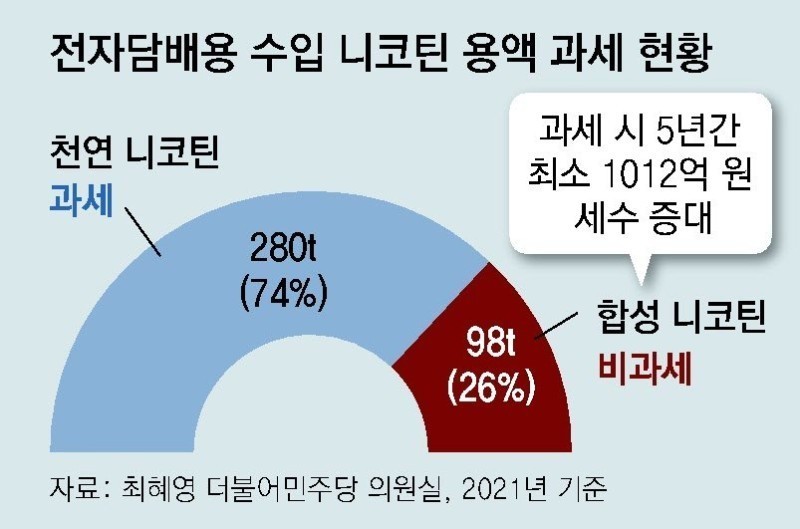
According to a report by South Korean news portal Naver on August 8th, data obtained by Korean lawmaker Choi Hye-young from customs revealed that a total of 378 tons of e-liquid was imported in 2021, with 98 tons of it containing synthetic nicotine, accounting for 26% of the total.
Currently, natural nicotine is subject to consumption tax, value-added tax, and a national health promotion fee, as well as local tobacco consumption tax and local education tax. However, synthetic nicotine is not subject to any taxes or fees. According to the Congressional Budget Policy Office, starting next year, synthetic nicotine will be subject to the same taxation and health promotion fees as natural nicotine. It is estimated that this measure will increase tax revenue by 101.2 billion Korean won over the next five years.
The e-cigarette industry produces e-liquid by diluting synthesized nicotine, with taxes and fees being levied on the final e-liquid product. As a result, the expected benefits of actual tax revenue are anticipated to be higher than projected. Kim Dohwan, Vice President of the Korean E-Cigarette Association, stated that "natural nicotine is typically in a finished state, whereas 1 ton of synthesized nicotine can produce approximately 90 tons of e-liquid products.
Under current regulations, e-liquid advertisements are not subject to the same strict restrictions as regular tobacco and online sales cannot be stopped. As 59% of synthetic nicotine comes from China, "Chinese companies are taking advantage of the regulatory gray area to profit," according to industry insiders.
Currently, the amendment to the Tobacco Business Act, which classifies e-cigarettes as "tobacco" and includes them in the scope of regulation, is being reviewed in the Congressional Finance and Planning Committee. However, due to the Ministry of Finance's insistence that the toxicity and safety of synthetic nicotine have not been confirmed, and their opposition to including it in the scope of tobacco, the amendment has not made substantial progress. Regarding e-liquid, some have pointed out the need for measures to be introduced from a public health perspective due to a lack of awareness.
According to a recent paper published by a research team from the Qiming Medical University, the analysis of adult e-cigarette usage and smoking cessation plans in South Korea reveals that users of e-liquids have no intention of quitting smoking, with a likelihood of continued tobacco use that is 1.8 times higher than that of traditional tobacco users. Assemblywoman Choi Hye-young emphasized that "even if it is only for the sake of public health, synthetic nicotine should be included in taxation and regulatory frameworks.
We welcome news tips, article submissions, interview requests, or comments on this piece.
Please contact us at info@2firsts.com, or reach out to Alan Zhao, CEO of 2Firsts, on LinkedIn
Notice
1. This article is intended solely for professional research purposes related to industry, technology, and policy. Any references to brands or products are made purely for objective description and do not constitute any form of endorsement, recommendation, or promotion by 2Firsts.
2. The use of nicotine-containing products — including, but not limited to, cigarettes, e-cigarettes, nicotine pouchand heated tobacco products — carries significant health risks. Users are responsible for complying with all applicable laws and regulations in their respective jurisdictions.
3. This article is not intended to serve as the basis for any investment decisions or financial advice. 2Firsts assumes no direct or indirect liability for any inaccuracies or errors in the content.
4. Access to this article is strictly prohibited for individuals below the legal age in their jurisdiction.
Copyright
This article is either an original work created by 2Firsts or a reproduction from third-party sources with proper attribution. All copyrights and usage rights belong to 2Firsts or the original content provider. Unauthorized reproduction, distribution, or any other form of unauthorized use by any individual or organization is strictly prohibited. Violators will be held legally accountable.
For copyright-related inquiries, please contact: info@2firsts.com
AI Assistance Disclaimer
This article may have been enhanced using AI tools to improve translation and editorial efficiency. However, due to technical limitations, inaccuracies may occur. Readers are encouraged to refer to the cited sources for the most accurate information.
We welcome any corrections or feedback. Please contact us at: info@2firsts.com