Spain Takes Action to Ban Smoking in Public Places

Regulations by 2FIRSTS.ai
Feb.01.2024
Spain Takes Action to Ban Smoking in Public Places
Spain's Health Ministry is taking action to ban smoking in public places, including e-cigarettes, as part of a comprehensive tobacco control plan.

According to a report by equinoxmagazine on January 31st, the Spanish Ministry of Health is taking proactive measures to eradicate smoking in public spaces.


Spanish Health Minister Monica Garcia, a medical doctor, emphasizes implementing protection and prevention in public health issues. Currently, she is launching a large-scale campaign targeting various forms of smoking. This official from Madrid has announced a "comprehensive plan for the prevention and control of smoking, aiming to change perceptions regarding e-cigarettes, smoke-free areas, and regulations related to addiction prevention and protecting public health.


Monica announced in a press release that "flavorings in tobacco derivatives such as cigarette filters, rolling papers, and tobacco capsules are now completely prohibited." E-liquids used in e-cigarettes will be subject to "regulations similar to traditional tobacco." She emphasized that "the sale of flavored e-liquid is now prohibited and it is necessary to label the product as harmful to health." These regulations will come into effect within three months of being announced.


At the same time, the Spanish Ministry of Health plans to implement a comprehensive smoking ban in bar terraces, public places such as parks, beaches, and schools nearby. This measure will apply to cigarettes, cigars, pipes, and e-cigarettes.


We welcome news tips, article submissions, interview requests, or comments on this piece.

Please contact us at info@2firsts.com, or reach out to Alan Zhao, CEO of 2Firsts, on LinkedIn


Notice

1.  This article is intended solely for professional research purposes related to industry, technology, and policy. Any references to brands or products are made purely for objective description and do not constitute any form of endorsement, recommendation, or promotion by 2Firsts.

2.  The use of nicotine-containing products — including, but not limited to, cigarettes, e-cigarettes, nicotine pouchand heated tobacco products — carries significant health risks. Users are responsible for complying with all applicable laws and regulations in their respective jurisdictions.

3.  This article is not intended to serve as the basis for any investment decisions or financial advice. 2Firsts assumes no direct or indirect liability for any inaccuracies or errors in the content.

4.  Access to this article is strictly prohibited for individuals below the legal age in their jurisdiction.


Copyright


This article is either an original work created by 2Firsts or a reproduction from third-party sources with proper attribution. All copyrights and usage rights belong to 2Firsts or the original content provider. Unauthorized reproduction, distribution, or any other form of unauthorized use by any individual or organization is strictly prohibited. Violators will be held legally accountable.

For copyright-related inquiries, please contact: info@2firsts.com


AI Assistance Disclaimer


This article may have been enhanced using AI tools to improve translation and editorial efficiency. However, due to technical limitations, inaccuracies may occur. Readers are encouraged to refer to the cited sources for the most accurate information.

We welcome any corrections or feedback. Please contact us at: info@2firsts.com

As JUUL2 Wins FDA Authorization, Harm Reduction Journal Highlights the Role of Real-World Evidence in Nicotine Product Regulation
A commentary published in the international open-access, peer-reviewed Harm Reduction Journal argues that randomized controlled trials remain central to evaluating smoking cessation efficacy but cannot alone capture real-world uptake, complete switching, longer-term use and population impact of non-combustible nicotine products such as e-cigarettes, heated tobacco and nicotine pouches. The authors frame impact as “reach × efficacy” and call for real-world evidence to complement RCTs. Three days after publication, the FDA authorized three JUUL2 products and highlighted complete switching among adult smokers in explaining its decision, providing a timely regulatory backdrop to the debate.
Sep.08
Couche-Tard Posts Double-Digit U.S. Same-Store Growth in Other Nicotine Products, Led by Pouches
Alimentation Couche-Tard said U.S. same-store sales in its “other nicotine products” category grew at a double-digit rate in the first quarter of fiscal 2027, led by nicotine pouches, while overall U.S. same-store merchandise revenues increased 1.7%. The company also said its Canadian nicotine business continued to face regulatory pressure and illicit-market headwinds. The U.S. performance coincides with Couche-Tard's participation in efforts to reopen Canadian convenience-store access to authorized nicotine pouches, though the company has not established a direct causal link between the two.
Sep.14
South Korea Constitutional Court Upholds Volume-Based E-Liquid Tax, With Challenged Rates at KRW 370 and KRW 628 per Milliliter
South Korea's Constitutional Court has upheld fixed taxes on nicotine-containing e-cigarette liquids based on solution volume, ruling that challenged provisions imposing KRW 370 per milliliter in individual consumption tax and KRW 628 per milliliter in tobacco consumption tax do not violate the Constitution. The cases stemmed from historical disputes involving importers that reported nicotine as being extracted from tobacco stems rather than leaves. South Korea has since broadened its tobacco definition to include synthetic nicotine, while current tax laws provide reduced rates for certain products not derived from tobacco.
Sep.18
FDA Authorizes JUUL2, Cites Adult Switching Amid Efforts to Speed PMTA Reviews
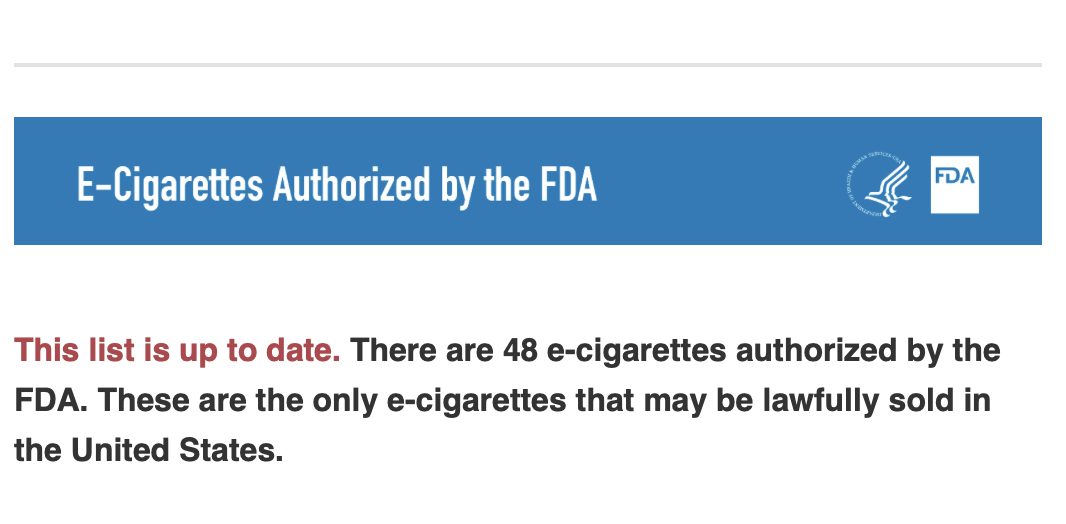
The FDA authorized the JUUL2 device and tobacco- and menthol-flavored pods on Aug. 28, bringing the number of authorized e-cigarette products to 48. The agency highlighted complete switching among adult smokers, with six-week switching rates reaching 28.4%–49.3% for the menthol pod. The decision comes as FDA works to speed PMTA reviews, reduce application backlogs and expand authorized e-cigarette and nicotine-pouch products while maintaining enforcement priorities for unauthorized products.
Regulations
Aug.29
Product | BAT Japan Launches virto Bright Peach Click in Japan, Expanding glo Hilo’s Capsule-Based Flavor Portfolio
British American Tobacco Japan (BAT Japan) has introduced virto Bright Peach Click, a new heated tobacco stick designed for the glo Hilo system. The product expands the existing virto consumable lineup with a combination of tobacco, menthol and ripe peach flavors, featuring a capsule mechanism that releases additional fruit flavor when activated. The product launched in Japan on July 27, 2026, through glo official online channels, convenience stores and tobacco retailers.
Aug.03
Trump Picks White House Health Policy Aide Heidi Overton to Lead FDA, Pending Senate Confirmation
U.S. President Donald Trump has chosen White House health policy aide Heidi Overton to lead the Food and Drug Administration, Bloomberg reported, citing a person familiar with the matter. Overton currently works on health policy at the White House and previously held a senior role at the America First Policy Institute. If confirmed by the Senate, she would take over an FDA that has experienced months of senior-level turnover. The agency regulates products representing roughly one-fifth of U.S. consumer spending, including e-cigarettes, drugs, vaccines and much of the food supply.
News
Aug.19