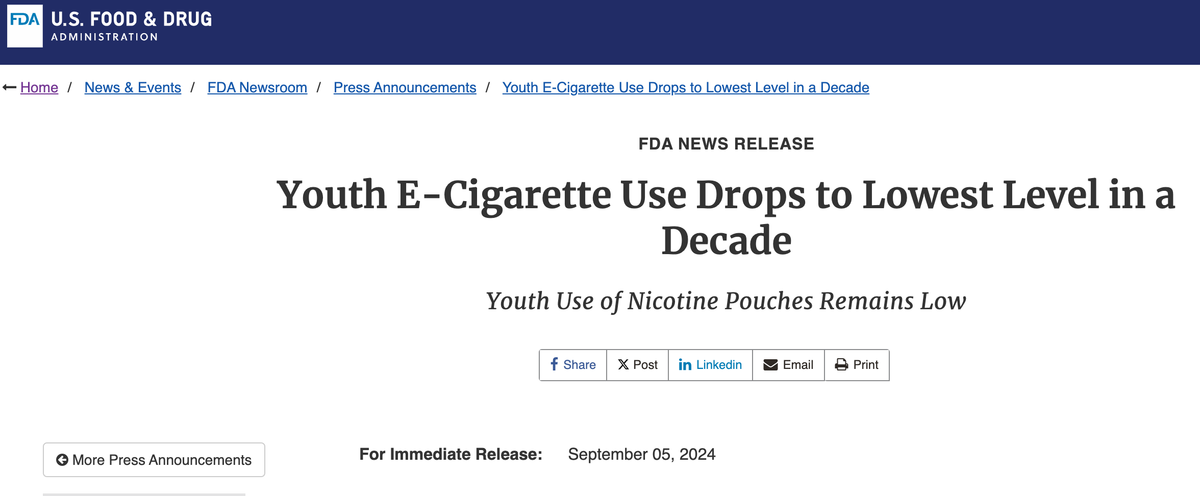
On September 5th, the latest data from the National Youth Tobacco Survey (NYTS) released by the Food and Drug Administration (FDA) and the Centers for Disease Control and Prevention (CDC) shows that the number of American adolescents using e-cigarettes decreased by 500,000 in 2024 compared to 2023. This data was published in the Morbidity and Mortality Weekly Report (MMWR).
The National Youth Tobacco Survey is an annual self-management survey based on schools, targeting middle school students (grades 6-8) and high school students (grades 9-12) in the United States. The survey was conducted from January 22 to May 22, 2024. The results showed a significant decrease in the number of middle and high school students reporting current (past 30 days) e-cigarette use - from 2.13 million (7.7%) in 2023 to 1.63 million (5.9%) in 2024. This decrease was primarily due to a decrease in high school students using e-cigarettes (from 1.56 million to 1.21 million), while the e-cigarette use rate among middle school students did not change significantly in the past year. The number of youth using e-cigarettes in 2024 is approximately one-third of the peak in 2019, with over 5 million young people reporting current e-cigarette use.
Among adolescents currently using e-cigarettes, 26.3% report using them daily. The vast majority of current e-cigarette users among adolescents use flavored products (87.6%), with fruit flavors (62.8%), candy flavors (33.3%), and mint flavors (25.1%) being the most common three flavors. Disposable e-cigarette products are the most widely used type of product; however, the most popular brands include both disposable and pod-style products. Among adolescents currently using e-cigarettes, the most commonly reported brands are ELFBAR (36.1%), Breeze (19.9%), Mr. Fog (15.8%), Vuse (13.7%), and JUUL (12.6%).
In the past year, the number of teenagers using ELFBAR brand e-cigarette products has significantly decreased from 56.7% in 2023 to 36.1% in 2024. ELFBAR, which is not FDA authorized, has been the subject of FDA compliance and enforcement actions since early 2023, including over 1000 warning letters and 240 civil fines issued to retailers and other entities in the supply chain. The FDA has also issued import alerts for ELFBAR brand products, placing them on a "red list" that allows the FDA to detain these products upon entry without conducting a full inspection.
The usage rate of nicotine pouches did not significantly change in 2024 compared to 2023 (1.5% in 2023 and 1.8% in 2024), but among adolescents using nicotine pouches, 22.4% reported daily use. The most common brands among youth using nicotine pouches were ZYN (68.7%), on! (14.2%), Rogue (13.6%), Velo (10.7%), and Juice Head ZTN (9.8%). Among current youth users of nicotine pouches, the majority used flavored products (85.6%), with mint flavor (53.3%), fruit flavor (22.4%), and mint chill flavor (19.3%) being the most common three flavors.
Dr. Brian King, Director of the FDA Center for Tobacco Products, stated that...
Although these numbers are relatively low overall, we remain concerned about all tobacco products that appeal to young people. We will continue to monitor the sales trends of nicotine pouches and their threat to public health, especially among teenagers.
We welcome news tips, article submissions, interview requests, or comments on this piece.
Please contact us at info@2firsts.com, or reach out to Alan Zhao, CEO of 2Firsts, on LinkedIn
Notice
1. This article is intended solely for professional research purposes related to industry, technology, and policy. Any references to brands or products are made purely for objective description and do not constitute any form of endorsement, recommendation, or promotion by 2Firsts.
2. The use of nicotine-containing products — including, but not limited to, cigarettes, e-cigarettes, nicotine pouchand heated tobacco products — carries significant health risks. Users are responsible for complying with all applicable laws and regulations in their respective jurisdictions.
3. This article is not intended to serve as the basis for any investment decisions or financial advice. 2Firsts assumes no direct or indirect liability for any inaccuracies or errors in the content.
4. Access to this article is strictly prohibited for individuals below the legal age in their jurisdiction.
Copyright
This article is either an original work created by 2Firsts or a reproduction from third-party sources with proper attribution. All copyrights and usage rights belong to 2Firsts or the original content provider. Unauthorized reproduction, distribution, or any other form of unauthorized use by any individual or organization is strictly prohibited. Violators will be held legally accountable.
For copyright-related inquiries, please contact: info@2firsts.com
AI Assistance Disclaimer
This article may have been enhanced using AI tools to improve translation and editorial efficiency. However, due to technical limitations, inaccuracies may occur. Readers are encouraged to refer to the cited sources for the most accurate information.
We welcome any corrections or feedback. Please contact us at: info@2firsts.com