Australia Adds 6-Methylnicotine to Schedule 9 Prohibited Substances, Effective October 1

News
Sep.29
Australia Adds 6-Methylnicotine to Schedule 9 Prohibited Substances, Effective October 1
Australia's Therapeutic Goods Administration published a final decision on September 25 to classify 6-methylnicotine as a Schedule 9 prohibited substance under the Poisons Standard, effective October 1, 2026. TGA said the chemical has been reported in e-cigarette liquids sold in Australia and marketed as nicotine-free or nicotine alternatives, while evidence also indicates its use in preparations such as oral pouches. The government originally proposed a Schedule 7 classification but ultimately adopted the stricter Schedule 9 designation, citing acute toxicity, dependence risk, use in unapproved consumer products and misleading marketing.

Key Points

  • Australia will classify 6-methylnicotine as a Schedule 9 prohibited substance from October 1, 2026.
  • The government initially proposed Schedule 7 but moved to Schedule 9 to strengthen controls over unlawful supply and possession.
  • TGA said the substance has appeared in nicotine-free or nicotine-alternative e-cigarette liquids sold in Australia and is also being added to preparations such as oral pouches.
  • An Australian study tested nine nicotine-alternative vape products and found 6-methylnicotine in all nine, with concentrations reaching about 100 mg/mL.

2Firsts

September 29, 2026

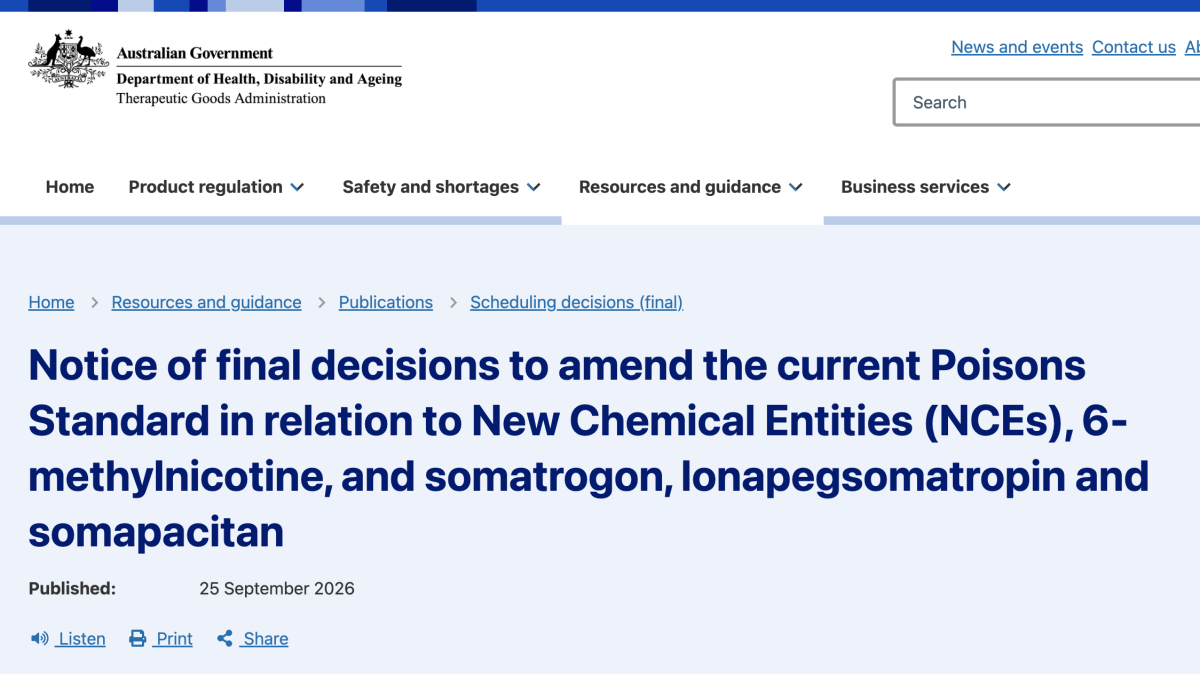
Australia's Therapeutic Goods Administration published a final decision on September 25 to classify 6-methylnicotine as a Schedule 9 prohibited substance under the country's Poisons Standard, effective October 1, 2026.

TGA said 6-methylnicotine has been reported in several e-cigarette liquids sold in Australia and advertised as nicotine-free or as nicotine alternatives. The regulator also cited evidence that the substance is being added to preparations such as oral pouches.

Australia Moves From Proposed Schedule 7 to Schedule 9

The Department of Health, Disability and Ageing initially proposed creating a Schedule 7 Dangerous Poison entry for 6-methylnicotine.

Following consideration by the Advisory Committee on Medicines Scheduling, the regulator ultimately confirmed an interim decision to place the substance in the more restrictive Schedule 9 category.

TGA cited acute toxicity, use in unapproved consumer products, misleading “nicotine-free” marketing and the risk of dependence, particularly among vulnerable populations.

The regulator said there are no identified therapeutic benefits for 6-methylnicotine and no lawful products currently available in Australia that would be affected by the decision.

TGA said Schedule 7 would not provide sufficient controls, while Schedule 9 offers a stronger legal framework for action against unlawful supply and possession, including higher penalties under Commonwealth and state or territory drug laws.

Study Found 6-Methylnicotine in All Nine Vape Products Tested

The regulatory decision follows earlier Australian research into products marketed as nicotine alternatives.

A 2024 study published in the Medical Journal of Australia analysed nine e-cigarette products purchased in Australia in November 2023 from three manufacturers. The samples included four concentrated solutions for dilution and five ready-to-use disposable devices or pod cartridges.

Products carried descriptions including “nicotine derivative,” “nicotine alternative agent,” “no-nicotine nicotine solution” and claims of a nicotine-like experience without nicotine.

Laboratory testing found 6-methylnicotine in all nine products.

Two concentrates labelled as equivalent to 100 mg/mL nicotine contained about 31.4 mg/mL and 20 mg/mL of 6-methylnicotine. Of two products labelled as 10% solutions, one contained about 100 mg/mL and the other about 57 mg/mL.

Brand names were not disclosed in the published study.

Routine Nicotine Analysis Did Not Identify the Compound

Researchers said the ingredient in all nine products was not identified by the routine analytical testing they used for nicotine.

They subsequently used nuclear magnetic resonance spectroscopy and high-resolution mass spectrometry to identify and fully characterise it as 6-methylnicotine.

The study cited laboratory evidence indicating that 6-methylnicotine has higher affinity for some nicotinic cholinergic receptors than nicotine and referenced earlier research reporting psychotropic potency around three times that of nicotine.

Researchers also said data on long-term inhalation and human health effects remain limited.

TGA Considered 163 Initial Public Submissions

TGA said it considered 163 public submissions during the pre-meeting consultation, nine of which included a written component.

One further submission was received during consultation on the interim decision and supported the stronger Schedule 9 classification.

The final decision confirmed the interim position and set an implementation date of October 1.

Schedule 9 Decision Targets the Substance Itself

Australia had already tightened separate product-level controls on vaping goods and nicotine pouches before the latest decision.

Non-therapeutic vapes cannot be supplied through ordinary retail channels, while regulated therapeutic vaping goods remain available through pharmacies under applicable requirements.

Australia tightened nicotine pouch regulation again in July 2026. From July 24, consumers can no longer import nicotine pouches under the Personal Importation Scheme or access unapproved pouches through the Special Access Scheme, Authorised Prescriber Scheme or pharmacist compounding pathways. TGA says there is now no lawful pathway for consumers to buy or import nicotine pouches in Australia.

The latest decision does not target a particular vape or pouch brand. It schedules 6-methylnicotine itself as a prohibited substance.

TGA's final notice does not identify specific vape brands, oral pouch brands or manufacturers linked to the substance.

From October 1, unlawful supply and possession of 6-methylnicotine will be subject to the stronger legal controls associated with Schedule 9 under Commonwealth and state or territory drug laws.

Follow 2Firsts for updates on global vape, nicotine pouch and novel nicotine-analogue regulation.

Cover Image: Therapeutic Goods Administration

Malaysia’s Vape Rules Face Review as Health Minister Dzulkefly Ahmad Addresses Dropped Nicotine Appeal
According to Free Malaysia Today on August 26, 2026, Malaysia’s Health Minister Dzulkefly Ahmad said the Health Ministry would explain the government’s decision to withdraw its appeal against a High Court ruling involving the exemption of liquid nicotine used in vape products from the Poisons List. The High Court previously ruled that the exemption decision was irrational. Dzulkefly said withdrawing the appeal did not mean the government would stop regulating vaping, and that future regulatory approaches would continue under existing legal frameworks.
Aug.28
Philippines BIR Steps Up Illicit Vape Enforcement Ahead of Christmas Shopping
The Philippines’ Bureau of Internal Revenue is intensifying enforcement against illicit vape and tobacco products ahead of the Christmas shopping season, directing regional and enforcement offices to strengthen monitoring of production sites, warehouses, distribution channels and retail outlets. The BIR destroyed 240,550 illicit vape products in August with an estimated tax liability of about PHP1.53 billion. A nationwide tax-compliance operation in July also inspected 3,590 businesses involved in tobacco and vapor products.
Regulations
Sep.17 by 2Firsts Perspectives
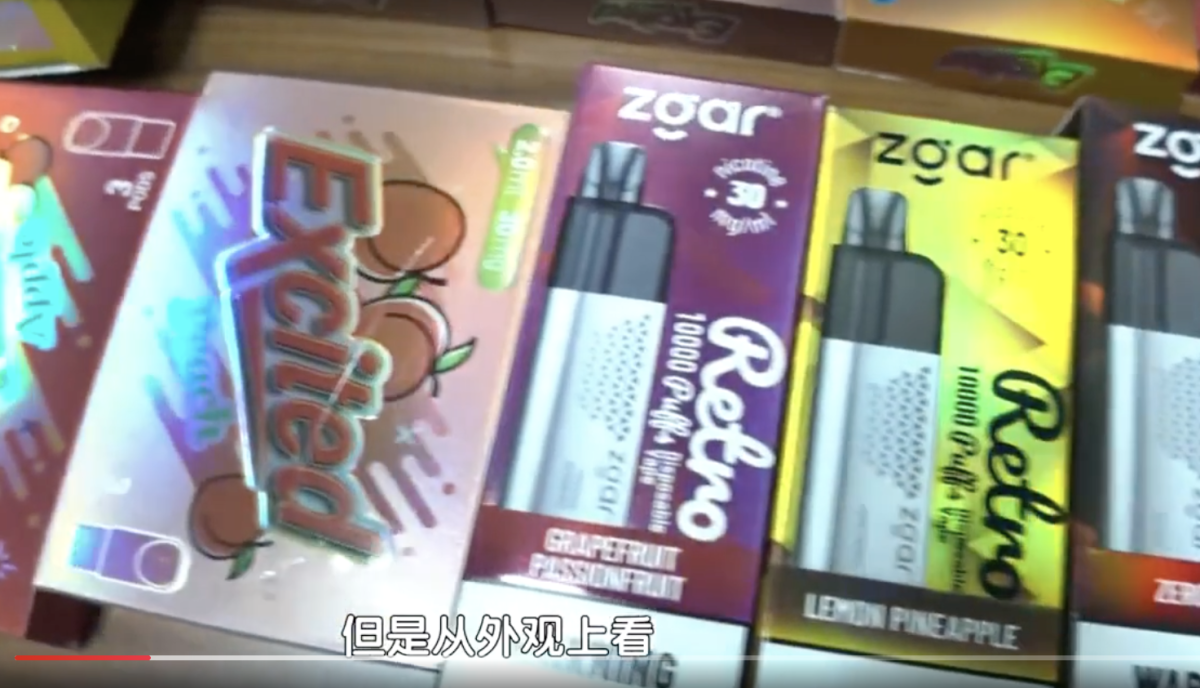
China Discloses First Criminal Case Over Counterfeit Vapes Disguised as “Medical Nebulizers” and “Zero-Nicotine” Products
Chinese authorities have disclosed the country’s first reported criminal case involving counterfeit vapes marketed as “medical nebulizers” and “zero-nicotine” products. Authorities determined that the products involved were counterfeit vapes and pursued criminal charges for producing and selling counterfeit goods. According to the report, the case resulted in the seizure of 347,000 counterfeit vape pods and 53,700 vape devices, with physical goods valued at 22.13 million yuan.
Aug.04
Canada Health Minister Says She Is Not Considering Looser Nicotine Pouch Retail Rules as PMI-Linked Group Pushes for Wider Access
Canadian Health Minister Marjorie Michel says she is not considering loosening retail restrictions on nicotine pouches. Canada regulates pouches containing 4 mg or less of nicotine per unit as non-prescription nicotine replacement therapy and requires newer NRT formats such as pouches to be sold from behind pharmacy counters. Meanwhile, Unsmoke Canada, linked to Philip Morris International's Canadian business, is pushing to allow pouches in convenience stores and other general retail outlets. Health Canada also acknowledges continued unauthorized sales, while recent research shows rising pouch use among Canadian youth aged 16 to 19.
Sep.24
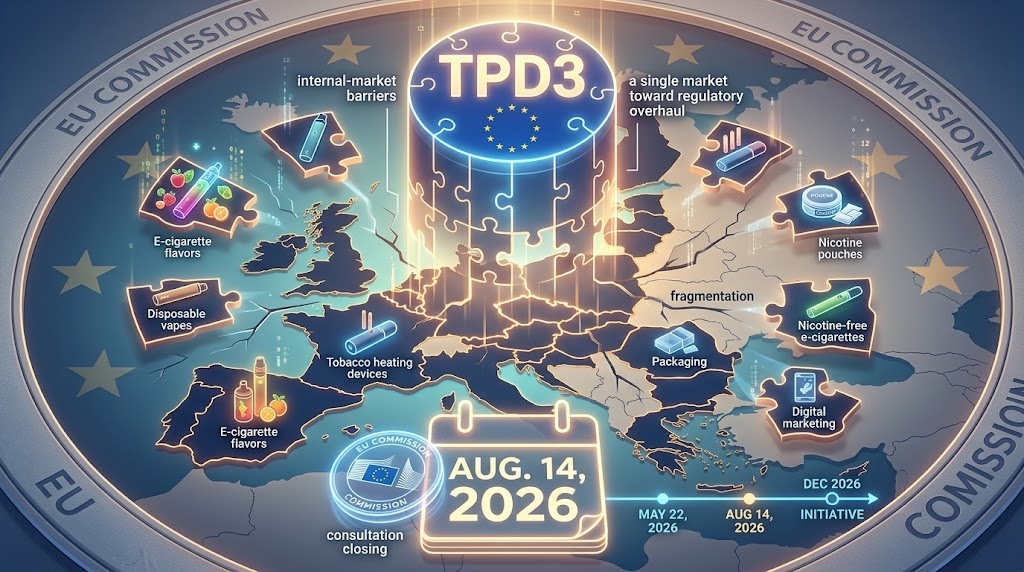
EU ‘TPD3’ Enters Next Phase on Aug. 14 as Fragmented Vape and Nicotine Pouch Rules Push the Single Market Toward Regulatory Overhaul
A 12-week European Commission consultation on revising the Tobacco Products Directive and Tobacco Advertising Directive is due to close on Aug. 14, 2026. The Commission has identified e-cigarette flavours, disposable vapes, tobacco heating devices, nicotine pouches, nicotine-free e-cigarettes, packaging and digital marketing among areas for possible new EU rules. National regulations already vary significantly across the bloc, a fragmentation the Commission says creates internal-market barriers and distorts competition. No formal revised TPD/TAD legislative text has yet been published, with the Commission currently indicating December 2026 for the legislative initiative.
Aug.14
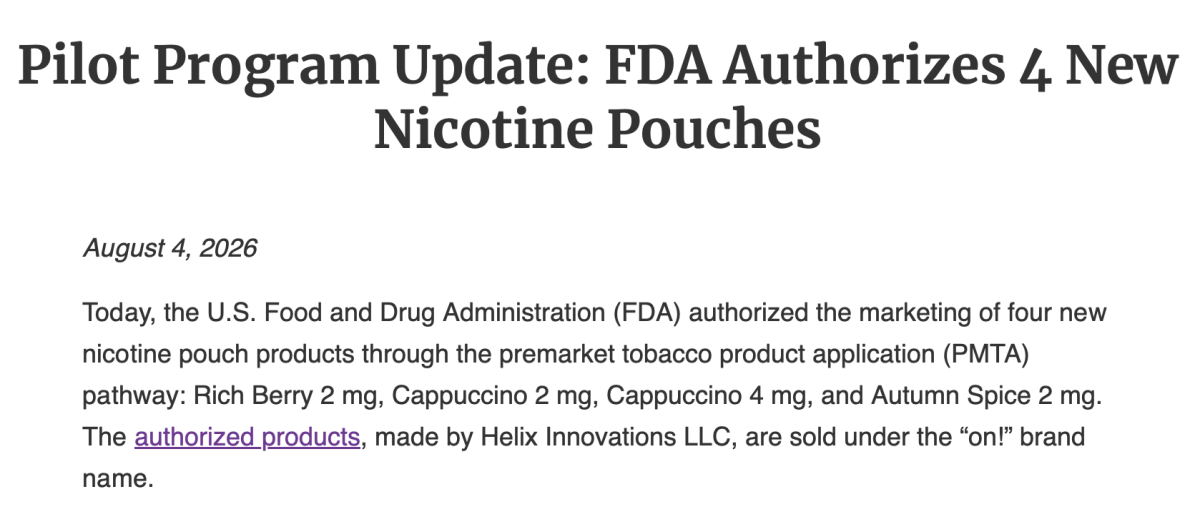
FDA Authorizes Four More Nicotine Pouches as Review Pilot Expands Beyond Initial Decisions
The FDA has authorized four additional on! nicotine pouches, bringing the U.S. total to 30. The decision marks another outcome of the agency’s nicotine pouch review pilot, whose communication and review practices are now being applied more broadly across the category. It also extends Helix’s authorized portfolio from on! PLUS to the earlier on! line. Yet all FDA-authorized nicotine pouches still come from subsidiaries of PMI or Altria, underscoring how concentrated U.S. regulatory access remains.
Aug.05