On November 28th, according to reports from multiple Australian media outlets, the Australian Minister of Health, Mark Butler, announced a series of regulatory policies regarding e-cigarettes. Below is a comprehensive compilation of these policies by 2FIRSTS.
Beginning in January 2024, the importation of disposable e-cigarettes will be prohibited in Australia. Additionally, Australian doctors and nurses will be granted the authority to prescribe e-cigarettes for patients, who will then be able to purchase them at pharmacies. This signals a loosening of e-cigarette prescription restrictions in Australia, expanding access beyond general practitioners. Starting in March 2024, personal imports of e-cigarettes will also be banned, meaning domestic consumers will no longer be allowed to purchase e-cigarettes from other countries. Furthermore, non-therapeutic open system imports will be prohibited, and stricter regulations regarding flavors, nicotine concentrations, and packaging will be enforced. However, the government has assured businesses a transition period to comply with the new requirements. Moreover, the government intends to prohibit domestic manufacturing, advertising, supply, and commercial ownership of non-therapeutic and disposable e-cigarettes in Australia.
Butler stated that the purpose of this measure is to reverse the trend of young Australians using e-cigarettes, although he also acknowledges that the plan is not perfect.
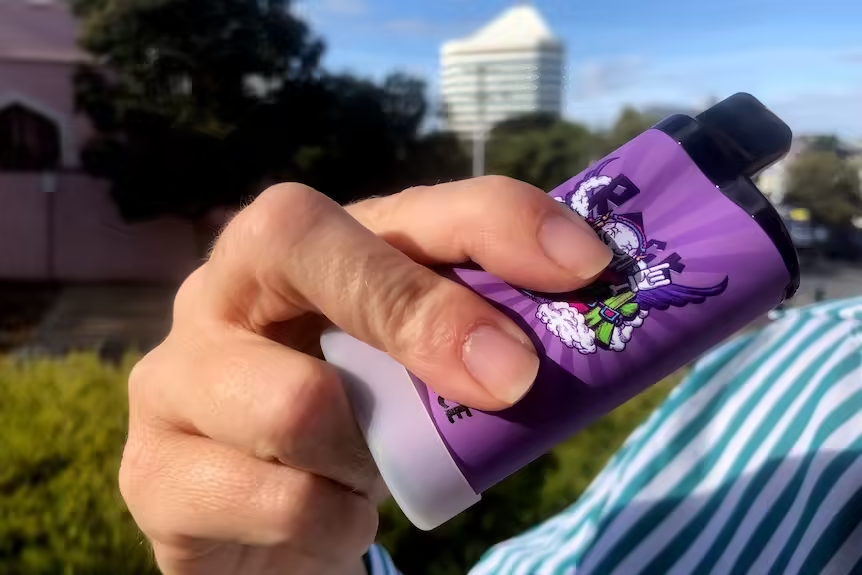
According to reports, Australia has recently made the decision to completely ban the sale of disposable e-cigarettes. The only legal method of purchase is through a prescription issued by a general practitioner, which allows individuals to buy them from pharmacies or online platforms outside the country. Any other means of purchase, such as buying them from tobacco or convenience stores, is considered to be illegal.
Previously, 2FIRSTS learned about the process of legally purchasing e-cigarettes in Australia. Firstly, "patients" need to consult a general practitioner to obtain a prescription for e-cigarettes. The price of the prescription is approximately 70 Australian dollars (equivalent to about 330 Chinese yuan). The choice of treatment duration includes 3 months, 9 months, and 12 months, and the specific duration needs to be determined by the doctor based on individual circumstances. After obtaining the prescription, "patients" also need to contact a pharmacy to pre-order e-cigarettes, as most pharmacies do not commonly stock e-cigarette products. However, the number of e-cigarette brands available in the country's compliant e-cigarette channels (pharmacies) is very limited.
Some people argue that the legal e-cigarette business in Australia has virtually no market and that prescriptions seem to be a superficial policy. It is reported that the compliant e-cigarette market in Australia accounts for less than 5%, while illegal products make up more than 95%. According to previous communications with individuals involved in the Australian e-cigarette market, there are still a significant number of e-cigarette retail stores in Australia, with over 2,000 in Sydney alone.
In addition, according to 2FIRSTS, Australian consumers primarily purchase e-cigarettes through online stores in New Zealand under the "personal importation scheme". Therefore, it is expected that the New Zealand market may experience some impact after the ban on the personal importation scheme takes effect in March next year.
We welcome news tips, article submissions, interview requests, or comments on this piece.
Please contact us at info@2firsts.com, or reach out to Alan Zhao, CEO of 2Firsts, on LinkedIn
Notice
1. This article is intended solely for professional research purposes related to industry, technology, and policy. Any references to brands or products are made purely for objective description and do not constitute any form of endorsement, recommendation, or promotion by 2Firsts.
2. The use of nicotine-containing products — including, but not limited to, cigarettes, e-cigarettes, nicotine pouchand heated tobacco products — carries significant health risks. Users are responsible for complying with all applicable laws and regulations in their respective jurisdictions.
3. This article is not intended to serve as the basis for any investment decisions or financial advice. 2Firsts assumes no direct or indirect liability for any inaccuracies or errors in the content.
4. Access to this article is strictly prohibited for individuals below the legal age in their jurisdiction.
Copyright
This article is either an original work created by 2Firsts or a reproduction from third-party sources with proper attribution. All copyrights and usage rights belong to 2Firsts or the original content provider. Unauthorized reproduction, distribution, or any other form of unauthorized use by any individual or organization is strictly prohibited. Violators will be held legally accountable.
For copyright-related inquiries, please contact: info@2firsts.com
AI Assistance Disclaimer
This article may have been enhanced using AI tools to improve translation and editorial efficiency. However, due to technical limitations, inaccuracies may occur. Readers are encouraged to refer to the cited sources for the most accurate information.
We welcome any corrections or feedback. Please contact us at: info@2firsts.com