Costa Rica Allows Agriculture Group to Grow and Process Cannabis

Dec.08.2022
Costa Rica Allows Agriculture Group to Grow and Process Cannabis
Costa Rica authorized cannabis cultivation and processing for the first time, with plans for a 150-acre factory.

According to a recent resolution signed by the Costa Rican Ministry of Agriculture, the country has authorized agricultural groups to grow and process marijuana for the first time.


Agricultural and food company, Ingenio Taboga SA, has announced plans to cultivate cannabis on 150 acres of land and construct a processing plant.


According to a report by "Today's Cannabis", Taboga, located in Guanacaste, Bedaro de Canias, has listed alcohol-based disinfectants, specialty sugars, natural sweeteners, protein powders and CBD products on its website.


Minister of Agriculture, Víctor Carvajal, stated that "the development of responsible and efficient agricultural activities with huge potential for agricultural exports is extremely important for the Ministry of Agriculture and Livestock." He also added that seven cannabis projects are currently being considered for approval, with the expectation of receiving approval soon.


Under rules approved by agricultural and health officials in September, licenses for cannabis cultivation and production are intended to be affordable and widely available in Costa Rica. Individuals and legal entities can be authorized to grow and process cannabis and establish rules for harvesting, storage, transportation, product manufacturing, marketing, import, and export of health, food, and industrial products.


Costa Rica's regulations have set the limit for tetrahydrocannabinol (THC) in marijuana plants at 1.0%. Most countries adhere to the widely accepted 0.3% THC threshold as the line between hemp and marijuana.


Advocates in Costa Rica's industry have said that establishing a robust marijuana sector could stimulate the development of the agriculture value chain by bringing economic and social opportunities to rural areas in the country, while also aiding the development of the pharmaceutical industry.


2FIRSTS will continue to provide coverage on this topic, with further updates available on the "2FIRSTSAPP." Scan the QR code below to download the app.


Disclaimer

This article is provided solely for professional research, industry discussion, and informational purposes. Any references to brands, companies, products, technologies, or policies are made for factual reporting and analytical purposes only, and do not constitute endorsement, recommendation, promotion, or advertising by 2Firsts.

Nicotine-containing products, including but not limited to cigarettes, e-cigarettes, heated tobacco products, and nicotine pouches, carry significant health risks. Readers are responsible for complying with all applicable laws and regulations in their respective jurisdictions, including age restrictions and access limitations.

The information contained in this article should not be regarded as investment, legal, medical, regulatory, or commercial advice. While 2Firsts strives to ensure the accuracy and reliability of its content, it does not assume liability for any direct or indirect loss arising from errors, omissions, inaccuracies, or reliance on the information contained herein.

This article is not intended for individuals below the legal age for accessing tobacco or nicotine-related information in their jurisdiction.


Copyright Notice

This article is either original content produced by 2Firsts or content reproduced, translated, summarized, or adapted from third-party sources with attribution where applicable. The intellectual property rights of the original content remain with 2Firsts or the respective original rights holders.

No individual or organization may copy, reproduce, distribute, republish, modify, translate, or otherwise use this content without prior authorization. Any unauthorized use may result in legal action.

For copyright-related inquiries, corrections, or removal requests, please contact: info@2firsts.com.


AI-Assisted Translation and Editing Notice

Portions of this article may have been translated, edited, or reviewed with the assistance of artificial intelligence tools to improve efficiency and readability. Due to the limitations of AI-assisted translation and editing, discrepancies, omissions, or inaccuracies may exist when compared with the original source.

Where applicable, readers are advised to refer to the original source for the most complete and accurate information. If you identify any errors or believe that any content infringes upon your rights, please contact us at info@2firsts.com, and we will review and address the matter promptly.


Philip Morris Malaysia Again Meets Religious Authority Over Cigarette Alternatives as Perlis Mufti Responds on Halal Criteria
Philip Morris Malaysia Managing Director Naeem Shahab Khan met Perlis Mufti Mohd Asri Zainul Abidin on September 17 and presented the company's shift from conventional cigarettes toward alternative products. The mufti said a product could be considered halal if it is clean, its side effects are not harmful or can be controlled, and it does not involve excessive waste. His remarks did not mention IQOS or any other specific PMI product and did not amount to a new product-specific religious ruling. It was at least the second publicly reported engagement between Philip Morris Malaysia and a Malaysian religious institution over cigarette alternatives within six months.
Regulations
Sep.18 by 2Firsts Perspectives
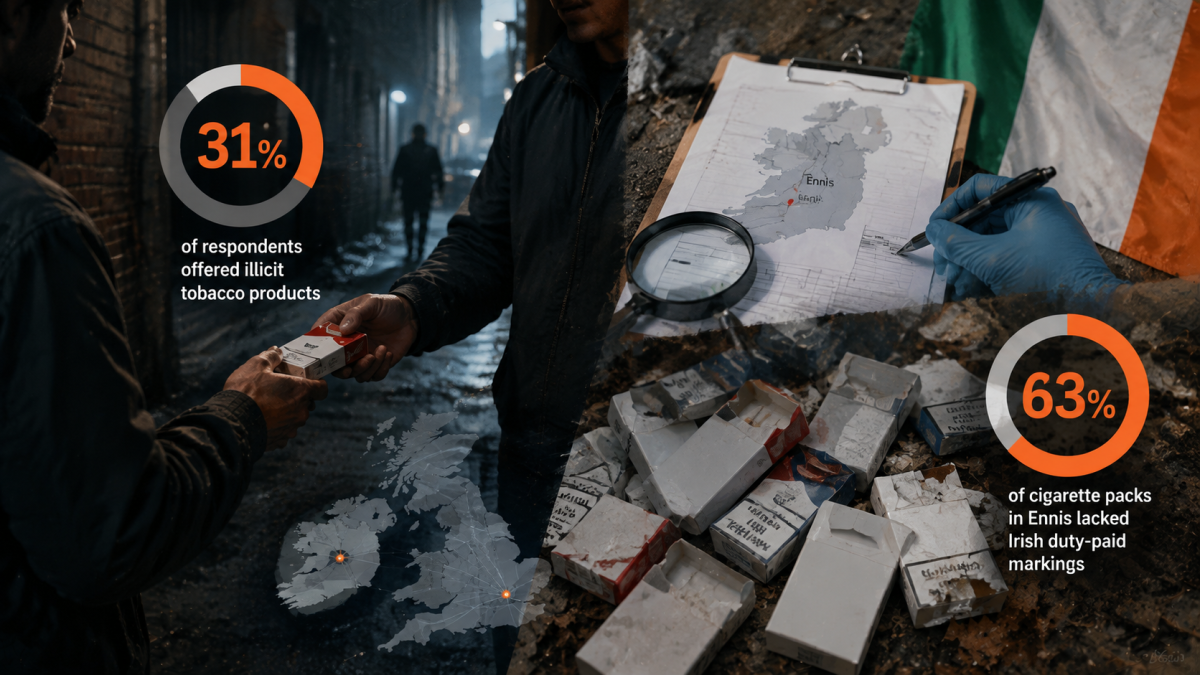
JTI Research Finds 31% of UK Respondents Offered Illicit Tobacco, While 63% of Ennis Packs Lack Duty Marks
Multiple JTI-backed studies in the UK and Ireland indicate that illicit tobacco remains visible across consumer interactions and local markets. In the UK, JTI research found that 31% of respondents said they had been offered illicit tobacco products. In Ireland’s Ennis area, a JTI-commissioned empty pack survey found that 63% of sampled cigarette packs did not carry Irish duty-paid markings. The findings come from industry research rather than official government estimates of illicit tobacco market size, but highlight continued concerns among regulators, legitimate retailers and tobacco companies over illicit trade.
Aug.19
JTI Proposes 25-Cent Irish Cigarette Tax Increase, Says It Could Raise €45 Million
Japan Tobacco International's Irish business has proposed a €0.25 tax increase on a pack of 20 cigarettes in its pre-Budget 2027 submission, below the €0.50-or-more increases typically imposed in recent Irish budgets. JTI says the proposal could generate around €45 million in additional Exchequer revenue while limiting further movement toward illicit and non-Irish-tax-paid tobacco. Revenue's existing estimate for a comparable €0.25 increase, including pro-rata rises on other tobacco products, is about €18 million for a full year.
JTI
Sep.18 by 2Firsts Perspectives
BAT’s Velo Study Finds 61% of Nicotine Users Feel More Comfortable Expressing Themselves When Others Do the Same
British American Tobacco’s (BAT) nicotine pouch brand Velo has released a global consumer study and launched its “Echoes of Tomorrowland” campaign with electronic music festival brand Tomorrowland. The research surveyed 2,009 nicotine users across the UK, Spain, Pakistan, Poland and Austria. Velo said 61% of respondents feel more comfortable expressing themselves when they see others doing the same, while 39% said building meaningful connections becomes harder with age. The campaign reflects how nicotine pouch brands are increasingly using music, communities and lifestyle marketing to build consumer engagement.
Aug.10
China Tobacco Hubei explores staged nicotine pouch delivery, using dynamic membranes to slow early release and gradient particles to sustain later delivery
China Tobacco Hubei Industrial Co., Ltd. disclosed several oral nicotine-related patent applications in August 2026, including two that approach staged nicotine release from different directions. One uses a high-viscosity membrane that forms inside the pouch after contact with saliva to slow rapid early release, while the other uses gradient particles with a faster-disintegrating outer layer and a slower core to create a fast-to-sustained release profile. Together, the filings explore how nicotine pouches could balance initial delivery with release later in use.
Sep.03
As Regulators Focus on Nicotine Pouch Child Safety, Safeguard Pursues an External Packaging Route
As regulators pay closer attention to child safety in nicotine pouches, manufacturers face a practical challenge: how to strengthen child-resistant packaging without unnecessarily reworking products, production lines and regulatory submissions already in place. In a written interview with 2Firsts, Chemular detailed Safeguard’s external packaging approach, its customer-specific testing requirements and possible PMTA pathways. The model remains early-stage, but it offers a new way to think about an increasingly important regulatory and manufacturing issue.
Industry Insight
Sep.19