According to a report by N.News on September 4th, the South Korean e-cigarette company Coupang stated that it will strengthen self-regulation and monitoring of vape products.
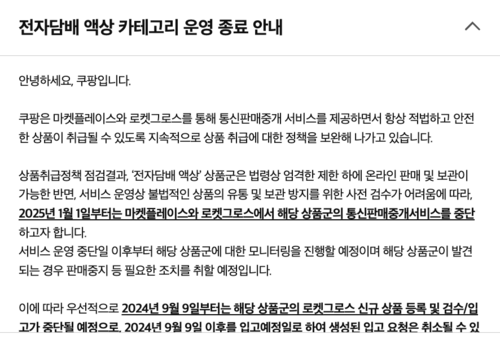
Coupang plans to halt operations of e-cigarette liquid category on its open market platforms "Marketplace" and "Rocket Growth" starting from January 1, 2025. After the service operations are suspended, Coupang will monitor the product category and take measures such as halting sales if any related products are found.
Firstly, starting from the 9th of this month, Coupang will cease new product registrations, reviews, and warehouse entries in this product category. However, sales through direct procurement will continue.
Previously, major e-commerce platforms had already implemented measures to address synthetic nicotine e-cigarette liquid. Recently, Naver shopping platform has seen an increase in cases where e-liquid products with nicotine content are registered as nicotine-free. In January of this year, Naver shopping once again strengthened its related policies. Platforms such as Naver shopping, 11th Street, Gmarket, and others have all prohibited the registration of nicotine-containing products, including synthetic nicotine. However, e-cigarette liquids containing similar substances, whether nicotine or nicotine-free, are still being sold.
According to sources at Coupang,
e-cigarette liquid products are subject to strict legal restrictions on online sales and storage, but there are significant difficulties in conducting pre-audits to prevent the illegal circulation and storage of products in service operations. We are constantly supplementing policies to ensure that legal and safe products can be properly handled.
Industry insiders believe that, with the recent increase in regulatory scrutiny, Coupang has decided to cease sales of e-cigarette liquid in the open market due to the high management difficulty, and will only retain sales of self-operated products. Unlike other tobacco products, e-cigarette liquid can be sold online because in South Korea, synthetic nicotine and similar nicotine-like substances are not considered tobacco products as defined by the Tobacco Business Act. Therefore, they are not subject to taxation and are not included in the scope of warning graphic labeling, making them considered in a regulatory gray area.
An industry insider stated that...
Consensus has been reached on the need to promptly regulate e-cigarette liquids and other products sold online, as they have remained outside of existing regulations.
Officials from the Ministry of Health and Welfare stated that...
If the definition of tobacco is expanded, the regulation of current sales of synthetic nicotine and other e-cigarette liquids will be strengthened. In order to prevent youth smoking, the Ministry of Health and Welfare believes that legislative measures and self-regulatory mechanisms at the platform level are both positive steps.
We welcome news tips, article submissions, interview requests, or comments on this piece.
Please contact us at info@2firsts.com, or reach out to Alan Zhao, CEO of 2Firsts, on LinkedIn
Notice
1. This article is intended solely for professional research purposes related to industry, technology, and policy. Any references to brands or products are made purely for objective description and do not constitute any form of endorsement, recommendation, or promotion by 2Firsts.
2. The use of nicotine-containing products — including, but not limited to, cigarettes, e-cigarettes, nicotine pouchand heated tobacco products — carries significant health risks. Users are responsible for complying with all applicable laws and regulations in their respective jurisdictions.
3. This article is not intended to serve as the basis for any investment decisions or financial advice. 2Firsts assumes no direct or indirect liability for any inaccuracies or errors in the content.
4. Access to this article is strictly prohibited for individuals below the legal age in their jurisdiction.
Copyright
This article is either an original work created by 2Firsts or a reproduction from third-party sources with proper attribution. All copyrights and usage rights belong to 2Firsts or the original content provider. Unauthorized reproduction, distribution, or any other form of unauthorized use by any individual or organization is strictly prohibited. Violators will be held legally accountable.
For copyright-related inquiries, please contact: info@2firsts.com
AI Assistance Disclaimer
This article may have been enhanced using AI tools to improve translation and editorial efficiency. However, due to technical limitations, inaccuracies may occur. Readers are encouraged to refer to the cited sources for the most accurate information.
We welcome any corrections or feedback. Please contact us at: info@2firsts.com