Key Points
- The bill has passed Ireland’s Dáil.
- Vape flavours would be limited to tobacco or unflavoured.
- Retail advertising and mixed-store displays would be restricted.
- Nicotine pouch sales to minors would be banned.
2Firsts
June 26, 2026
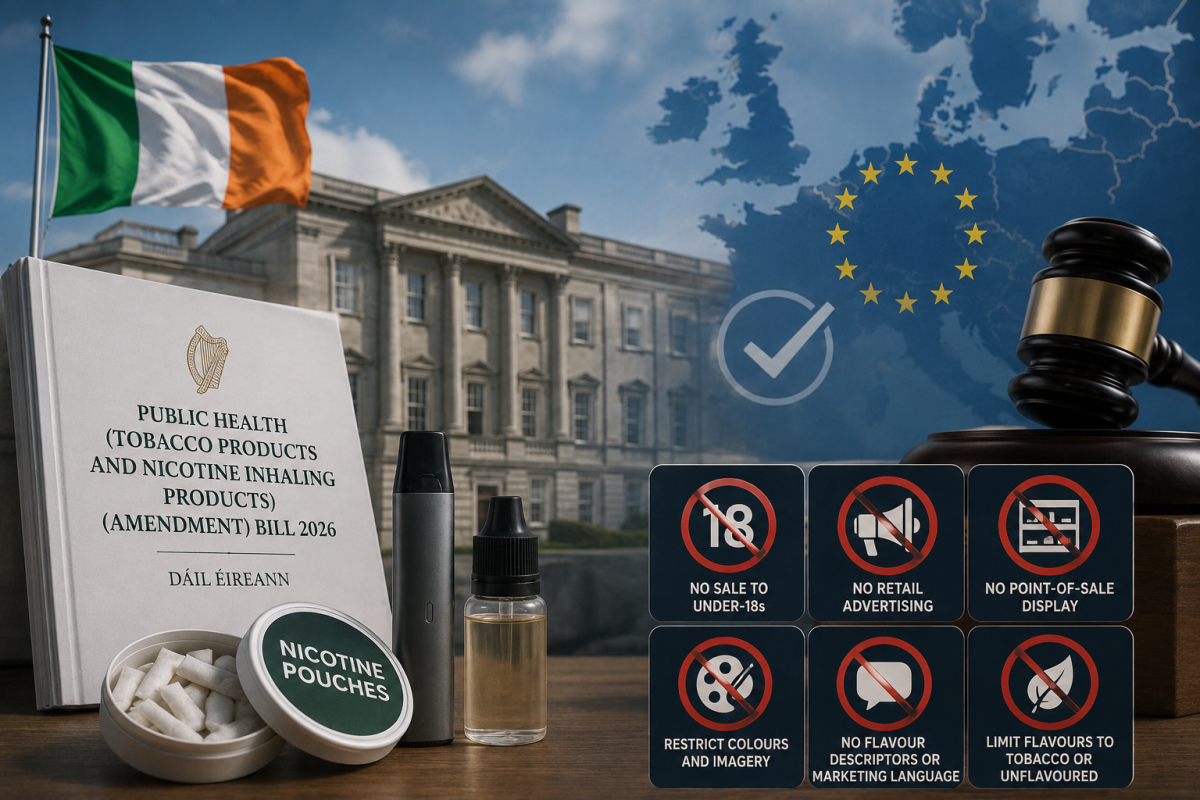
According to Irish Examiner, Ireland’s Public Health (Tobacco Products and Nicotine Inhaling Products) (Amendment) Bill 2026 has passed final stage in the Dáil and will be sent to the Seanad. The bill would further restrict vape flavours, packaging, retail advertising and in-store displays, while creating clearer baseline regulation for “nicotine consumption products” such as nicotine pouches.
Flavour and Packaging Rules Tighten
Under the bill, Ireland would limit flavours in nicotine inhaling products to tobacco or unflavoured. That means fruit, dessert, beverage, ice and other flavoured vapes would face sales restrictions. The bill would also ban flavour descriptors and marketing language beyond basic flavour names, reducing the appeal of such products to younger consumers.
The bill would also restrict colours and imagery on nicotine inhaling product devices and packaging. Irish Examiner reported that the proposed measures include curbs on bright colours, imagery and device or packaging designs that may appeal to minors.
From an industry perspective, flavour and packaging restrictions will directly affect vape brands’ product portfolios, SKU planning and visual identity. If enacted in its current direction, the Irish vape market would move away from flavour-led differentiation toward a more standardized and lower-visibility compliance model.
The bill still needs to be debated in the Seanad. The Irish Government is also expected to receive EU notification in the coming weeks on whether the bill can be enacted before the summer recess. That process will be important for the implementation timetable.
Retail Advertising and Display Restricted
The bill would prohibit advertising of nicotine inhaling products and nicotine consumption products in all retail outlets and ban point-of-sale display in mixed retail outlets. Mixed retailers typically include convenience stores and community retailers that sell food, daily goods, tobacco or other products alongside vapes or nicotine products.
This would move vapes and nicotine products closer to traditional tobacco-style retail controls. For convenience stores and mixed retailers, product display, shelf position, in-store promotional materials and counter visibility could all be affected.
Retail changes could reshape brand exposure. In many European markets, vapes have relied on packaging colour, flavour naming and point-of-sale display for consumer recognition. If advertising and display are restricted, brands may need to rely more heavily on compliant channels, adult-consumer education and pricing.
The bill would also introduce further enforcement measures and related offences. For retailers, compliance costs may come from staff training, covering or removing displays, clearing advertising materials, age verification and differentiating between product categories at the point of sale.
Nicotine Pouches Enter Baseline Regulation
Beyond vapes, the bill covers “nicotine consumption products” such as nicotine pouches. According to Irish Examiner, it would ban the sale of nicotine consumption products, including pouches, to under-18s and place restrictions on retail advertising and sales practices.
During the Dáil debate, Social Democrats TD Pádraig Rice pushed to include nicotine pouches in packaging restrictions. He said pouches are currently displayed in shops in bright, colourful packaging and are becoming increasingly popular among teenagers.
Minister of State for Public Health Jennifer Murnane O’Connor said the bill already contains restrictions on pouches. She said accepting the packaging amendment would require a new notification to the EU and could delay full operation of the bill by up to a year.
Ireland’s Department of Health previously said the inclusion of novel nicotine products is intended to be “future-proofed,” applying not only to products currently on the market but also to any new nicotine products that emerge.
Murnane O’Connor said she regularly hears concerns from parents and teachers about children’s use of nicotine products. She said nicotine is highly addictive and that evidence shows young people who vape are more likely to take up smoking. She also acknowledged that the measures will affect some businesses, but said government decisions are health-led.
For the industry, Ireland’s bill signals that regulation is moving from e-cigarettes to the broader market for non-medicinal recreational nicotine products. Vape brands, nicotine pouch brands, convenience stores and specialist retailers will need to assess the commercial impact of flavour, packaging, display, advertising and age-limit rules.
Key issues to watch next include the Seanad debate, the EU notification process, the implementation timetable and whether nicotine pouches will later face additional packaging and colour restrictions.
Follow 2Firsts for the latest updates on global tobacco harm reduction, nicotine products and regulatory developments.
Cover image:generated by AI