Juul and Altria settlement payments begin as some users confirm payments received

Oct.25.2024
Juul and Altria settlement payments begin as some users confirm payments received
Juul Labs has begun issuing settlement payments following its agreement with Altria, with a total payout of $300 million. Users have reported on social media that they've received amounts ranging from a few hundred dollars to over $9,000.

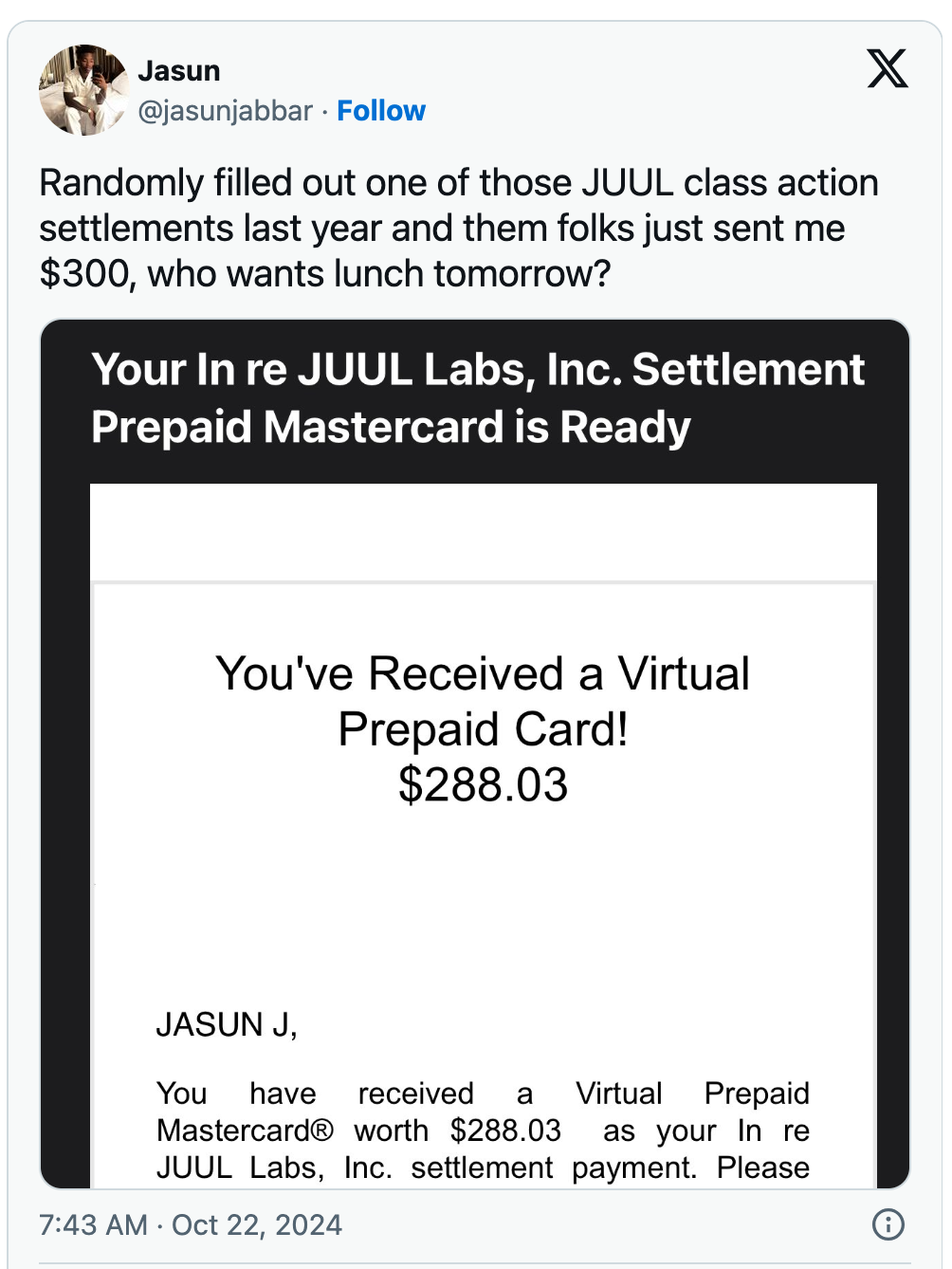
The 2022 settlement agreement between e-cigarette company Juul and tobacco company Altria has begun to be paid out, with users on platforms such as Reddit and X claiming to have already received thousands of dollars in compensation, according to a 22 October report from Forbes.


The settlement amount for this case is $3 billion, to be paid jointly by Juul and Altria. The lawsuit alleged that consumers paid inflated prices for e-cigarettes, that Juul failed to accurately disclose the addictive and safety risks of its products, and that it engaged in illegal marketing to minors.


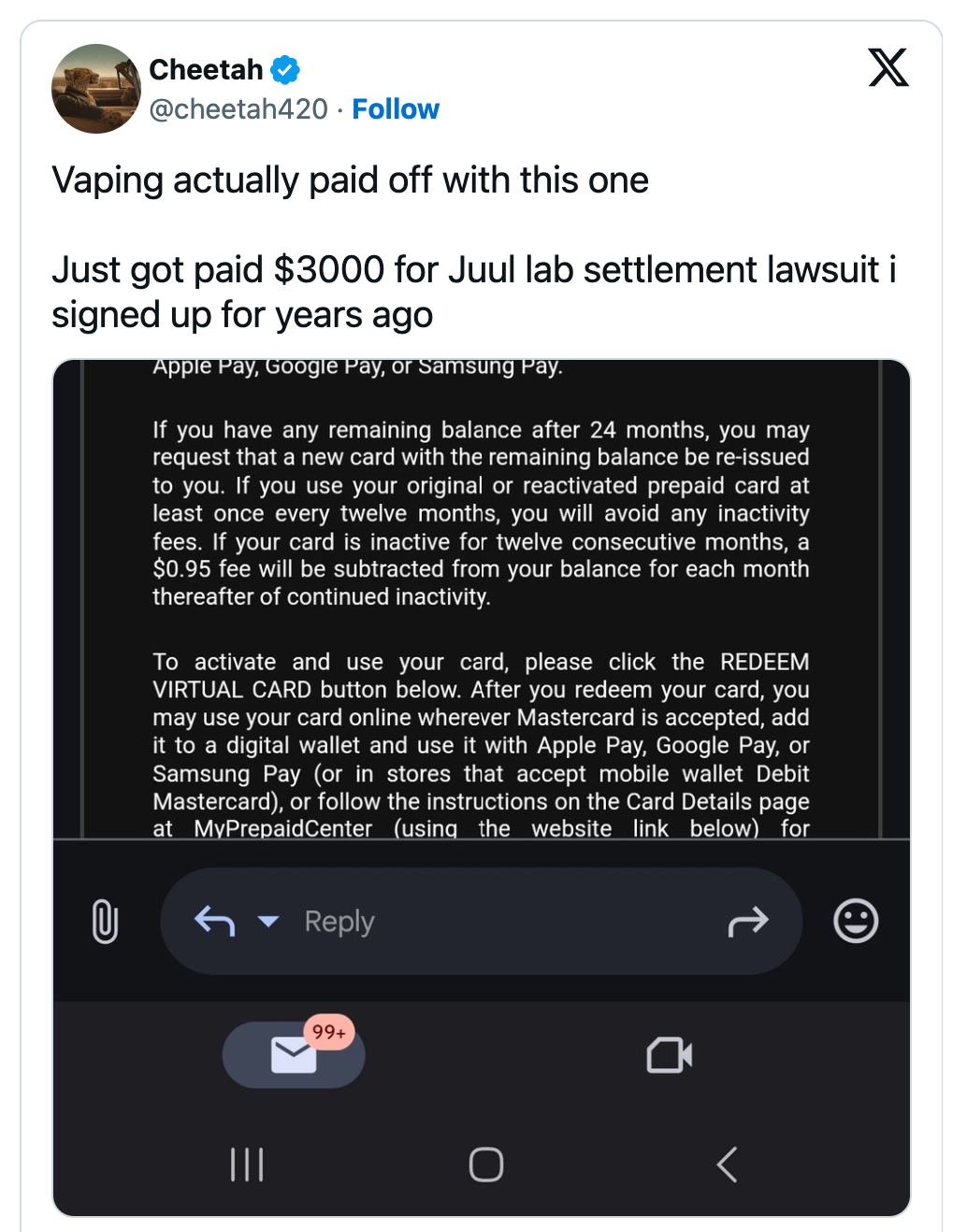
The payouts were approved earlier this month, according to the r/juul subreddit. Users have reported receiving amounts ranging from a few hundred dollars to over $9,000. Some X users have shared screenshots of their payments, while others are disappointed that they were not included in the settlement list. The settlement agreement includes consumers who purchased Juul products before 7 December 2022. Juul did not admit any wrongdoing in the settlement, and Altria has denied the allegations against it.
 

Juul and Altria settlement payments begin as some users confirm payments received
Some users of platform X claim to have received compensation | Image source: X


Juul and Altria settlement payments begin as some users confirm payments received
Some X platform users claimed to have received compensation | Image source: X


The amount of compensation is influenced by several factors, including the amount the claimant spent on Juul products, the time period of the purchase, and the age at the time of the purchase. Obviously, users who spent more during the qualifying period will receive more compensation.


The class action stems from more than 8,000 lawsuits filed against Juul by municipalities, school districts, indigenous tribes and individuals. In 2019, Juul stopped advertising in the US market and discontinued most of its flavoured products due to legal disputes and government sanctions.


Following a multi-state investigation into its marketing practices, the company reached a settlement agreement for nearly $4.4 billion, followed by another agreement for $3 billion. In 2018, Altria had invested nearly $13 billion in Juul, but pulled out of the investment last year and invested in another competing startup. Juul avoided bankruptcy through cost-cutting, massive layoffs and support from wealthy investors.


We welcome news tips, article submissions, interview requests, or comments on this piece.

Please contact us at info@2firsts.com, or reach out to Alan Zhao, CEO of 2Firsts, on LinkedIn


Notice

1.  This article is intended solely for professional research purposes related to industry, technology, and policy. Any references to brands or products are made purely for objective description and do not constitute any form of endorsement, recommendation, or promotion by 2Firsts.

2.  The use of nicotine-containing products — including, but not limited to, cigarettes, e-cigarettes, nicotine pouchand heated tobacco products — carries significant health risks. Users are responsible for complying with all applicable laws and regulations in their respective jurisdictions.

3.  This article is not intended to serve as the basis for any investment decisions or financial advice. 2Firsts assumes no direct or indirect liability for any inaccuracies or errors in the content.

4.  Access to this article is strictly prohibited for individuals below the legal age in their jurisdiction.


Copyright


This article is either an original work created by 2Firsts or a reproduction from third-party sources with proper attribution. All copyrights and usage rights belong to 2Firsts or the original content provider. Unauthorized reproduction, distribution, or any other form of unauthorized use by any individual or organization is strictly prohibited. Violators will be held legally accountable.

For copyright-related inquiries, please contact: info@2firsts.com


AI Assistance Disclaimer


This article may have been enhanced using AI tools to improve translation and editorial efficiency. However, due to technical limitations, inaccuracies may occur. Readers are encouraged to refer to the cited sources for the most accurate information.

We welcome any corrections or feedback. Please contact us at: info@2firsts.com

NAS 2026 | Former FDA Tobacco Chief Mitch Zeller Calls for Shift From “End Game” to “End State”
At the 2026 New Approaches Summit in New York, former FDA Center for Tobacco Products Director Mitch Zeller called for the tobacco harm reduction debate to shift from the traditional “end game” toward defining a desired “end state.” He also highlighted unresolved concerns around dual use, argued that biomarkers of exposure may be more meaningful than cigarettes-per-day in assessing risk reduction, and said nicotine misperceptions remain a major barrier to public health progress.
Sep.25
U.S. Fifth Circuit Vacates NicQuid Vape MDO, Says FDA Comparative-Efficacy Standard Violated APA Procedures
According to VitalLaw on August 27, 2026, the U.S. Court of Appeals for the Fifth Circuit vacated an FDA marketing denial order (MDO) against NicQuid LLC, ruling that the agency’s comparative-efficacy standard for electronic nicotine delivery system (ENDS) applications had become a substantive rule requiring notice-and-comment rulemaking under the Administrative Procedure Act (APA). The court did not reject FDA’s authority to compare the public health benefits and risks of flavored vapes, but held that the agency could not establish a broadly binding standard through informal adjudications. The case was remanded to FDA for further proceedings.
Aug.28
Couche-Tard Posts Double-Digit U.S. Same-Store Growth in Other Nicotine Products, Led by Pouches
Alimentation Couche-Tard said U.S. same-store sales in its “other nicotine products” category grew at a double-digit rate in the first quarter of fiscal 2027, led by nicotine pouches, while overall U.S. same-store merchandise revenues increased 1.7%. The company also said its Canadian nicotine business continued to face regulatory pressure and illicit-market headwinds. The U.S. performance coincides with Couche-Tard's participation in efforts to reopen Canadian convenience-store access to authorized nicotine pouches, though the company has not established a direct causal link between the two.
Sep.14
Charlie’s Says 30 PACHA Vape SKUs Tentatively Identified for FDA’s Non-Priority Enforcement Public List
Charlie’s Holdings said the U.S. Food and Drug Administration notified the company on June 23, 2026, that 30 PACHA vape SKUs with submitted PMTAs had been tentatively identified for inclusion on a planned public-facing FDA webpage. Under enforcement guidance issued by FDA in May, the webpage is intended to identify certain unauthorized products for which the agency generally does not intend to prioritize enforcement of premarket authorization requirements. Charlie’s disclosed the development alongside second-quarter revenue of $3.8 million, up 116% year over year.
Aug.25
U.S. Ninth Circuit Upholds FDA Denial of MH Global’s Flavored Vape PMTA Applications
The U.S. Court of Appeals for the Ninth Circuit upheld the FDA’s denial of MH Global LLC’s applications to market flavored electronic nicotine delivery systems (ENDS). The court ruled that FDA’s comparative-efficacy framework, which requires applicants to show that flavored products provide greater cessation or switching benefits than tobacco-flavored alternatives, is consistent with the Tobacco Control Act’s “appropriate for the protection of the public health” standard. The court also found that FDA was not required to establish the framework through notice-and-comment rulemaking.
Aug.26
Yinghe-Controlled Vape Maker SKE Ordered to Post £569,039 Security as It Pursues Crystal Bar Design Infringement Case in UK
The UK High Court has ordered Chinese vape manufacturer Shenzhen SKE Technology to provide £569,039 ($776,000) in security for costs in its design infringement proceedings against Vapepen London and other defendants over its Crystal Bar vape product. The court did not accept the defendants’ main argument that recovering costs from a China-based company would face significant enforcement obstacles, but found that SKE had not sufficiently disclosed its own financial position. The order is procedural and does not determine the underlying infringement claims.
News
Aug.21