Malaysia Urged to Act as Teen E-cigarette Use Rises

May.20.2025
Malaysia Urged to Act as Teen E-cigarette Use Rises
As youth vaping continues to rise in Malaysia, the Malaysian Thoracic Society and the Lung Foundation are urging the government to immediately enforce the Control of Smoking Products for Public Health Act 2024. Experts warn that many e-cigarettes are designed to resemble toys, candies or USB drives, making them highly appealing to teenagers and potentially acting as a gateway to drug use.

Key points:


1.Malaysia is facing a challenge of rising youth e-cigarette usage rates, prompting calls for the government to take urgent action.


2.Legal experts and medical professionals are urging the swift implementation of the 2024 Public Health Tobacco Control Act (Bill 852).


3.A survey has shown that there is an increasingly clear correlation between the use of e-cigarettes and the abuse of illegal drugs.


4.Some states have taken measures to restrict the sale of e-cigarettes, but nationwide enforcement laws are considered necessary.


According to Sinar Harian, as the use of e-cigarettes among Malaysian teenagers is significantly increasing, the government, especially the Malaysian Ministry of Health, is being urged to immediately fully enforce the Public Health Act on Smoking Control Products 2024 (Act 852).


The Malaysian Thoracic Society (MTS) and the Malaysian Lung Foundation (LFM) emphasized in a joint statement the urgent need to take action to curb the worsening health crisis caused by the use of harmful products. The statement pointed out that many e-cigarette devices are designed to resemble toys, markers, USB drives, and candy, with their bright colors disguising the dangers of nicotine addiction.


The statement also warns that this product strategy not only fails to reduce harm, but actually attracts young users to start using it. More concerning is that teachers and counselors have found that e-cigarette use is becoming a gateway for young people to be exposed to drugs. Data has shown that students who use flavored e-cigarettes are more likely to move on to using illicit substances, leading to an increase in positive cases of tetrahydrocannabinol (THC) and other drugs detected in school drug tests.


A report has highlighted the need for the government to immediately ban the use of e-cigarettes nationwide to address the escalating health risks and abuse of prohibited substances among young people. Tan Sri Lee Lam Thye, Chairman of the Community Safety Alliance, stated that recent findings show a 32% increase in the seizure rate of e-liquid contaminated with drugs by the police, while data from the Ministry of Health revealed that 65.6% of e-liquids seized in the past two years contained dangerous substances.


Additionally, the Malaysian Council for Tobacco Control (MTS) and the Malaysian Anti-Smoking Youth Movement (LFM) stated that legislation and comprehensive enforcement will curb the proliferation of e-cigarette products and can lead to strict measures against marketing targeted towards adolescents, including the prohibition of toy-like devices. They also praised the proactive measures taken by the states of Johor, Kelantan, Terengganu, and Pahang to restrict the sale of e-cigarettes, but warned that without consistent federal enforcement, these efforts may not be sufficient to address the nationwide issue.


We welcome news tips, article submissions, interview requests, or comments on this piece.

Please contact us at info@2firsts.com, or reach out to Alan Zhao, CEO of 2Firsts, on LinkedIn


Notice

1.  This article is intended solely for professional research purposes related to industry, technology, and policy. Any references to brands or products are made purely for objective description and do not constitute any form of endorsement, recommendation, or promotion by 2Firsts.

2.  The use of nicotine-containing products — including, but not limited to, cigarettes, e-cigarettes, nicotine pouchand heated tobacco products — carries significant health risks. Users are responsible for complying with all applicable laws and regulations in their respective jurisdictions.

3.  This article is not intended to serve as the basis for any investment decisions or financial advice. 2Firsts assumes no direct or indirect liability for any inaccuracies or errors in the content.

4.  Access to this article is strictly prohibited for individuals below the legal age in their jurisdiction.


Copyright


This article is either an original work created by 2Firsts or a reproduction from third-party sources with proper attribution. All copyrights and usage rights belong to 2Firsts or the original content provider. Unauthorized reproduction, distribution, or any other form of unauthorized use by any individual or organization is strictly prohibited. Violators will be held legally accountable.

For copyright-related inquiries, please contact: info@2firsts.com


AI Assistance Disclaimer


This article may have been enhanced using AI tools to improve translation and editorial efficiency. However, due to technical limitations, inaccuracies may occur. Readers are encouraged to refer to the cited sources for the most accurate information.

We welcome any corrections or feedback. Please contact us at: info@2firsts.com

UK ONS Data: Vaping Rate Among Women Aged 25–34 Reaches 18.3%, Compared With 14.4% for Men
The vaping rate among women aged 25 to 34 in Great Britain reached 18.3% in 2025, up from 13.7% in 2024 and 8.3% in 2020, according to data from the Office for National Statistics (ONS). The figure was the highest for this group since records began in 2014 and exceeded the 14.4% recorded among men of the same age. Adults aged 25 to 34 also overtook those aged 16 to 24 as the age group with the highest vaping prevalence. Overall, about 5.4 million adults in Great Britain used e-cigarettes in 2025, broadly unchanged from the previous year.
DATA
Oct.13
Wisconsin Vape Directory One Year On: Retailer Reports Four Store Closures and 70% Staff Cuts
Wisconsin's electronic vaping device directory has been fully enforced for more than a year, and local vape retailers say the reduced range of eligible products has contributed to declining sales, store closures and layoffs. Johnny Vapes owner Ben Hall said he has closed four of seven locations and cut about 70% of his staff. State law bars the sale of vaping devices not listed on the Wisconsin Department of Revenue directory and allows penalties of $1,000 per day for each unlisted device sold or offered for sale. In April 2026, the U.S. Court of Appeals for the Seventh Circuit allowed enforcement of the law to continue.
Regulations
Oct.10
Special Report | Altria's NACS Booth Raises Questions Over U.S. Tobacco Advertising Warnings
During its coverage of Altria's booth at NACS Show 2026, 2Firsts documented product displays that prompted questions about U.S. tobacco advertising warning requirements. Following public comments from a former FDA official, 2Firsts sought responses from Altria and independently consulted U.S. regulatory lawyer Azim Chowdhury. Altria maintained that its B2B communications complied with applicable laws, while Chowdhury explained that federal warning rules provide no general trade-show exemption for e-cigarettes and nicotine pouches. The special report examines the broader regulatory implications.
Nov.04
PMI Launches Fourth IQOS Convenience-Store Discount of 2026 for Black Friday in Japan, Cutting ILUMA i ONE to About $19 After Ploom AURA Fell to About $9
Philip Morris Japan launched its fourth confirmed nationwide convenience-store discount campaign for IQOS ILUMA i devices in 2026 on October 26, cutting three models by as much as ¥2,000, or about $12.70. The campaign began one day after JT ended a promotion that reduced Ploom AURA to ¥1,480, or about $9.40. JT says Ploom's share of Japan's heated-products category rose from 10.9% in January 2024 to 18.3% in June 2026, a gain of 7.4 percentage points, while PMI says IQOS still held about 68% category share in the third quarter. At the same time, Japan's two-stage heated-tobacco tax adjustment has pushed stick prices higher, leaving device discounts as an increasingly important tool for lowering the upfront cost of customer acquisition.
Market
Oct.28
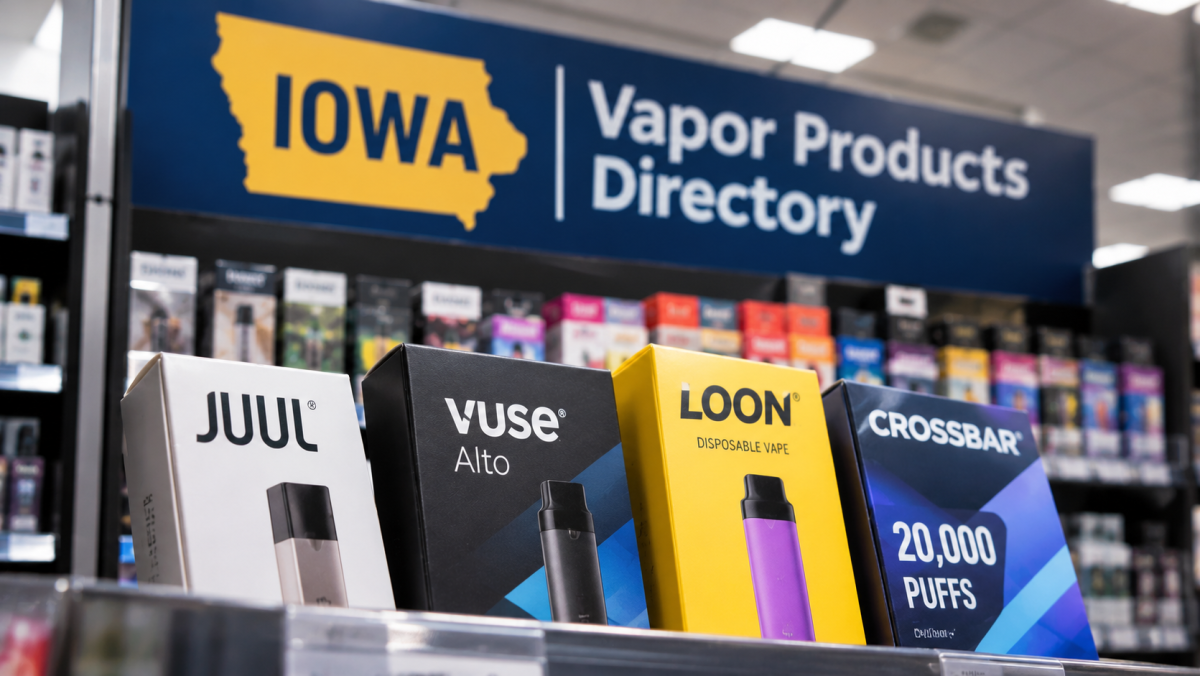
Iowa's First Vape Directory Lists JUUL and Vuse Pod Systems Alongside Loon and Crossbar Disposables, With 20,000-Puff Products Listed Across States
Iowa published its first vapor products directory on November 16, 2026, listing 361 product entries, including 175 covering prefilled pods, devices, kits and disposable e-cigarettes. Established tobacco-company brands such as JUUL and Vuse appear alongside independent disposable brands including Loon, Crossbar and Z Stick. The products range from traditional small-capacity disposables to Crossbar's 13mL, 20,000-puff devices. Of the 361 records, 288 are marked FDA Pending. Both Crossbar entries were dated November 16 and carry UPCs also found in other state directories. By contrast, a matching Z Stick product lost its active Louisiana listing after its certification was not renewed.
Regulations
Nov.17
Special Report | From New York to Washington: How FDA’s Tobacco Center Is Reworking Product Review
FDA’s Center for Tobacco Products is reshaping how it approaches tobacco product review. Based on 2Firsts’ on-site reporting in New York and Washington, this report traces CTP’s emerging direction: stronger links between PMTA and tobacco harm reduction, more category-specific review, greater emphasis on decision-relevant science, more predictable timelines and expanded use of sPMTA for product modifications. CTP also acknowledged major constraints, including just nine PMTA review teams, persistent backlogs and limits on hiring capacity.
Regulations
Oct.08