New Dangerous Trend: THC-Infused E-Cigarettes Seized in Catania

Aug.12.2024
New Dangerous Trend: THC-Infused E-Cigarettes Seized in Catania
Italian police discovered two devices containing potent cannabis resin in Catania, posing potential public health risks.

According to a report from La Sicilia on August 11th, Italian authorities discovered two devices containing highly potent cannabis resin in an operation in Catania. These devices could pose a potential danger to public health.


The drug market constantly introduces new products in an attempt to evade law enforcement crackdowns. In an apartment located between Giuffrida Street and Vulcania Street, authorities seized two e-cigarettes, also known as svapo, and a small quantity of amphetamines and other narcotics. This is a new development in the Catania black market for drugs.


These devices, originally intended as alternatives for nicotine addicts, have instead become tools for "getting high". Furthermore, compared to regular marijuana, they have a stronger numbing effect, possibly even double that of skunk and amnesia marijuana.


E-cigarettes are equipped with a capsule containing viscous oil. In subsequent testing, highly concentrated cannabis extracts were found to contain a very high percentage of THC (tetrahydrocannabinol). Therefore, these devices are referred to as "drug bombs.


The second part of the investigation will involve inquiries into the "caretakers" and supply channels related to the products. Who manufactures them? Who delivers them to Vulcan's Shadow? What are their prices? All of this information needs to be clarified.


This is the first time that the city has confiscated these "super" e-cigarettes. Several months ago, police in Novi Ligure, Piedmont, discovered and confiscated 11 similar e-cigarettes.


Last May in Ascoli, authorities confiscated equipment containing high levels of THC (tetrahydrocannabinol) in cannabis oil. The results have been entered into the National Early Warning System (Snap), which is a police scientific laboratory and forensic toxicology network that can identify new phenomena related to the emergence of new psychoactive substances in Italy and traditional methods of consuming narcotic substances that may pose a danger to public health. Information sharing between different investigative offices may help trace the supply chain. According to research from some publicly available sources, it appears that this equipment was produced in the United States and sold through the dark web.


This method is truly clever: even smoking an e-cigarette in public is certainly less likely to attract attention than smoking "traditional" marijuana. It could also potentially become a way to disguise marijuana use within the household. Considering the high concentration of THC (tetrahydrocannabinol) which has very potent psychoactive properties and significant sedative capabilities - they could truly become very dangerous.


These devices heat anesthetic substances and transform them into vapor, preserving more of the cannabis' active ingredients compared to burning herbs. Following the widespread nightmare of cocaine among teenagers, there may be another urgent situation of adolescent drug dependence. Investigators explain, "These devices are becoming popular as alternatives to traditional cannabis, they are easy to use, have very high psychoactive ingredients, and significant anesthetic capabilities".


We welcome news tips, article submissions, interview requests, or comments on this piece.

Please contact us at info@2firsts.com, or reach out to Alan Zhao, CEO of 2Firsts, on LinkedIn


Notice

1.  This article is intended solely for professional research purposes related to industry, technology, and policy. Any references to brands or products are made purely for objective description and do not constitute any form of endorsement, recommendation, or promotion by 2Firsts.

2.  The use of nicotine-containing products — including, but not limited to, cigarettes, e-cigarettes, nicotine pouchand heated tobacco products — carries significant health risks. Users are responsible for complying with all applicable laws and regulations in their respective jurisdictions.

3.  This article is not intended to serve as the basis for any investment decisions or financial advice. 2Firsts assumes no direct or indirect liability for any inaccuracies or errors in the content.

4.  Access to this article is strictly prohibited for individuals below the legal age in their jurisdiction.


Copyright


This article is either an original work created by 2Firsts or a reproduction from third-party sources with proper attribution. All copyrights and usage rights belong to 2Firsts or the original content provider. Unauthorized reproduction, distribution, or any other form of unauthorized use by any individual or organization is strictly prohibited. Violators will be held legally accountable.

For copyright-related inquiries, please contact: info@2firsts.com


AI Assistance Disclaimer


This article may have been enhanced using AI tools to improve translation and editorial efficiency. However, due to technical limitations, inaccuracies may occur. Readers are encouraged to refer to the cited sources for the most accurate information.

We welcome any corrections or feedback. Please contact us at: info@2firsts.com

South Korea Constitutional Court Upholds Volume-Based E-Liquid Tax, With Challenged Rates at KRW 370 and KRW 628 per Milliliter
South Korea's Constitutional Court has upheld fixed taxes on nicotine-containing e-cigarette liquids based on solution volume, ruling that challenged provisions imposing KRW 370 per milliliter in individual consumption tax and KRW 628 per milliliter in tobacco consumption tax do not violate the Constitution. The cases stemmed from historical disputes involving importers that reported nicotine as being extracted from tobacco stems rather than leaves. South Korea has since broadened its tobacco definition to include synthetic nicotine, while current tax laws provide reduced rates for certain products not derived from tobacco.
Sep.18
EU Tobacco Tax Reform Targets November Push as Sweden Holds Nicotine-Pouch Minimum at €20 per Kilogram
The Irish presidency of the Council of the European Union is using bilateral talks to push the bloc’s Tobacco Taxation Directive toward a political agreement in November. According to Law360, citing an EU official, Sweden is unwilling to accept a minimum excise threshold above €20 per kilogram for nicotine pouches. Council negotiations have already lowered the European Commission’s original proposal, but a May 2026 presidency compromise still set the minimum at 10% of the tax-inclusive retail price or €30 per kilogram in 2028-29, with higher levels later.
Market
Sep.17 by 2Firsts Perspectives
Iowa Enforces Vape Registry Law as Retailers Warn Product Limits Could Increase Store Pressure
Iowa has begun enforcing its vape registry law, requiring vape products to be registered before they can be legally sold in the state. The move follows a decision by the U.S. Court of Appeals for the Eighth Circuit to lift an injunction that had blocked enforcement. Retailers have warned that tighter product availability rules could increase pressure on vape shops. One Iowa retailer said that if only a limited number of products remain available, many stores could face significant business challenges.
Aug.06
FDA Revises Import Alert 98-07 Rules, Bringing May Enforcement Priorities Into Unauthorized ENDS Detentions
The U.S. Food and Drug Administration has revised the rules under Import Alert 98-07 to incorporate its May 2026 enforcement-priority policy for certain electronic nicotine delivery systems marketed without premarket authorization. The alert continues to allow detention without physical examination, or DWPE, for ENDS lacking required marketing authorization, while directing field divisions to apply the May risk-based framework. When necessary, detention or refusal decisions must also undergo review by the FDA's Center for Tobacco Products. Products including PACHA and Vuse Pro have already emerged as industry examples of the May policy, although enforcement discretion does not constitute FDA marketing authorization.
News
Sep.28 by 2Firsts Perspectives
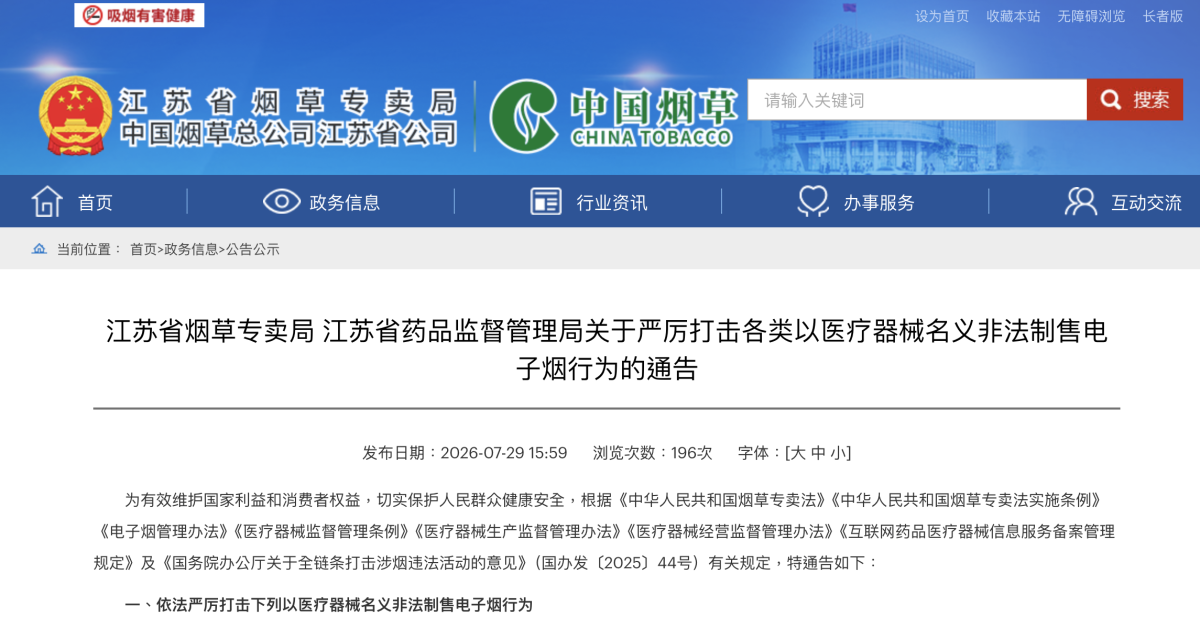
China’s Jiangsu Tobacco Monopoly Bureau and Drug Regulator Target Illegal Vape Sales Disguised as Medical Devices, Define Six Violations
China’s Jiangsu Tobacco Monopoly Bureau and Jiangsu Provincial Medical Products Administration have issued a joint notice targeting illegal production and sales of vape products disguised as medical devices. The notice identifies six categories of violations, including obtaining medical licenses through false materials, misusing medical device credentials, expanding production beyond approved scopes, and using medical device-related online platforms to promote or sell vape products. The action is based on China’s tobacco and medical device regulations and aims to strengthen vape oversight and consumer protection.
Aug.04
China Tobacco Plans CNY 60 Billion Investment in ICBC, Agricultural Bank as Strategic Ties Extend Beyond Equity
China National Tobacco Corporation and several subsidiaries plan to invest a combined CNY 60 billion ($8.7 billion) in share placements by Industrial and Commercial Bank of China and Agricultural Bank of China as strategic investors. The agreements extend beyond equity investment to corporate governance, banking services and supply-chain finance. The filings also disclose 2025 data on China Tobacco’s tax and profit contributions and industry scale.
Sep.07