New York Senate Passes Bill Banning E-Cigarettes Targeting Children

Jun.05.2024
New York Senate Passes Bill Banning E-Cigarettes Targeting Children
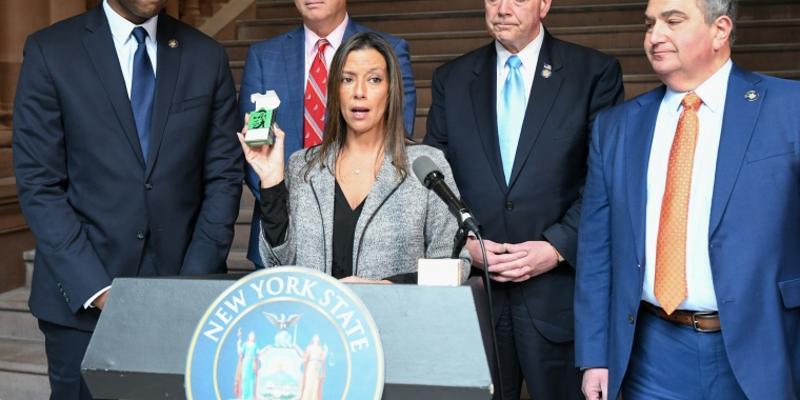
New York State Senate passes bill prohibiting sales of e-cigarette products resembling school supplies or children's toys.

According to a report by CSP Daily News on June 4th, the New York State Senate passed a bill that would ban the sale of e-cigarette products that resemble school supplies or children's toys, as well as e-cigarette products with packaging and advertising targeting children.


Senate bill S7882, introduced by State Senator Monica Martinez, proposes penalties of up to $1500 for first-time violations and up to $2500 for each subsequent violation if enacted.


According to this legislation, businesses selling tobacco and related products will be prohibited from providing items that may include images, logos, symbols, slogans, sales information, or colors that are attractive to minors, as well as symbols representing animated characters, movie characters, video game characters, toys, electronic devices, and school supplies, including markers, highlighters, ballpoint pens, and USB drives.


This bipartisan legislation proposed by nine state senators still needs to be approved by the legislative committee and signed by the governor in order to take effect. A companion version of the proposal, introduced by legislator Charles Fall, is also on the committee's agenda.


We welcome news tips, article submissions, interview requests, or comments on this piece.

Please contact us at info@2firsts.com, or reach out to Alan Zhao, CEO of 2Firsts, on LinkedIn


Notice

1.  This article is intended solely for professional research purposes related to industry, technology, and policy. Any references to brands or products are made purely for objective description and do not constitute any form of endorsement, recommendation, or promotion by 2Firsts.

2.  The use of nicotine-containing products — including, but not limited to, cigarettes, e-cigarettes, nicotine pouchand heated tobacco products — carries significant health risks. Users are responsible for complying with all applicable laws and regulations in their respective jurisdictions.

3.  This article is not intended to serve as the basis for any investment decisions or financial advice. 2Firsts assumes no direct or indirect liability for any inaccuracies or errors in the content.

4.  Access to this article is strictly prohibited for individuals below the legal age in their jurisdiction.


Copyright


This article is either an original work created by 2Firsts or a reproduction from third-party sources with proper attribution. All copyrights and usage rights belong to 2Firsts or the original content provider. Unauthorized reproduction, distribution, or any other form of unauthorized use by any individual or organization is strictly prohibited. Violators will be held legally accountable.

For copyright-related inquiries, please contact: info@2firsts.com


AI Assistance Disclaimer


This article may have been enhanced using AI tools to improve translation and editorial efficiency. However, due to technical limitations, inaccuracies may occur. Readers are encouraged to refer to the cited sources for the most accurate information.

We welcome any corrections or feedback. Please contact us at: info@2firsts.com

Smoore Seeks to Toss CCELL Price-Fixing Claim as Court Weighs Vertical Distribution Versus Horizontal Conspiracy
Smoore and four authorized U.S. CCELL distributors are asking a California federal court to permanently dismiss a core antitrust claim brought by direct purchasers. Plaintiffs allege that Smoore coordinated minimum wholesale prices, customer allocation and limits on price competition among distributors, amounting to a per se unlawful horizontal conspiracy. The defendants say the alleged conduct reflects ordinary vertical relationships between a manufacturer and its distributors. The court previously dismissed a similar claim, and the latest dispute centers on whether the second amended complaint adds sufficient facts to establish a horizontal agreement.
Sep.14
FDA Authorizes Four More Nicotine Pouches as Review Pilot Expands Beyond Initial Decisions
The FDA has authorized four additional on! nicotine pouches, bringing the U.S. total to 30. The decision marks another outcome of the agency’s nicotine pouch review pilot, whose communication and review practices are now being applied more broadly across the category. It also extends Helix’s authorized portfolio from on! PLUS to the earlier on! line. Yet all FDA-authorized nicotine pouches still come from subsidiaries of PMI or Altria, underscoring how concentrated U.S. regulatory access remains.
Aug.05
Ispire Q4 Revenue Rebounds 33% but Full-Year Sales Still Fall 25% as FY2027 Focus Shifts to Malaysia Manufacturing, ODM, Nicotine Pouches and Age Verification
Ispire Technology reported FY2026 revenue of about $96 million, down 24.7% year over year, as U.S. cannabis-vapor hardware and European e-cigarette sales declined by $17.4 million and $12.7 million, respectively. Fourth-quarter revenue rose 32.5% to $26.7 million, while quarterly gross margin fell to 6.3%. For FY2027, the company is prioritizing Malaysia manufacturing and vapor ODM while continuing to develop nicotine pouches, IKE Tech age-verification technology and G-Mesh licensing. Ispire has not separately disclosed the revenue or profit contribution of those newer businesses.
Regulations
Sep.17 by 2Firsts Perspectives
South Korea Imports 12,126 Kg of Nicotine Analogues From April to August After Bringing Synthetic Nicotine Under Tobacco Law
South Korea's liquid-vape market is showing changes across raw-material imports, product types and sales channels after synthetic nicotine came under the Tobacco Business Act on April 24. Customs data show nicotine-analogue imports totaled 12,126 kilograms from April through August, while synthetic-nicotine imports over the same five months totaled 231,663 kilograms, just 39.3% of the amount imported in March alone. Physical liquid-vape stores tracked in Seoul and Gyeonggi Province fell 9.9%, unmanned outlets edged higher and online sales listings increased from 27,774 to 42,437. Government testing of 105 liquid inhalation products promoted as nicotine-free separately found nicotine in 13 and 6-methylnicotine in 12.
Sep.22
Retail Case Study | Wisconsin Vape Market One Year After New Regulations: Johnny Vapes Reports 80% Sales Decline as Consumers Shift Online and Across State Lines
According to WNCY on August 24, 2026, some independent vape retailers in Wisconsin say they have faced significant business pressure one year after new vape regulations took effect. Johnny Vapes, a retailer operating in northeast Wisconsin, said its store count fell from seven locations to four, sales declined by about 80%, and roughly 90% of its inventory was affected. Retailers said some consumers have shifted to online purchases or traveled to neighboring Michigan to buy vape products. The case highlights how local regulations can reshape retail operations, inventory management and consumer purchasing patterns.
Aug.28
EU Trade Department Faces Scrutiny Over Contacts With Tobacco Industry
European Ombudswoman Teresa Anjinho has opened an inquiry into how the European Commission’s Directorate-General for Trade handles interactions with the tobacco industry. The case follows a complaint from a civil society organisation that alleges regular, unnecessary and non-transparent contacts between DG TRADE and tobacco industry representatives, raising questions over compliance with the EU’s obligations under the WHO Framework Convention on Tobacco Control. The inquiry remains ongoing, and the Ombudswoman has not reached any finding of maladministration.
Aug.24