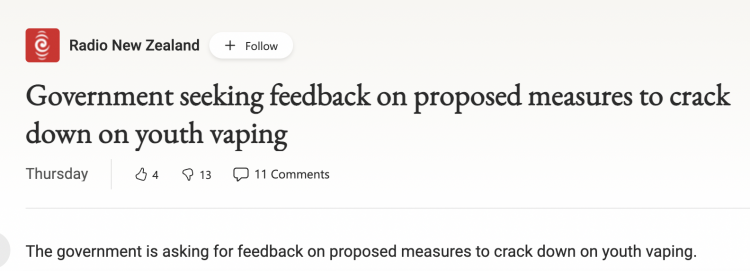
The New Zealand government is seeking feedback on proposed measures to combat the use of electronic cigarettes by teenagers.
These measures include new regulations pertaining to packaging, flavor names, nicotine salt concentration, and safety of disposable products, as well as restrictions on the location of electronic cigarette specialty stores.
Dr. Ayesha Verrall, Deputy Minister of Health in New Zealand, has stated that the number of young people vaping is on the rise. Despite never having smoked before, many are choosing to use e-cigarettes.
She stated, "In addition to our efforts to reduce smoking, we also hope to ensure the safety and regulation of electronic cigarette products, and that they are only used for their intended purpose of smoking cessation.
Electronic cigarettes can play a role in ensuring that smokers who wish to quit smoking can use e-cigarette products.
However, the proportion of young people vaping is too high, and we need to achieve a better balance.
What proposals are there?
Location restrictions: The new regulations regarding the location of exclusive electronic cigarette stores prohibit them from being situated near schools and athletic fields. This restriction does not apply to general electronic cigarette retailers such as dairy shops and gas stations, which have already been limited to selling only three flavors of electronic cigarettes.
Flavor Names: Restrictions on e-cigarette flavor names in order to reduce their appeal to young people. For example, flavor names such as "cotton candy" and "gummy bear" may no longer be allowed and generic terms such as "candy" must be used instead.
Packaging: Restrict electronic cigarette liquid and product packaging to descriptions of the product's flavor.
Specific requirements for disposable/disposable electronic cigarettes:
The concentration of nicotine salts has been reduced from 50mg/mL to 35mg/mL. People can choose to use lower concentrations of nicotine in reusable devices, but disposable devices have a fixed concentration. The devices are marked with serial numbers for tracking in case of safety issues and to prevent children from using them. The proposed regulations for tobacco control also require feedback on proposals to significantly reduce the availability, attractiveness, and addictiveness of tobacco.
The opinion paper has been made accessible to the public with a deadline of March 15th.
Disclaimer
This article is provided solely for professional research, industry discussion, and informational purposes. Any references to brands, companies, products, technologies, or policies are made for factual reporting and analytical purposes only, and do not constitute endorsement, recommendation, promotion, or advertising by 2Firsts.
Nicotine-containing products, including but not limited to cigarettes, e-cigarettes, heated tobacco products, and nicotine pouches, carry significant health risks. Readers are responsible for complying with all applicable laws and regulations in their respective jurisdictions, including age restrictions and access limitations.
The information contained in this article should not be regarded as investment, legal, medical, regulatory, or commercial advice. While 2Firsts strives to ensure the accuracy and reliability of its content, it does not assume liability for any direct or indirect loss arising from errors, omissions, inaccuracies, or reliance on the information contained herein.
This article is not intended for individuals below the legal age for accessing tobacco or nicotine-related information in their jurisdiction.
Copyright Notice
This article is either original content produced by 2Firsts or content reproduced, translated, summarized, or adapted from third-party sources with attribution where applicable. The intellectual property rights of the original content remain with 2Firsts or the respective original rights holders.
No individual or organization may copy, reproduce, distribute, republish, modify, translate, or otherwise use this content without prior authorization. Any unauthorized use may result in legal action.
For copyright-related inquiries, corrections, or removal requests, please contact: info@2firsts.com.
AI-Assisted Translation and Editing Notice
Portions of this article may have been translated, edited, or reviewed with the assistance of artificial intelligence tools to improve efficiency and readability. Due to the limitations of AI-assisted translation and editing, discrepancies, omissions, or inaccuracies may exist when compared with the original source.
Where applicable, readers are advised to refer to the original source for the most complete and accurate information. If you identify any errors or believe that any content infringes upon your rights, please contact us at info@2firsts.com, and we will review and address the matter promptly.