Philippine Bureau of Internal Revenue Raises Tobacco Prices Mandate

Sep.18.2024
Philippine Bureau of Internal Revenue Raises Tobacco Prices Mandate
Philippine BIR prohibits selling e-cigarettes, cigarettes and heated tobacco below set minimum price, violators to face criminal charges.

According to a report by GMA Integrated News on September 18, the Philippines' Bureau of Internal Revenue (BIR) has now prohibited the sale of e-cigarettes, cigarettes, and heated tobacco products at prices lower than those set by the tax authorities, which include a combination of consumption tax and value-added tax.
Philippine Bureau of Internal Revenue Raises Tobacco Prices Mandate
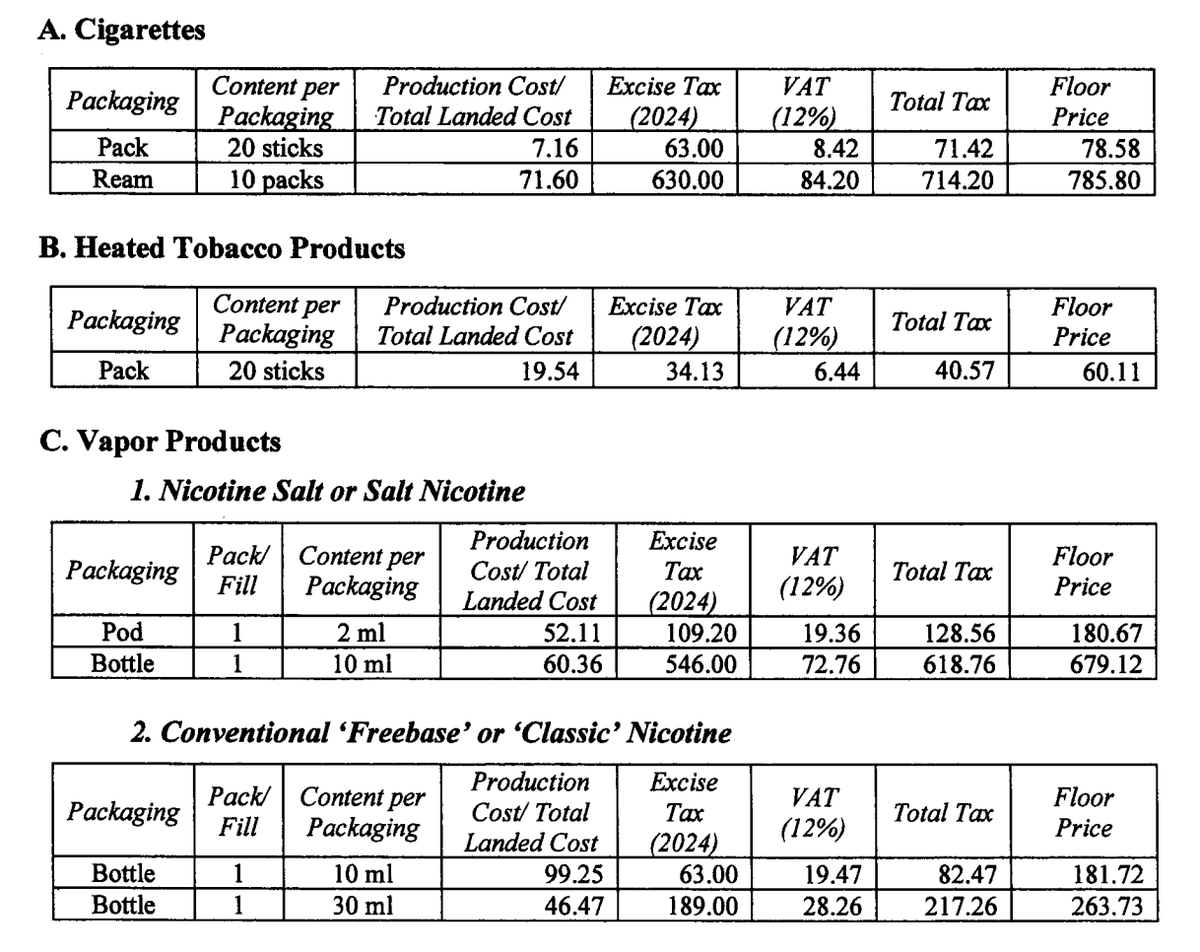
Revenue Regulation No. 16-2024" (RR No. 16-2024) specifies the latest floor prices for cigarettes, heated tobacco, and e-cigarette products in 2024. | Image source: BIR official website


On September 16, Bureau of Internal Revenue (BIR) Commissioner Romeo Lumagui Jr. issued Revenue Regulation No. 16-2024, updating the latest floor prices for cigarettes, e-cigarettes, and heated tobacco products.


Ma Guo reminded online sellers, retailers, and distributors of tobacco products that they will face criminal liability if they sell these products below the prescribed minimum price. He emphasized that selling these products below the minimum price is a criminal offense, and sellers will be sentenced to prison.


We are closely monitoring online platforms and physical stores. Do not sell products below the minimum price and immediately remove all posts and products priced below the minimum.


The latest rates for Revenue Regulation No. 16-2024 (RR No. 16-2024) are as follows:


The Bureau of Internal Revenue (BIR) stated that selling tobacco products at a price lower than the legally required comprehensive consumption and value-added tax is prohibited under Section 145 (C) of the amended National Internal Revenue Code (NIRC).


The agency also added that sellers who sell tobacco products below the specified base price "will be subjected to a fine of no less than 10 times the total amount of excise tax and value-added tax payable, but not less than 200,000 pesos (approximately $3,600) and not exceeding 500,000 pesos (approximately $9,000), and will be sentenced to imprisonment for no less than four years but not exceeding six years.


According to Article 263(A) of the revised National Internal Revenue Code, anyone selling heated tobacco products and vaping products at a price lower than the comprehensive consumption tax and value-added tax will be fined an amount equal to ten times the total amount of the consumption tax owed but not less than 200,000 pesos (approximately $3,600), and will also be sentenced to a minimum of four years but not more than six years in prison.


We welcome news tips, article submissions, interview requests, or comments on this piece.

Please contact us at info@2firsts.com, or reach out to Alan Zhao, CEO of 2Firsts, on LinkedIn


Notice

1.  This article is intended solely for professional research purposes related to industry, technology, and policy. Any references to brands or products are made purely for objective description and do not constitute any form of endorsement, recommendation, or promotion by 2Firsts.

2.  The use of nicotine-containing products — including, but not limited to, cigarettes, e-cigarettes, nicotine pouchand heated tobacco products — carries significant health risks. Users are responsible for complying with all applicable laws and regulations in their respective jurisdictions.

3.  This article is not intended to serve as the basis for any investment decisions or financial advice. 2Firsts assumes no direct or indirect liability for any inaccuracies or errors in the content.

4.  Access to this article is strictly prohibited for individuals below the legal age in their jurisdiction.


Copyright


This article is either an original work created by 2Firsts or a reproduction from third-party sources with proper attribution. All copyrights and usage rights belong to 2Firsts or the original content provider. Unauthorized reproduction, distribution, or any other form of unauthorized use by any individual or organization is strictly prohibited. Violators will be held legally accountable.

For copyright-related inquiries, please contact: info@2firsts.com


AI Assistance Disclaimer


This article may have been enhanced using AI tools to improve translation and editorial efficiency. However, due to technical limitations, inaccuracies may occur. Readers are encouraged to refer to the cited sources for the most accurate information.

We welcome any corrections or feedback. Please contact us at: info@2firsts.com

Chinese Disposable Brands OXBAR, LYCO Challenge Vuse and JUUL: Pennsylvania’s Pending List Offers a Glimpse of the Future Legal Vape Market
Pennsylvania’s June 26 ENDS Pending Certifications list previews the state’s future legal vape market, placing Vuse, JUUL and Logic alongside Chinese-linked disposable brands OXBAR and LYCO. Shaped by PMTA eligibility and state rules, the list shows competition shifting from market share to market access.
Special Report
Jul.06
Altria Smokeable Profit Rises 2.4% as Marlboro Share Falls and U.S. Discounts Gain
Altria’s second-quarter results show a U.S. nicotine market splitting across price, product and regulation. Smokeable profit rose 2.4% as Marlboro pricing offset lower volumes, while discount brand Basic gained share among value-conscious smokers. In oral nicotine, on! PLUS expanded distribution but faced intensifying competition from ZYN and Velo. NJOY remained off the market as patent and regulatory hurdles delayed its return. The broader lesson: U.S. growth increasingly depends on price-tier strategy, retail execution, authorisation and enforcement readiness across the industry.
Special Report
Jul.31
Imperial Brands Plans Thousands of Job Cuts Across U.S. and Europe in Cost Restructuring
According to Reuters, citing Bloomberg News, British tobacco company Imperial Brands PLC plans to cut thousands of jobs across the United States and Europe as part of a cost reduction and organizational restructuring effort. The announcement drew market attention to the company’s shares. The move comes as global tobacco companies continue adjusting their operations amid slower cigarette market growth, changing consumer preferences and the transition toward next-generation nicotine products.
Aug.11
Adani’s Mumbai Airport Duty-Free Shops Face Scrutiny Over Nicotine Pouch Sales in India
An Indian investigation found that duty-free shops at Mumbai international airport operated by billionaire Gautam Adani’s business group sold nicotine pouches in breach of the law, Reuters reported, in a case that could shape how India regulates sales of new nicotine products at airport retail outlets.
Jul.08
Data|China’s January-May Vape Exports: U.S. Shipments Fall 13.8% as Japan Posts Fastest Growth
According to China Customs export data analyzed by 2Firsts, the United States remained China’s largest destination for vape-related exports during January-May 2026 despite a 13.82% year-on-year decline in export value. Meanwhile, exports to Japan, Russia, Indonesia and the United Arab Emirates recorded strong growth, highlighting continued diversification across China’s export markets.
Special Report
Jun.29
France Vape Market 2026: Use Reaches 7.9% Amid Tax, Regulatory and Scientific Debate
France remains one of Europe’s active vape markets in 2026, with adult vaping prevalence rising to 7.9%; at the same time, e-liquid taxation, public-space restrictions, advertising compliance and health-risk debate are pushing the industry into a critical policy period.
Jun.23