Key Takeaways
- PMI has released a white paper calling for cross-sector dialogue on how human cognition will evolve—and how it should be governed—in the age of AI.
- It argues that as AI moves deeper into knowledge work, “human advantage” capabilities such as critical thinking, creativity and adaptability will become more important.
- The paper identifies two main risks: “cognitive atrophy,” as generative AI substitutes for thinking processes, and “attention erosion,” driven by information feeds and synthetic content.
- It warns that a “cognitive divide” could widen and that deepfakes and other synthetic media will intensify pressures on trust and verification.
2Firsts, January 21, 2026
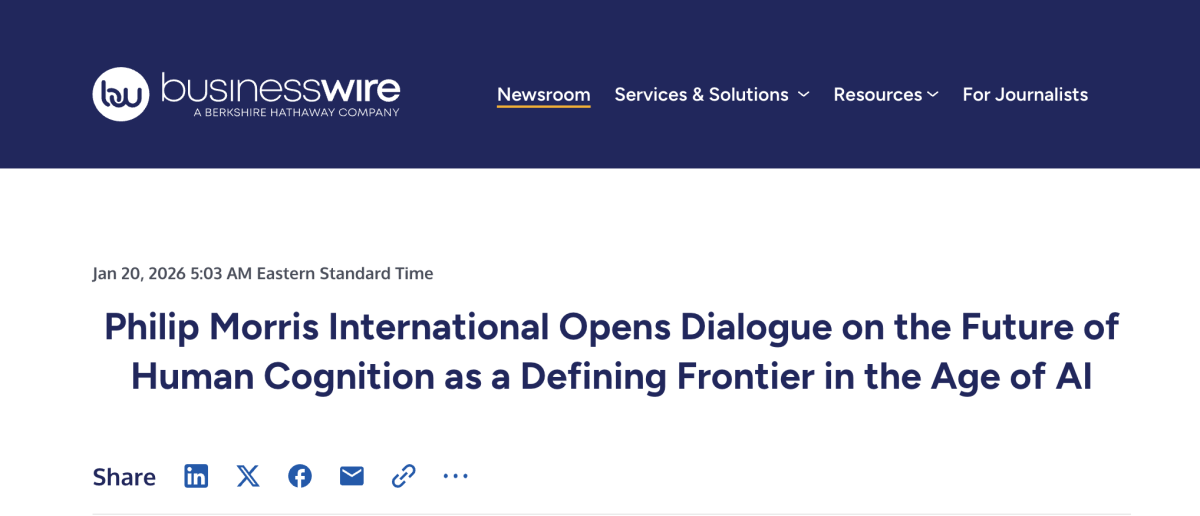
According to Business Wire, Philip Morris International (PMI) released a white paper on Jan. 20 in Stamford, Connecticut, titled Human Cognition: The Next Frontier? (Chinese: Human Cognition: The Next Frontier?), calling for cross-sector discussion on “how human cognitive abilities will evolve” as artificial intelligence continues to reshape the way work, society and economies function.
The white paper argues that as AI increasingly automates routine tasks and expands into knowledge-work processes, capabilities such as critical thinking, creativity and adaptability will become more important. It says organizations need to reassess how to develop and protect human cognitive abilities.
The document also outlines what it describes as “accelerating cognitive risks.” It defines “cognitive atrophy” as the substitution effect of generative AI in ideation, drafting and analysis, which could reduce deep thinking and independent judgment built through sustained mental effort. It describes “attention erosion” as the impact of always-on environments—notifications, information feeds, dashboards and synthetic content—that can fragment attention and weaken sustained focus and complex reasoning.
In addition, the paper raises the prospect of an “emerging cognitive divide,” arguing that disparities in access to time, focus and advanced learning resources may widen and become entrenched as a new form of inequality in the AI era. It also warns that the growth of synthetic media and deepfakes will create “trust and verification challenges,” requiring new habits of information verification and stronger digital skepticism.
Cover image source: Business Wire
We welcome news tips, article submissions, interview requests, or comments on this piece.
Please contact us at info@2firsts.com, or reach out to Alan Zhao, CEO of 2Firsts, on LinkedIn
Notice
1. This article is intended solely for professional research purposes related to industry, technology, and policy. Any references to brands or products are made purely for objective description and do not constitute any form of endorsement, recommendation, or promotion by 2Firsts.
2. The use of nicotine-containing products — including, but not limited to, cigarettes, e-cigarettes, nicotine pouchand heated tobacco products — carries significant health risks. Users are responsible for complying with all applicable laws and regulations in their respective jurisdictions.
3. This article is not intended to serve as the basis for any investment decisions or financial advice. 2Firsts assumes no direct or indirect liability for any inaccuracies or errors in the content.
4. Access to this article is strictly prohibited for individuals below the legal age in their jurisdiction.
Copyright
This article is either an original work created by 2Firsts or a reproduction from third-party sources with proper attribution. All copyrights and usage rights belong to 2Firsts or the original content provider. Unauthorized reproduction, distribution, or any other form of unauthorized use by any individual or organization is strictly prohibited. Violators will be held legally accountable.
For copyright-related inquiries, please contact: info@2firsts.com
AI Assistance Disclaimer
This article may have been enhanced using AI tools to improve translation and editorial efficiency. However, due to technical limitations, inaccuracies may occur. Readers are encouraged to refer to the cited sources for the most accurate information.
We welcome any corrections or feedback. Please contact us at: info@2firsts.com