Russian Government Supports Draft Law on Restricting Online Tobacco Sales

Nov.12.2024
Russian Government Supports Draft Law on Restricting Online Tobacco Sales
Russian government committee conditionally supports draft law to restrict online sales of tobacco and nicotine products.

The Russian government commission has conditionally supported a draft law aimed at blocking retail information for tobacco and nicotine-containing products, according to a report by Versia on November 11.


The law, which seeks to restrict online sales information, will undergo further revisions before its second reading in the State Duma.


The bill, identified as Bill No. 650932-8, was submitted to parliament by a group of lawmakers in June of this year. It is scheduled to take effect on March 1st of the following year, but official implementation will require a minimum of 90 days after it is officially announced.


According to this bill, amendments will be made to sections 10.6 and 15.1 of the Information Act to restrict the remote sale of tobacco and nicotine-containing products. If the law is passed, social networks will be required to block the publication of sales information related to these products.


At the same time, this ban information will be included in the unified register of banned information of the Russian Federation, managed by the Federal Service for Supervision of Communications, Information Technology and Mass Media (Roskomnadzor). The authors of the bill pointed out that websites, social media, and instant messaging services have become one of the main channels for selling cheap counterfeit or smuggled tobacco products. They emphasized that the prohibition of remote retail of tobacco products is explicitly stated in Section 3 of Article 19 of Federal Law No. 15 on the Protection of Environmental Health of Citizens.


The government's proposed review highlights that the bill may help improve the enforcement of the ban on sales of tobacco products and nicotine-containing products. Therefore, if this bill successfully passes through the State Duma, significant changes are expected in the regulations governing the circulation of tobacco products in Russia, which could also impact market dynamics and consumer behavior.

We welcome news tips, article submissions, interview requests, or comments on this piece.

Please contact us at info@2firsts.com, or reach out to Alan Zhao, CEO of 2Firsts, on LinkedIn


Notice

1.  This article is intended solely for professional research purposes related to industry, technology, and policy. Any references to brands or products are made purely for objective description and do not constitute any form of endorsement, recommendation, or promotion by 2Firsts.

2.  The use of nicotine-containing products — including, but not limited to, cigarettes, e-cigarettes, nicotine pouchand heated tobacco products — carries significant health risks. Users are responsible for complying with all applicable laws and regulations in their respective jurisdictions.

3.  This article is not intended to serve as the basis for any investment decisions or financial advice. 2Firsts assumes no direct or indirect liability for any inaccuracies or errors in the content.

4.  Access to this article is strictly prohibited for individuals below the legal age in their jurisdiction.


Copyright


This article is either an original work created by 2Firsts or a reproduction from third-party sources with proper attribution. All copyrights and usage rights belong to 2Firsts or the original content provider. Unauthorized reproduction, distribution, or any other form of unauthorized use by any individual or organization is strictly prohibited. Violators will be held legally accountable.

For copyright-related inquiries, please contact: info@2firsts.com


AI Assistance Disclaimer


This article may have been enhanced using AI tools to improve translation and editorial efficiency. However, due to technical limitations, inaccuracies may occur. Readers are encouraged to refer to the cited sources for the most accurate information.

We welcome any corrections or feedback. Please contact us at: info@2firsts.com

Florida Governor DeSantis Expands TANF Restrictions, Blocking Welfare Benefits From Buying Tobacco and Vapes
Florida Governor Ron DeSantis announced an expansion of Temporary Assistance for Needy Families (TANF) restrictions that would prohibit Electronic Benefit Transfer (EBT) funds from being used to purchase tobacco and vaping products. The state will amend its TANF State Plan and submit the changes for federal approval. Florida officials said the restrictions would not affect eligibility for temporary cash assistance or the amount of benefits received, but would change how funds can be spent.
Aug.25
Charlie’s Bets on Age-Gating and 678 PMTA Assets as U.S. Vape Enforcement Landscape Shifts
Charlie’s Holdings said in its latest shareholder letter that it is moving to commercialize PACHA products and monetize its PMTA assets as the FDA changes enforcement priorities for unauthorized ENDS products. Thirty PACHA SKUs were previously tentatively identified for a proposed public list of products that the FDA generally does not intend to prioritize for enforcement. Charlie’s is also preparing test-market sales of age-gated flavored disposables and says it currently holds 678 PMTA-related product assets while seeking additional strategic transactions and partnerships.
Sep.11
U.S. Expands Illicit Vape Enforcement as ATF Brings PACT Act Powers Into Trade Fraud Task Force
The U.S. Bureau of Alcohol, Tobacco, Firearms and Explosives said on September 23 that it has joined the interagency Trade Fraud Task Force to strengthen enforcement against illegal, misdeclared and smuggled vape and tobacco products. ATF will bring its authority under the Prevent All Cigarette Trafficking Act into the task force, including registration, reporting, shipping and record-inspection requirements covering interstate sales of electronic nicotine delivery systems. ATF said the move will strengthen its ability to trace illicit products from U.S. points of entry through domestic trafficking and distribution networks.
News
Sep.28 by 2Firsts Perspectives
Product | PMI Japan Launches SENTIA Passion Fruit Capsule, Expanding the IQOS ILUMA Flavor Portfolio
Philip Morris Japan (PM Japan) has introduced SENTIA Passion Fruit Capsule, a new tobacco stick designed for the IQOS ILUMA heated tobacco platform. Featuring a crush-activated capsule, the product combines menthol with passion fruit flavor to provide an additional flavor experience. The product launched in Japan from August 3, 2026, through IQOS official channels, convenience stores and tobacco retailers.
Aug.04
FDA Authorizes Four More Nicotine Pouches as Review Pilot Expands Beyond Initial Decisions
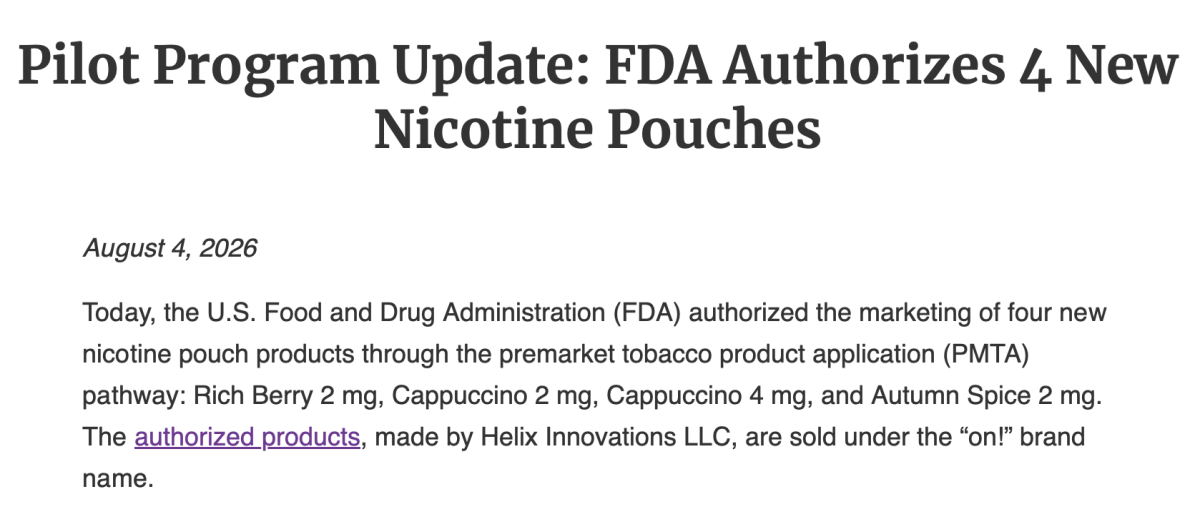
The FDA has authorized four additional on! nicotine pouches, bringing the U.S. total to 30. The decision marks another outcome of the agency’s nicotine pouch review pilot, whose communication and review practices are now being applied more broadly across the category. It also extends Helix’s authorized portfolio from on! PLUS to the earlier on! line. Yet all FDA-authorized nicotine pouches still come from subsidiaries of PMI or Altria, underscoring how concentrated U.S. regulatory access remains.
Aug.05
China’s Jiangsu Tobacco Monopoly Bureau and Drug Regulator Target Illegal Vape Sales Disguised as Medical Devices, Define Six Violations
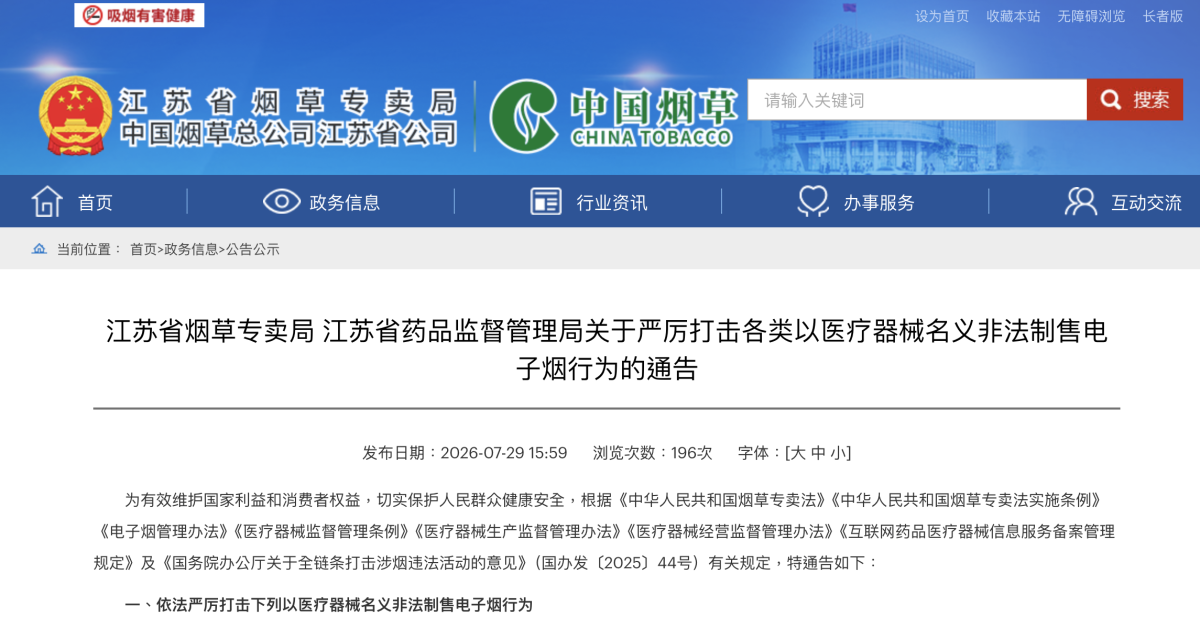
China’s Jiangsu Tobacco Monopoly Bureau and Jiangsu Provincial Medical Products Administration have issued a joint notice targeting illegal production and sales of vape products disguised as medical devices. The notice identifies six categories of violations, including obtaining medical licenses through false materials, misusing medical device credentials, expanding production beyond approved scopes, and using medical device-related online platforms to promote or sell vape products. The action is based on China’s tobacco and medical device regulations and aims to strengthen vape oversight and consumer protection.
Aug.04