Selangor, Malaysia Mulls Full E-Cigarette Sales Ban; Policy Proposal to be Reviewed

May.13.2025
Selangor, Malaysia Mulls Full E-Cigarette Sales Ban; Policy Proposal to be Reviewed
The Selangor state government is evaluating a potential full ban on e-cigarette sales, with a policy proposal set to be presented to the state executive council for review, considering health and social impacts. Earlier, Terengganu announced a complete e-cigarette sales ban starting in August.

Key Points:


1.The government of Selangor state in Malaysia is currently evaluating whether to completely ban the sale of e-cigarette products. The decision is pending the submission of a policy research report to the state executive council (MMKN) for review.


2.This comes shortly after the state of Michigan announced a ban on the sale of e-cigarette products statewide starting on August 1, 2025.


According to Utusan's report on May 13th, the Selangor state government is currently in the process of deliberating a decision on banning the sale of e-cigarette products.


According to the recent statement made by Selangor Menteri Besar Datuk Seri Amirudin Shari at a press conference, the state government has instructed the Health and Environment Exco Jamaliah Jamaludin to draft relevant policy documents, which will be discussed and decided upon in full at the State Executive Council (MMKN) upon completion.


"The state government's position needs to take into account all factors to ensure effective protection of public health for both the current and future generations."


On April 24, the Terengganu state government has announced that all business premises within the state will be prohibited from selling e-cigarettes and related products starting from August 1, 2025. This move by Penang is seen as an important signal that Selangor may also follow suit.


We welcome news tips, article submissions, interview requests, or comments on this piece.

Please contact us at info@2firsts.com, or reach out to Alan Zhao, CEO of 2Firsts, on LinkedIn


Notice

1.  This article is intended solely for professional research purposes related to industry, technology, and policy. Any references to brands or products are made purely for objective description and do not constitute any form of endorsement, recommendation, or promotion by 2Firsts.

2.  The use of nicotine-containing products — including, but not limited to, cigarettes, e-cigarettes, nicotine pouchand heated tobacco products — carries significant health risks. Users are responsible for complying with all applicable laws and regulations in their respective jurisdictions.

3.  This article is not intended to serve as the basis for any investment decisions or financial advice. 2Firsts assumes no direct or indirect liability for any inaccuracies or errors in the content.

4.  Access to this article is strictly prohibited for individuals below the legal age in their jurisdiction.


Copyright


This article is either an original work created by 2Firsts or a reproduction from third-party sources with proper attribution. All copyrights and usage rights belong to 2Firsts or the original content provider. Unauthorized reproduction, distribution, or any other form of unauthorized use by any individual or organization is strictly prohibited. Violators will be held legally accountable.

For copyright-related inquiries, please contact: info@2firsts.com


AI Assistance Disclaimer


This article may have been enhanced using AI tools to improve translation and editorial efficiency. However, due to technical limitations, inaccuracies may occur. Readers are encouraged to refer to the cited sources for the most accurate information.

We welcome any corrections or feedback. Please contact us at: info@2firsts.com

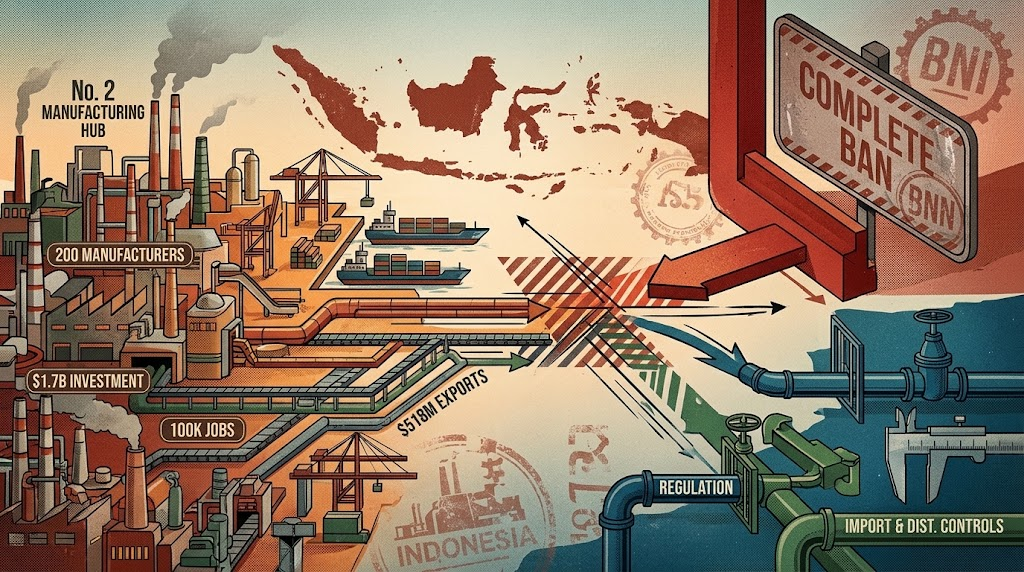
Special report|Indonesia's Vape Industry Has 200 Manufacturers and $1.7 Billion in Investment. Could a Regulatory Divide Derail Its Rise as the World's No. 2 Manufacturing Hub After Shenzhen?
Indonesia's Ministry of Industry said at a November 3, 2026, policy forum that the country has about 200 electronic cigarette companies, Rp31 trillion (approximately $1.71 billion) in cumulative industry investment and around 100,000 jobs across the supply chain. The National Narcotics Agency is seeking a comprehensive ban on vape use and circulation, while the industry ministry favors tighter import, product-standard and distribution controls. Indonesia exported approximately $518 million in vaping products in 2025, and Chinese manufacturers including Smoore, GEEKVAPE and Jinjia Group have established local operations. An international logistics specialist interviewed by 2Firsts said more Chinese vape companies began production in Indonesia from the second half of 2025, accompanied by increased shipments of manufacturing equipment and investment in logistics facilities. The regulatory debate comes as Indonesia expands its role in international vaping manufacturing.
Special Report
Nov.05
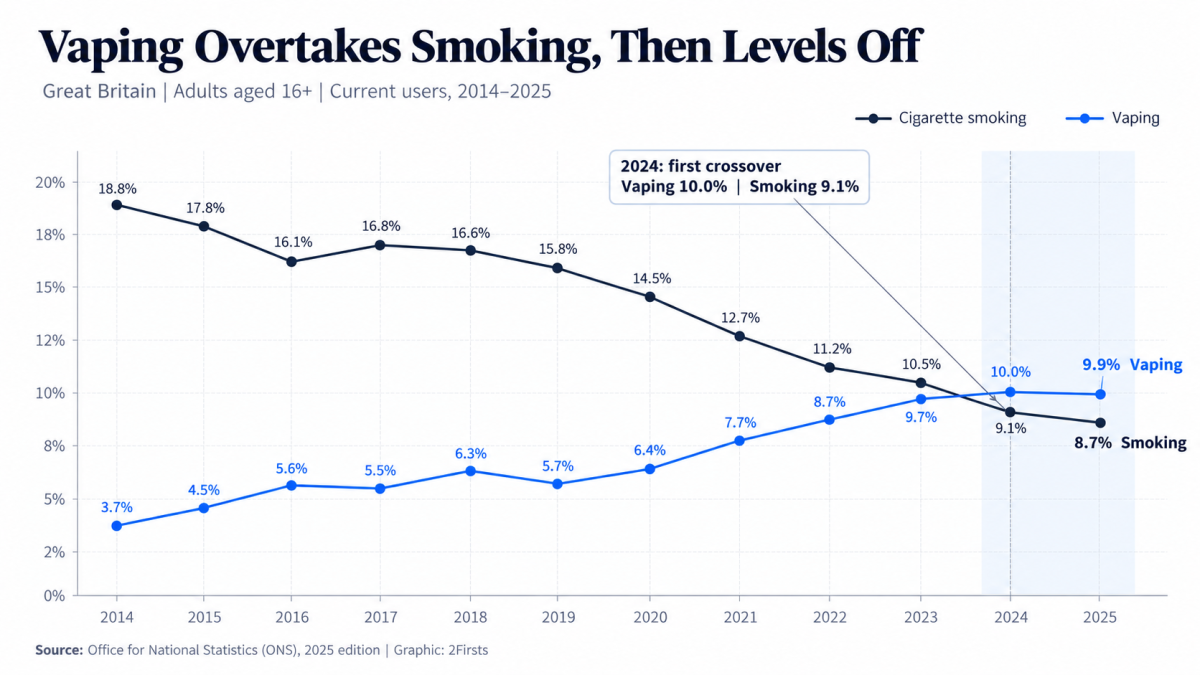
Latest UK ONS Data: Vaping Rate Edges Down to 9.9% in 2025, a Year After Overtaking Cigarette Smoking
Vaping prevalence in Great Britain edged down to 9.9% in 2025 from 10.0% in 2024, with the number of adult users holding at approximately 5.4 million for a second consecutive year, according to the Office for National Statistics (ONS). E-cigarette use had risen from 6.4% in 2020 to 10.0% in 2024, when it exceeded cigarette smoking prevalence for the first time. Cigarette smoking continued to decline to 8.7% in 2025, widening the gap to 1.2 percentage points. Daily vaping declined slightly, while usage among adults aged 25–34 increased despite falling rates in other age groups.
DATA
Oct.14
EU TPD Revision May Slip to 2027: Parliament Backs Wider Nicotine Rules by 447 Votes as Commission Impact Assessment Reportedly Receives Negative Opinion
On Nov 12, 2026, the European Parliament adopted a resolution on implementing Europe’s Beating Cancer Plan by 447 votes to 66, with 91 abstentions, urging the European Commission to speed up revisions to the Tobacco Products Directive (TPD) and Tobacco Advertising Directive (TAD). Parliament called for broader regulation of e-cigarettes, heated tobacco, nicotine pouches and other emerging nicotine products, proposing measures on packaging, health warnings, flavors, ingredient reporting, online age verification, digital marketing and premarket health impact assessments. EUNews and others reported that the Commission’s Regulatory Scrutiny Board (RSB) issued a negative opinion on the revisions’ impact assessment on Nov 9. The Commission had scheduled the initiative for December 2026, but the reported setback could push the legislative proposal into 2027. No revised official timetable has been announced, and Parliament’s resolution does not amend existing EU law.
Regulations
Nov.19
BAT Adds Former Apple General Counsel Bruce Sewell to Board as Finance, Legal, Marketing and Regional Leadership Shift
British American Tobacco has appointed former Apple Senior Vice President, General Counsel and Secretary Bruce Sewell as an independent non-executive director, effective January 1, 2027. He will also join BAT's Audit and Nominations Committees. BAT Chair Luc Jobin highlighted Sewell's experience in technology, government and regulatory affairs, public-company governance and AI-company boards. Over the past 18 months, BAT has changed or announced changes to its CFO, general counsel, CMO and APMEA regional leadership, while the main board has also seen multiple changes. The appointment comes as BAT advances Horizon 2030 and its Fit2Win transformation while expanding New Categories and reshaping parts of its digital, technology and operating structure.
Business
Oct.29
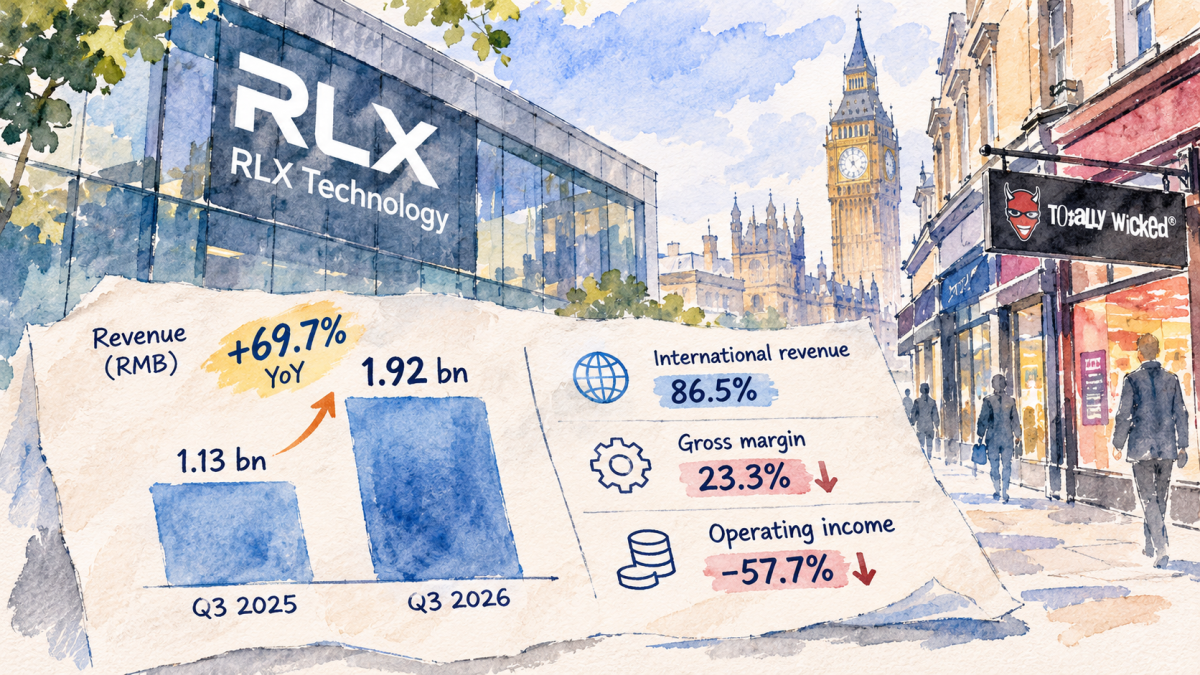
Special Report|RLX Technology Consolidates European Distribution Business for First Time: Q3 2026 Revenue Rises Nearly 70%, Gross Margin Falls to 23.3%
RLX Technology reported a 69.7% year-on-year increase in third-quarter 2026 revenue to RMB1.92 billion ($285.9 million), driven primarily by the consolidation of a newly acquired Western European distributor. International markets accounted for 86.5% of revenue. The acquisition followed RLX's RMB744 million purchase of controlling interests in UK vaping company Totally Wicked in 2025, expanding the group's directly controlled European retail and distribution operations. SEC filings also show that purchases from Shenzhen Smoore Technology Limited declined from 80% of RLX's total purchases in 2022 to 23% in 2025. Third-quarter gross margin fell to 23.3%, while GAAP operating income declined 57.7%.
Business
Nov.20
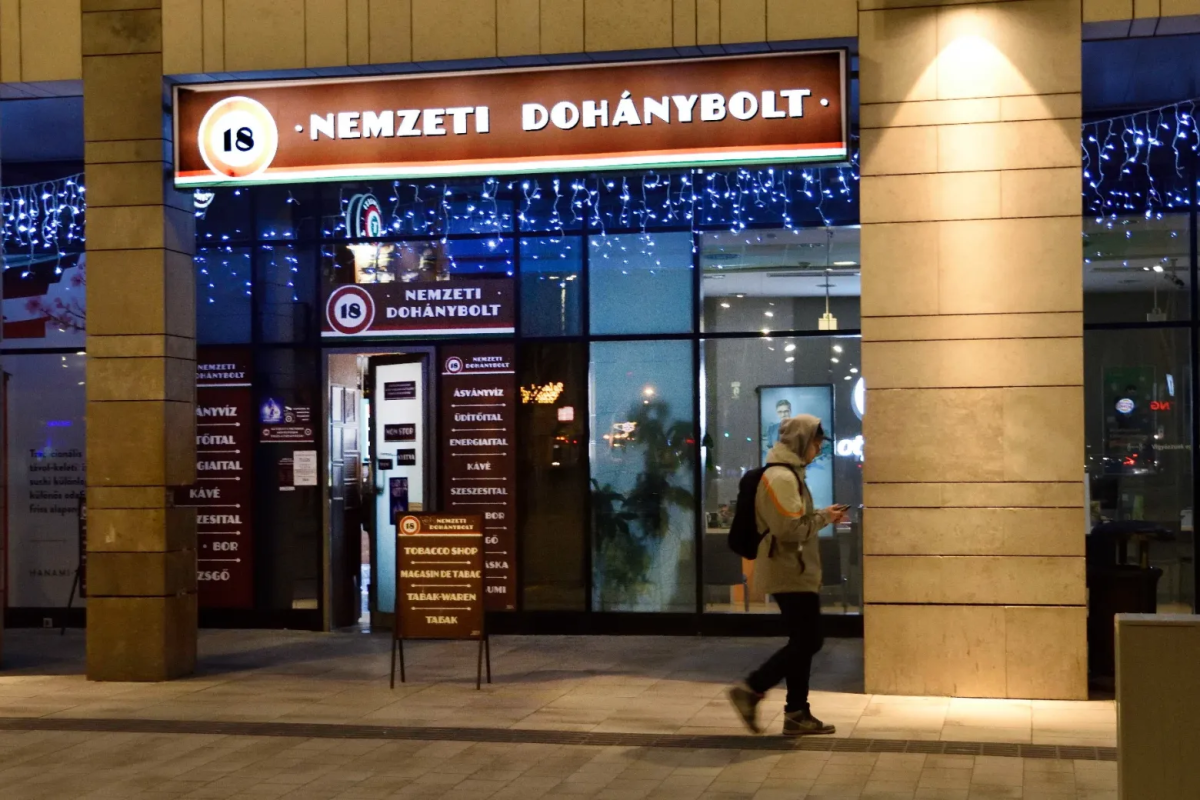
Hungary Moves to End BAT-Backed Tobacco Supply Monopoly Eight Years Early After $200 Million in Profits, With No Compensation Planned
Hungary's government announced on November 18, 2026, plans to terminate the exclusive tobacco retail supply concession held by Országos Dohányboltellátó (ODBE) on June 1, 2027, approximately eight years before the contract's scheduled expiry in 2035. ODBE is owned 49% by a Hungarian subsidiary of British American Tobacco (BAT) and 51% by Tabán Trafik. It has served as the exclusive supplier to Hungary's licensed tobacco retail network since 2015. The proposed legislation would end the concession without compensation and allow other qualified suppliers and tobacco wholesalers to serve retailers directly. ODBE generated HUF 67.3 billion (approximately $200 million) in after-tax profit between 2015 and 2025 and distributed nearly HUF 64 billion ($191 million) in dividends. The bill also proposes changes to retail margins, inventory rules, payment arrangements and procurement penalties, including those affecting heated tobacco products.
company
Nov.19 by 2Firsts Perspectives